
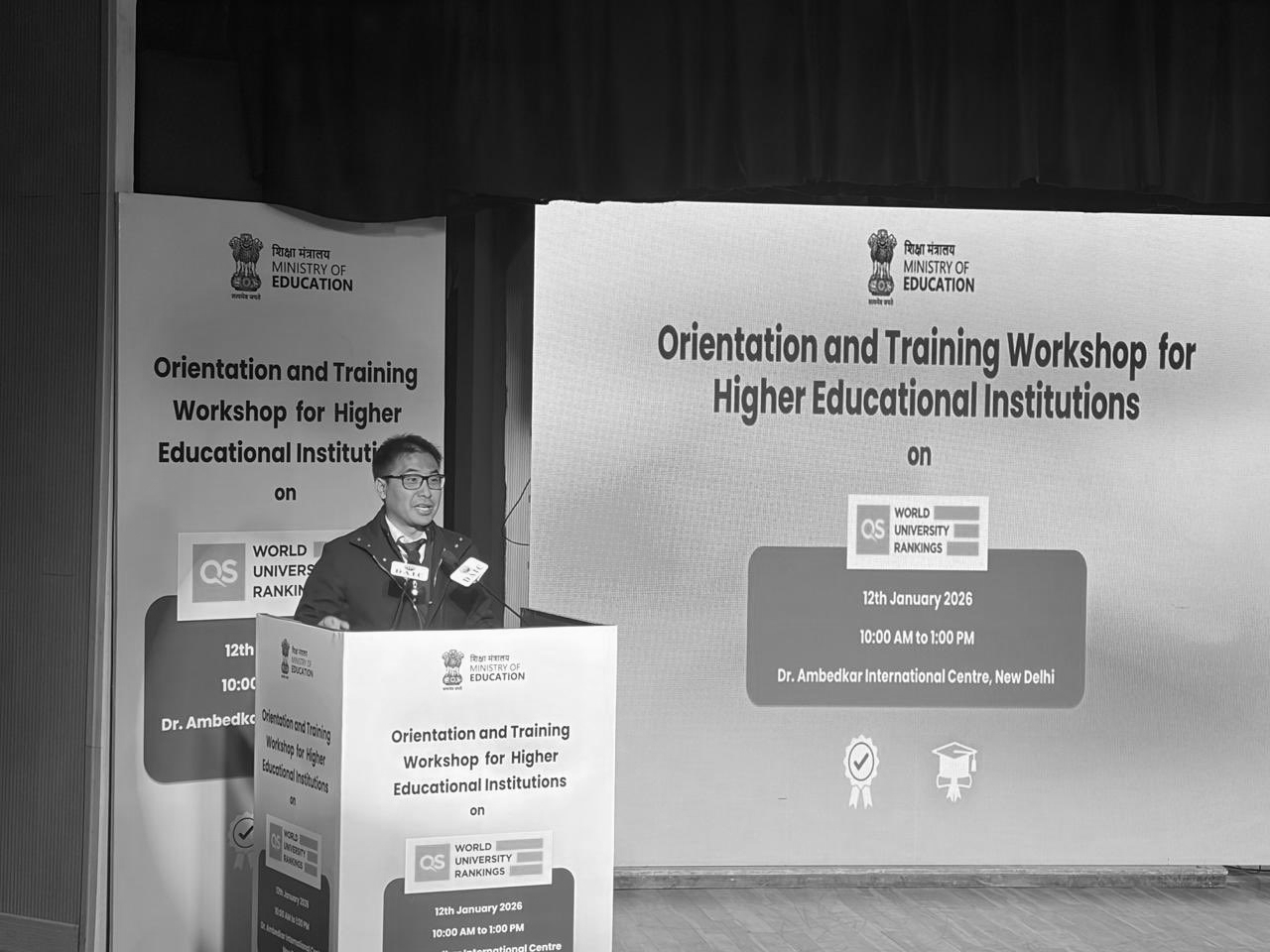
MoE’s QS Bootcamp: Indian HEIs Gear Up for the Global League
India’s push to raise the global competitiveness of its higher education sector gained fresh momentum with the Ministry of Education (MoE) recently organising a half-day Orientation and Training Workshop on the QS World University Rankings , aimed at strengthening the capacity of Indian Higher Educational Institutions (HEIs) to understand and improve their global ranking performance. Conducted by Dr Ashwin Fernandes of QS Corporate , the programme focused on ranking parameters, institutional challenges, research improvement strategies and international engagement and drew strong participation, with around 400 participants joining virtually and over 60 attending in person , reflecting growing seriousness among Indian universities about global benchmarking and academic excellence.
The workshop comes at a time when Indian universities are increasingly trying to compete with foreign institutions not only in student outcomes, but also in global research reputation, international collaborations and world-class infrastructure. While India has expanded its higher education network rapidly, policy makers and experts acknowledge that global competitiveness is now determined by measurable performance indicators especially those linked to high-quality research, citation impact, global academic reputation and internationalisation , which are key drivers of global ranking frameworks such as QS and Times Higher Education.
A major emphasis of the MoE-QS workshop was to help HEIs understand that rankings are shaped primarily by structured research performance rather than branding. Experts point out that many Indian institutions face gaps in research governance systems, uneven infrastructure and limited international academic visibility, despite producing strong talent. The training therefore encouraged universities to invest in the backbone of a strong research ecosystem including research and development (R&D) cells, grants and proposal support offices, publication ethics monitoring, quality peer review systems, advanced laboratory facilities, shared research platforms, and reliable institutional repositories . Such mechanisms help institutions shift from scattered research activity to a sustained, measurable research culture.
The research component is also directly tied to India’s broader national goal of improving its R&D strength. Although India produces a large volume of STEM graduates, overall R&D spending remains modest compared to top research-driven countries, and experts say increasing investment and improving execution capacity at the university level will be essential. This is where capacity-building workshops become strategic: they guide universities on how research outcomes are measured globally, how citation impact is improved through quality publishing and collaboration, and how international research networks strengthen global credibility.
International collaboration emerged as another key research enabler discussed in the workshop. Global ranking systems increasingly reward universities that participate in international research projects and co-author publications with global partners. Indian HEIs, therefore, are being encouraged to move beyond symbolic MoUs and build partnerships that produce outcomes joint research papers, global funding projects, faculty exchanges and collaborative labs. These linkages are also aligned with the NEP 2020 internationalisation vision , which aims to position India as a global knowledge hub by increasing international student mobility, faculty exchange programmes, joint degrees and world-standard multidisciplinary research universities.
Experts say the stronger research focus also determines how effectively Indian universities can compete with foreign universities on infrastructure and academic environment. While India’s top institutions such as IISc and leading IITs have achieved global credibility through strong labs, research output and innovation ecosystems, global competitiveness is still concentrated within a limited set of institutions. Many universities, especially in state and mid-tier categories, continue to face challenges such as outdated equipment, limited post-doctoral culture, faculty shortages and weak industry-funded research. Foreign universities, by contrast, often benefit from higher research funding per university, strong endowments, robust corporate research partnerships and globally diversified faculty, allowing them to maintain uniformly high-quality infrastructure and research output.
Despite these gaps, India is gaining strength in key competitive areas. Indian universities remain globally respected for producing high-performing graduates and building a rapidly expanding innovation ecosystem through incubation centres, research parks, startup mentoring and entrepreneurship programmes . India’s strong digital higher education infrastructure through platforms like SWAYAM , DIKSHA , and NEP-linked reforms such as the Academic Bank of Credits (ABC) has also improved access and flexibility, creating an advantage in scale and affordability compared to many international systems.
The MoE’s QS workshop is therefore being seen as a strategic intervention that connects global benchmarking with institutional reform. By training HEIs to understand how performance is measured and what reforms matter most research governance, infrastructure planning, internationalisation and reputation building the programme strengthens the chances of Indian universities climbing global rankings while simultaneously improving real academic outcomes. Education experts believe such workshops will play a key role in translating NEP 2020’s vision into measurable progress, especially if they are backed by improved research funding mechanisms, stronger faculty recruitment and continued investments in laboratories, innovation hubs and international collaboration frameworks.
As India aims to position itself among the world’s leading higher education ecosystems, the success of this transition will depend not only on policy intent but on execution at the institutional level. The shift underway is clear: Indian universities are moving from being large-scale education providers to becoming research-driven, globally networked institutions, a transformation essential for competing effectively with foreign universities in the coming decade.