
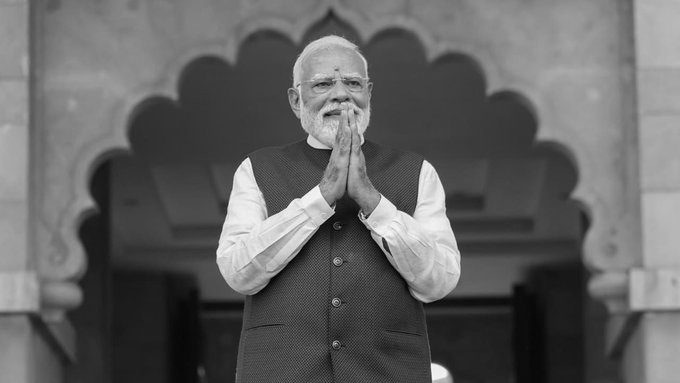
Modi Surpasses Nehru, Becomes India's Longest Continuously Serving Elected Prime Minister
A single day separates two eras of Indian political history. On June 10, 2026 , Prime Minister Narendra Modi completed 4,399 uninterrupted days in office , edging past the record of 4,398 consecutive days set by India's founding Prime Minister Jawaharlal Nehru , to become the longest continuously serving elected Prime Minister in the country's history. It is a milestone defined by its precision and by the remarkable democratic consistency that produced it.
Modi's tenure began on May 26, 2014 , when he was sworn in after leading the Bharatiya Janata Party (BJP) to a decisive majority in the Lok Sabha elections. He repeated that feat in 2019 with an even larger mandate and returned to power for a third straight term following the 2024 general elections . Nehru's comparable record runs from May 13, 1952 , when he assumed office after India's first general election, until his death on May 27, 1964 . His earlier years from 1947 to 1952 are excluded from this comparison, as that stint was as head of an interim government predating institutionalised elections.
The June 10 milestone is the third in a rapid sequence of records. In July 2025 , Modi surpassed Indira Gandhi's unbroken tenure of 4,077 days . Then, in March 2026 , he became the longest-serving head of any elected government in India by combining his years as Chief Minister of Gujarat with his time as Prime Minister, crossing 8,931 days in public office and entering his 25th consecutive year in an executive leadership role , surpassing former Sikkim Chief Minister Pawan Kumar Chamling in the process.
The scale of the democratic arena in which Modi has sustained this dominance is worth appreciating. When Nehru governed a newly independent nation, the electorate numbered roughly 17 crore voters and 53 political parties contested the first general election. By 2024, over 83 crore voters were on the rolls and 744 parties entered the fray. Winning three consecutive mandates in that environment is a feat without modern precedent in Indian politics.
Political commentators have framed the milestone as emblematic of a broader transformation. Issues long considered intractable from the Ram Temple in Ayodhya and Article 370 in Jammu and Kashmir to the Naxalite insurgency in central India were addressed during his tenure. Modi himself has pointed to the "Viksit Bharat" vision for 2047 as the horizon that now defines his government's purpose, emphasizing that the real measure of his years in office lies not in records but in welfare delivered to India's most marginalized citizens.
One distinction, however, remains firmly with Nehru. His total tenure as Prime Minister stands at 6,131 days across three election victories, a record of overall service that Modi has not yet approached. What Modi now holds, and what no Prime Minister before him has held, is the record for the longest unbroken, democratically mandated tenure at the head of the Indian government.