
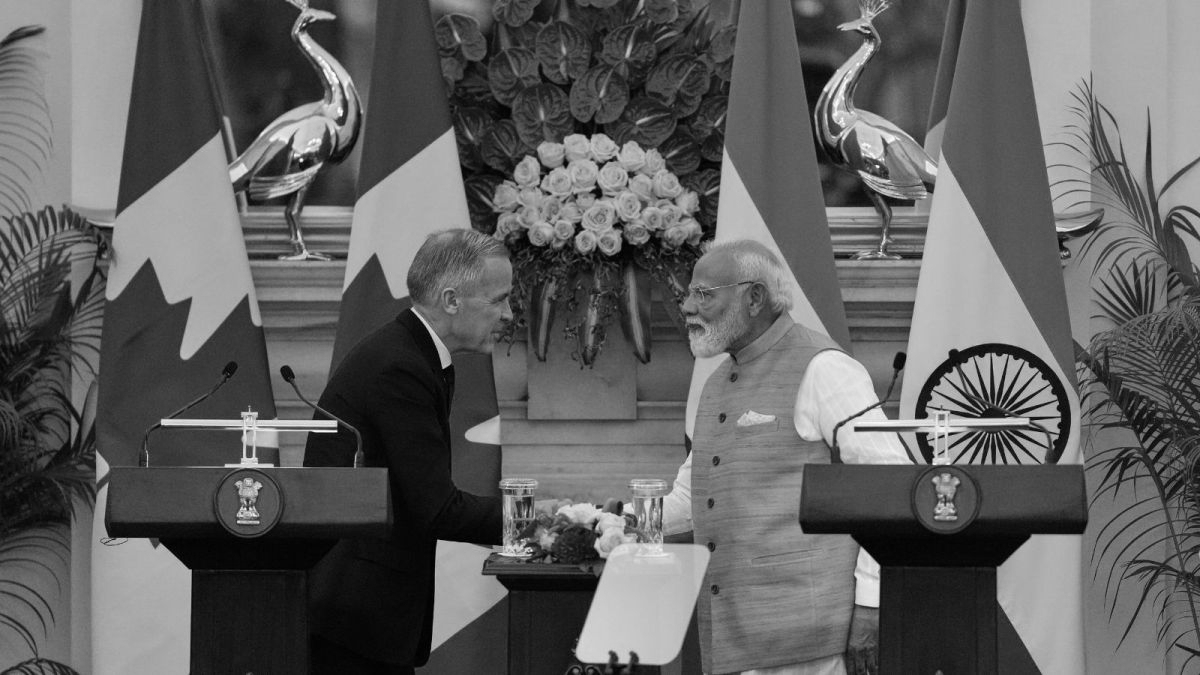
Modi, Carney Build on 2008 Nuclear Deal as India Canada Target $50B Trade
Prime Minister Narendra Modi and Canadian Prime Minister Mark Carney on Monday signed a long-term uranium supply agreement , building on the framework enabled by the 2008 India-US civil nuclear agreement , which opened the door for India’s global nuclear commerce after decades of restrictions.
The two leaders held wide-ranging talks in New Delhi and finalised key pacts on the supply of uranium, cooperation in small modular reactors (SMRs), and critical minerals , while also committing to conclude a Comprehensive Economic Partnership Agreement (CEPA) soon.
In his media statement, Modi said, “In civil nuclear energy, we have signed a landmark deal for long-term uranium supply. We will also work together on small modular reactors and advanced reactors.” Carney described the agreement as reflecting a shared commitment to clean and reliable energy.
Beyond nuclear cooperation, both sides set an ambitious target to scale up bilateral economic engagement to USD 50 billion by 2030 , envisaged as a cumulative expansion of trade and investment flows over the coming years. The two leaders underlined that accelerating CEPA negotiations would be crucial to unlocking opportunities across goods, services, and strategic sectors.
India and Canada share a complex nuclear history. After India’s first commercial nuclear reactor at Tarapur was supplied by a US company, Canada assisted in setting up heavy water reactors at Kalpakkam and other sites. This cooperation was halted following India’s peaceful nuclear explosion at Pokhran on May 18, 1974. The reactors developed with Canadian collaboration were known as CANDU reactors .
The revival of nuclear ties became possible only after the Indo-US Nuclear Agreement of October 2008 , which ended India’s isolation from global nuclear fuel and technology markets. The agreement had faced strong political opposition at the time.
Reacting to Monday’s developments, Congress general secretary Jairam Ramesh said the India-Canada uranium pact was possible “only because of the Indo-US Nuclear Agreement,” crediting former prime minister Dr Manmohan Singh for securing it despite opposition, including from the BJP at the time.
The renewed partnership signals not only an expansion of strategic energy ties but also a broader effort to deepen India-Canada economic cooperation through the remainder of the decade.