
Mobiles - Catalysts of India’s digital rise
On July 31, 1995, India heard its first-ever mobile ring when a historic call connected the then Union Communications Minister Sukh Ram in Delhi with West Bengal Chief Minister Jyoti Basu in Kolkata. What began as a symbolic exchange has today transformed into a multi-trillion-rupee digital revolution turning mobiles from mere devices into engines of growth.
“India has become a key hub for mobile phone manufacturing, with exports now reaching global markets”- PM Narendra Modi
From call to catalyst
With 85.5% of households owning at least one smartphone, mobiles have become India’s bank, classroom, and television. In villages, farmers use mobile apps like mKisan and NPSS for market updates, crop surveys, and pest alerts. The Comprehensive Modular Survey: Telecom (Jan–Mar 2025) revealed mobile penetration among youth at nearly 97% in both rural and urban areas.
Manufacturing boom
A decade ago, India relied heavily on imports, with 78% of demand met from abroad. Today, the story is dramatically different.
• Mobile production soared from ₹18,000 crore in 2014–15 to ₹5.45 lakh crore in 2024–25 a 28-fold leap.
• India now hosts over 300 mobile manufacturing units, up from just 2 in 2014.
• More than 12 lakh jobs have been created in the sector.
Tamil Nadu leads with 47 manufacturing units under the Ministry of Electronics and IT’s support schemes, while Noida’s mega plants from Samsung and Apple suppliers are driving exports.
Exports surpass milestones
India’s rise as a mobile exporter has been nothing short of historic:
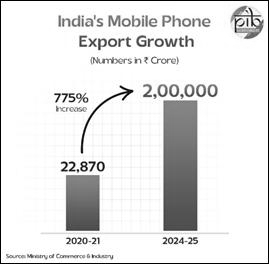
• Smartphone exports hit ₹2 lakh crore in FY 2024–25, up from just ₹1,500 crore in 2014–15.
• In the first five months of FY 2025–26 alone, exports crossed ₹1 lakh crore, a 55% jump year-on-year.
• In Q2 2025, India overtook China to become the largest smartphone exporter to the US.
Foxconn plans to double iPhone output in India by end-2025, while Samsung’s Noida plant pushed exports to $20.4 billion last year.
Policy push
Several government schemes have underpinned this growth:
• Make in India (2014): Revived domestic manufacturing.
• Digital India (2015): Expanded internet access to 96.9 crore users by 2024.
• PLI Scheme (2020): Attracted global smartphone giants.
• SPECS & ECMS: Boosted electronic components and semiconductors.
• National Policy on Electronics (2019): Set ambitious $400 billion revenue goals.
Union Minister Ashwini Vaishnaw says India is now entering the “deep component manufacturing” phase, a shift that promises higher value addition and supply chain resilience.
Changing consumer landscape
India’s smartphone market is evolving rapidly:
• 5G phones now account for 82% of shipments , growing 49% YoY.
• Mid-range devices (₹10,000–13,000) dominate sales, making high-performance phones affordable.
• Premium phones (above ₹25,000) rose 26% YoY, reflecting aspirational consumption.
Global impact - The China+1 factor
As firms diversify beyond China, India is emerging as the top choice. Between 2023–24, while China’s and Vietnam’s mobile exports dipped, India’s rose by $4.5 billion, capturing nearly half the lost share.
Outlook
India’s digital economy is projected to contribute nearly 20% of GDP by 2029–30, overtaking agriculture and manufacturing in share. By 2026, India is targeting $300 billion in electronics production and contributing up to 5% of global electronics exports by 2030.
“India has become a key hub for mobile phone manufacturing, with exports now reaching global markets,” Prime Minister Narendra Modi said recently, adding that the nation is “rapidly moving towards being No. 1 in mobile phones manufacturing.” From being import-dependent to becoming the world’s second-largest mobile manufacturer, India’s journey is a remarkable case of policy-driven transformation. Smartphones have not only connected 1.4 billion Indians but also reshaped global supply chains, cementing the nation’s rise as a digital powerhouse.