
Miniratna, Maharatna join hands for India’s mineral security
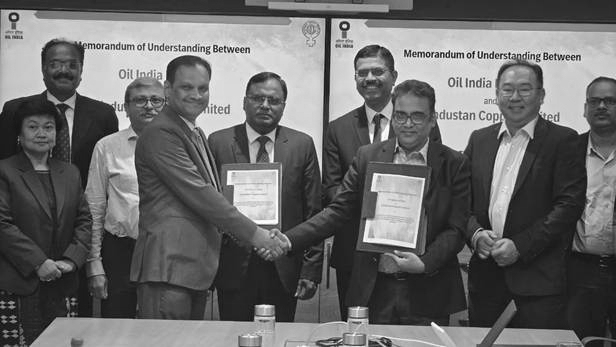
In a move that underlines New Delhi’s push for mineral self-reliance, Oil India Limited (OIL) and Hindustan Copper Limited (HCL) signed a Memorandum of Understanding on September 19, 2025 to cooperate on exploration and development of critical and strategic minerals starting with copper and associated resources. The pact, exchanged in the presence of HCL CMD Sanjiv Kumar Singh and OIL CMD Dr Ranjit Rath, signals growing collaboration between India’s energy and mining public sector units to secure feedstocks essential for the green transition and industrial growth.
What the MoU covers - and why does it matter?
The MoU frames cooperation across exploration, technical collaboration, value-addition and mutual sharing of expertise and data combining HCL’s mining/beneficiation capabilities with OIL’s exploration and project-delivery experience. That combination aims to accelerate identification and development of domestic copper deposits and associated critical minerals that are increasingly vital for batteries, grid infrastructure and high-end electronics. The government has positioned such alliances as integral to the National Critical Mineral Mission.
How this fits into India’s national strategy
The Government of India launched the National Critical Mineral Mission (NCMM) in 2025 to reduce import dependence, scale up domestic exploration and build end-to-end value chains for minerals such as copper, lithium, graphite, nickel and rare earths. Under NCMM, the Geological Survey of India (GSI) and other agencies are to undertake large-scale exploration (around 1,200 projects through 2030-31), expand beneficiation and processing, and coordinate overseas acquisitions where domestic resources fall short. The mission includes central funding and expects PSU investments alongside private sector capital.
Parallel policy and statutory upgrades notably the Mines & Minerals (Development & Regulation) Amendment in 2025 and other measures have been pushed to make leasing, deep-seated extraction, mineral trading and value-addition easier, with explicit exemptions and tools aimed at critical minerals. These reforms are intended to unblock long lead times in exploration and permit quicker scale-up of domestic production.
What HCL and OIL bring to the table?
Hindustan Copper (HCL) is a Miniratna PSU with existing copper mines and smelting/concentrator capacity and a clear expansion roadmap. HCL’s recent corporate plans show capital investment and capacity expansion for flagship assets such as Malanjkhand and Khetri including underground expansion, new concentrators and beneficiation projects and management has indicated multi-thousand-crore capex through the rest of the decade to lift ore throughput and concentrate output. Independent reporting places HCL’s medium-term capex plans in the region of ~₹2,000 crore for core expansion, with an ambition to materially increase ore output by 2030–31. The HCL–OIL MoU will allow HCL to couple these plans with wider exploration acreage and technical inputs.
Oil India (OIL) , a Maharatna energy PSU, brings large-scale exploration skills, overseas project experience and a rising capex envelope. OIL has already signalled diversification into critical minerals (it signed MoUs with IREL earlier this year and flagged critical minerals in investor filings), and the company has sizable capex targets across energy and new strategic activities. OIL’s overseas stakes (for example in Mozambique LNG and earlier Russian assets) and its project-management skillset can be leveraged for both domestic exploration campaigns and overseas asset acquisitions under NCMM. OIL has also publicly stated a large capex pipeline to 2030 that gives it firepower for strategic investments.
Together, HCL and OIL say they will share geological data, co-develop exploration blocks, deploy joint drilling programmes, and pursue downstream beneficiation / value-addition opportunities steps designed to move beyond raw ore discovery to making India a stronger supplier of refined intermediates and concentrates.
Government’s major initiatives to boost mineral production
• National Critical Mineral Mission (NCMM) - central funding, GSI-led exploration (≈1,200 projects to 2030–31), emphasis on domestic mapping, offshore exploration and recycling.
• MMDR Amendment Act, 2025 - legal tweaks to encourage deep-seated mining, permit addition of minerals to existing leases, allow sale of mineral dumps, strengthen exploration financing (raising NMET/NMET-type contributions) and create frameworks for mineral exchanges and easier overseas acquisitions.
• Exploration and auction programmes - targeted auction rounds and state-level block tenders for critical mineral blocks, and expanded Geological Survey of India and MECL activity backed by NMET funding.
• Demand-side industrial programmes - PLI and capacity incentives for Advanced Chemistry Cell (ACC) batteries, support for smelters and refineries, and strategic agreements with foreign producers (including offtake and technology). These policies create guaranteed downstream demand that justifies upstream investment.
• Overseas asset acquisition push - a government drive (part of NCMM) to acquire or partner on assets abroad (Chile, Zambia and elsewhere) to fill domestic shortfalls; the government has signalled multi-billion dollar PSU investment corridors for such deals.
Who else is moving big companies and the private sector
India’s private mining and metals majors are already mobilising capital and exploration programmes: Vedanta is publicly pursuing critical mineral blocks domestically and abroad; Hindalco has announced multi-thousand-crore investments across aluminium and copper value chains and is exploring lithium/nickel opportunities; Tata Steel, JSW, NMDC, NALCO and other large groups are either expanding upstream footprints, setting up processing capacity or partnering in overseas resource plays. These private investments complement PSU action under NCMM and are central to creating integrated value chains in India.
Outlook
The HCL–OIL MoU is both tactical and symbolic: tactical because it pairs complementary technical strengths (mining beneficiation and exploration/project execution) that can accelerate discovery and early development of copper and allied minerals; symbolic because it reinforces the government’s wider NCMM thrust to turn India from a net-importer into a resilient participant in critical mineral value chains. If the announced joint programmes are backed by rapid field work, capex and downstream capacity, India could meaningfully narrow import dependence for copper and other minerals over the balance of the decade but success will hinge on policy continuity, fast permits, and robust private-public coordination.