
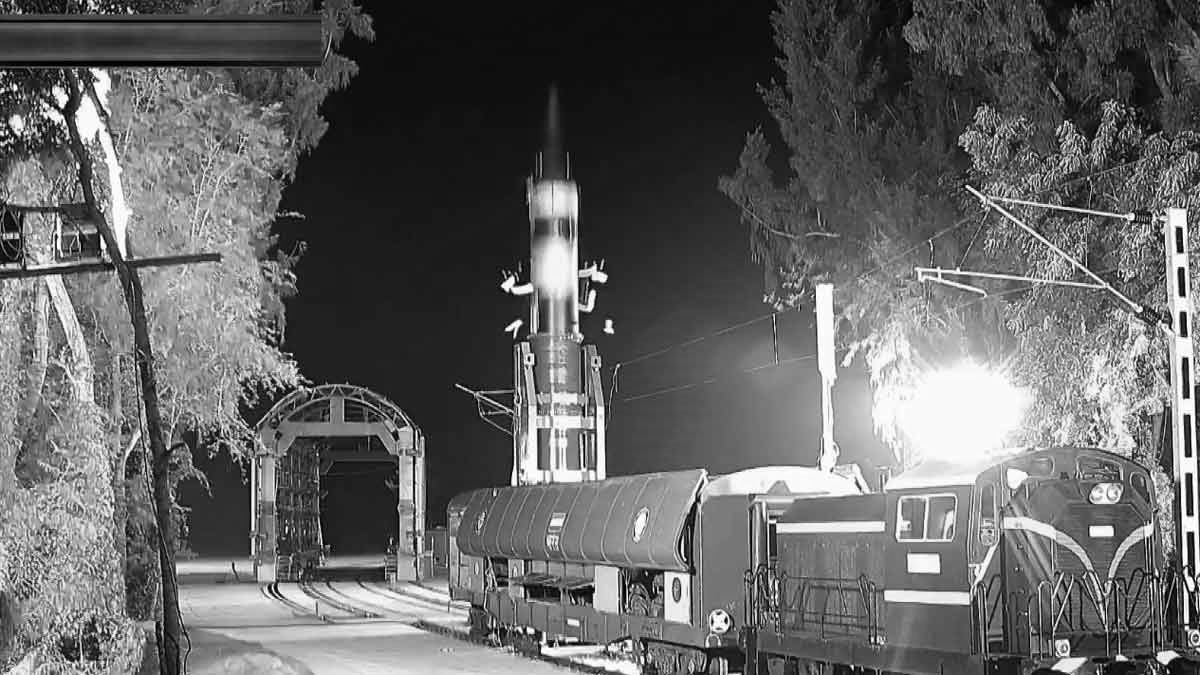
Milestone moment: DRDO’s Agni-Prime makes historic rail-based debut
India has taken a major step forward in strengthening its national security with the successful launch of the Agni-Prime ballistic missile from a rail-based mobile launcher. Simply put, Agni-Prime is a nuclear-capable intermediate-range ballistic missile designed to deliver powerful warheads deep into enemy territory, up to 2,000 km away, with high precision. It plays a crucial role in India’s strategic deterrence, which means its primary purpose is not to start a conflict, but to prevent one by ensuring that India can respond decisively if ever attacked. This capability is central to the country’s nuclear doctrine of credible minimum deterrence, which relies on the ability to launch both a first strike, if necessary, and a guaranteed second strike in retaliation.
Developed by the Defence Research and Development Organisation (DRDO) in collaboration with the Strategic Forces Command (SFC), Agni-Prime represents the next generation of India’s missile arsenal. It’s designed to replace older systems like Agni-I and Agni-II with more advanced technology, improved accuracy, faster launch readiness, and greater survivability.
A new era of strategic mobility
The missile was launched using a specially designed Rail-Based Mobile Launcher (RBML), essentially a modified train coach or wagon, which can travel anywhere across India’s vast rail network without any pre-conditions. This allows the missile to be moved discreetly and deployed from almost any part of the country, regardless of terrain or landscape. The launcher can fire the missile within minutes, with reduced visibility and minimal preparation, making it much harder for adversaries to detect or target.
The canisterized system means the missile is stored and transported in a sealed container, protecting it from weather or damage and allowing for rapid launch whenever required. This combination of mobility, concealment, and quick reaction capability greatly strengthens India’s deterrence posture and ensures the missile’s survivability even in the event of a surprise first strike.
A real-world example: How it could be used
Imagine a high-tension scenario where an adversary attempts a pre-emptive strike on India’s known missile bases. Traditional, fixed launch sites might be vulnerable. But with Agni-Prime mounted on a rail-based launcher, India could quietly transport the missile across the country, positioning it in remote or concealed locations using the existing rail network. From there, it could launch a retaliatory strike or a calibrated deterrence strike within minutes, ensuring that India’s second-strike capability remains secure and credible.
Defence Minister Rajnath Singh congratulated DRDO, SFC, and the Armed Forces, saying India successfully launched the Intermediate Range Agni-Prime missile from a rail-based mobile launcher. He highlighted its 2,000 km range, advanced features, cross-country mobility, quick launch capability, and noted that this achievement places India among a select group of nations with canisterised rail-launch missile systems.
The successful test, which also included a night launch to validate operational readiness, highlights India’s growing ability to deploy strategic weapons flexibly, securely, and swiftly. It is a major milestone in the country’s journey towards a more credible and resilient nuclear deterrent, placing India alongside leading military powers like Russia and China with rail-based missile launch capabilities.