
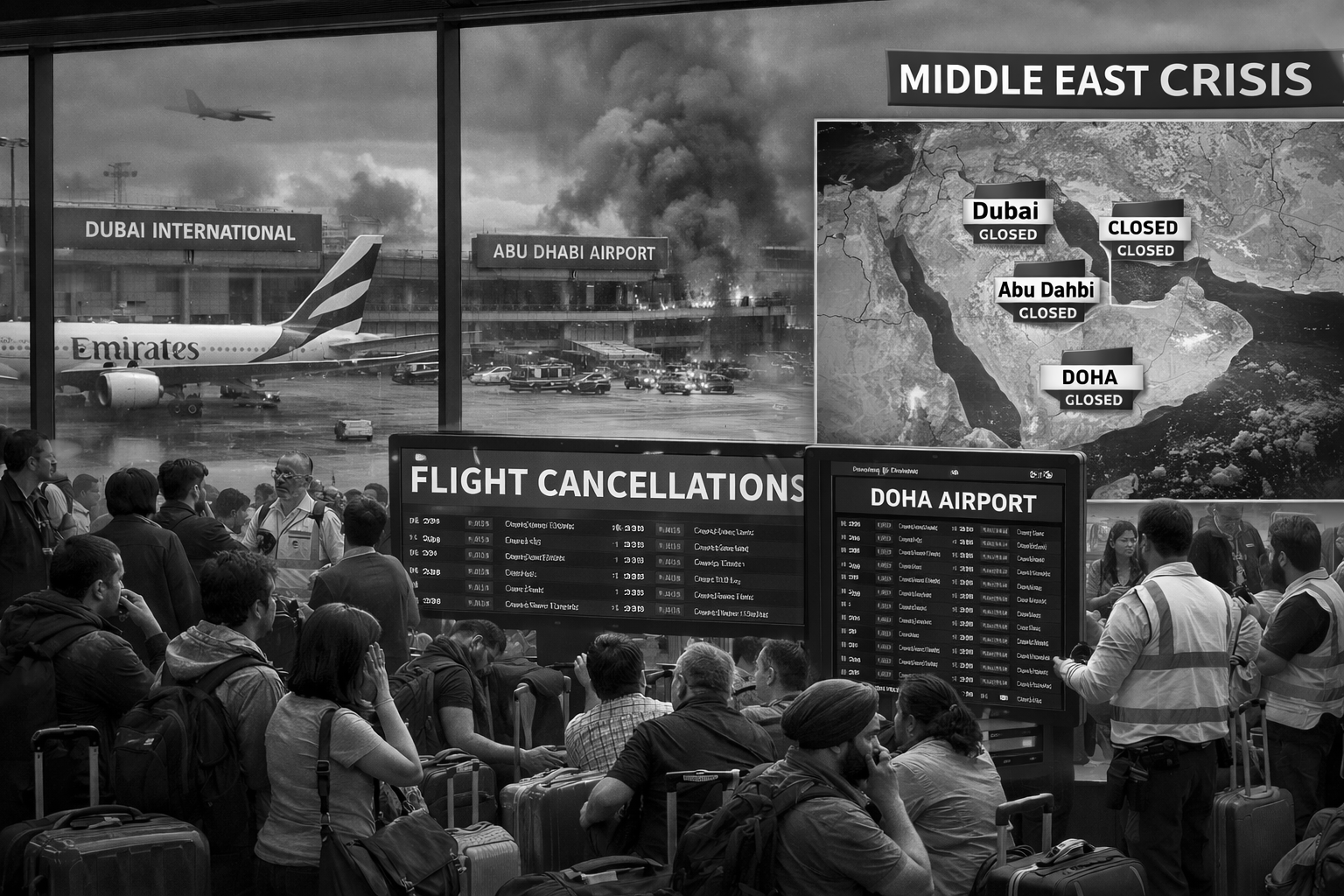
Middle East war hits global aviation, Indian airlines reel in chaos
The fallout from escalation in the Middle East is already visible, with the aviation sector bearing the brunt as airspace closures and military strikes ripple across the region and beyond. Following intensified military action involving the United States, Israel, and Iran , countries including Iran, Iraq, Kuwait, Bahrain, Qatar, the United Arab Emirates, and Israel have closed or heavily restricted their skies to civilian flights. This has led to thousands of flights being cancelled or rerouted, leaving tens of thousands of passengers stranded across Asia, Europe, and the Middle East.
Flights were grounded or diverted, causing chaos at key international hubs. Airports such as Dubai International, Abu Dhabi, and Doha , critical crossroads for global traffic connecting Europe, Asia, and Africa, experienced partial closures, severe operational restrictions, and in some cases damage from missile and drone strikes. In Dubai, a concourse at Dubai International Airport was hit, causing fires and injuries to four staff members, while Abu Dhabi’s Zayed International Airport also reported injuries and at least one fatality during retaliatory strikes. These incidents prompted immediate suspension of civilian flights as authorities prioritized safety and security. Gulf carriers including Emirates, Etihad, and Qatar Airways suspended operations, and many long-haul airlines were forced to cancel or reroute flights entirely . Aircraft are stranded far from home, crews are out of position, and schedules are collapsing, with experts warning that normal operations could take days to resume.
Indian airlines have been hit hard. On 1 March , around 350 flights operated by Indian carriers were cancelled, following over 400 cancellations on 28 February. Air India alone suspended approximately 50 international flights to destinations including London, New York, Toronto, Frankfurt, Amsterdam, Milan, Zurich, Vienna, and Birmingham, while IndiGo cancelled several Europe-bound services and extended rebooking and refund waivers through at least 2 March. Other carriers including Air India Express, SpiceJet, and Akasa Air faced similar operational disruptions.
The impact is evident across all major international airports in India , including Mumbai, Delhi, Bengaluru, Chennai, Kolkata, Hyderabad, Kochi, Jaipur, and Ahmedabad , with widespread cancellations and passenger backlogs. In Mumbai , about 57 flights were cancelled by mid‑evening, while Delhi, Bengaluru, Chennai, Kolkata, Hyderabad, and Kochi reported dozens of cancellations. Jaipur and Ahmedabad saw smaller but significant disruptions, mainly on flights routed through Gulf airspace. These cancellations affect both short-haul and long-haul international flights , which are crucial revenue sources for Indian carriers.
Analysts estimate the financial impact at ₹400-₹600 crore ($50-$75 million) in lost revenue and additional operational costs from fuel, crew, and rerouted flights. Longer reroutes further increase fuel use, crew hours, and operational complexity, potentially magnifying losses. Experts warn that if the disruption persists, cumulative losses could be heavy , hitting both profitability and market confidence.
India’s aviation regulator DGCA has formally advised carriers to avoid Persian Gulf airspace , and governments worldwide have issued travel warnings urging citizens to limit movement, check flight status, and follow embassy guidance closely . Passengers are advised to prepare for delays and stay updated with their carriers as the conflict continues to disrupt routine air travel globally.