
Middle East war, Day 8: A week of war and not a single sign of peace
Seven days in, and the Iran war has become something no war room in Washington or Tel Aviv fully modelled. It has no walls. It has no edges. It has hit a school, a synagogue, a radar dish worth $1.1 billion, an oil refinery, a hotel lobby, a military academy mid-broadcast, and now, in a moment that rewrites the rules of 21st-century warfare, three Amazon data centres.
As Day 7 opened, US-Israeli strikes ramped up further, with explosions heard across Tehran and Beirut overnight. An Al Jazeera correspondent in Tehran described the bombardment as more intense than previously seen , with civilian sites, residential buildings, car parks, petrol stations, among the targets. Strikes also hit near Pasteur Street, the fortified government corridor where Khamenei was killed on Day 1. In Shiraz, 20 were killed and 30 injured in the Zibashahr area alone. Two paramedics were also killed there. In Qom, Israel issued a forced displacement order for the Shokouhiyeh industrial zone, warning residents to leave within hours or risk their lives.
Iran's Foreign Ministry spokesman posted footage of destroyed classrooms at an elementary school in Tehran's Niloufar Square. Of the more than 1,300 killed in Iran so far, UNICEF confirmed at least 181 are children.
Iran fired back across the entire Gulf simultaneously. Saudi Arabia intercepted three drones east of Riyadh and three ballistic missiles targeting a base south of the capital. A missile struck an oil refinery in Bahrain, fire contained. The US Embassy in Kuwait City was evacuated after Iranian drones targeted American bases there. The UAE intercepted multiple Iranian missiles and more than 120 drones. Qatar was hit by a barrage of missiles and drones after explosions rocked Doha.
Then came the front nobody anticipated. Iranian drones struck three Amazon Web Services data centres, two in the UAE directly hit, one in Bahrain damaged by a nearby strike, for what Iran's IRGC called AWS's "support of the enemy's military and intelligence activities." Banking apps, payment platforms, delivery services and enterprise software across the UAE crashed. Banks including ADCB and Emirates NBD reported outages. AWS advised all customers to migrate servers out of Bahrain and the UAE immediately. Digital infrastructure has become a theatre of war.
Inside Iran itself, internet connectivity has collapsed to just 1% of normal levels , a near-total blackout now stretching beyond 100 hours, with the regime's Minister of ICT refusing to acknowledge it publicly. Iranians abroad cannot reach their families. The regime, meanwhile, opened a fake Starlink app to spy on citizens attempting to connect.
Shipping giant Maersk became the second major carrier to suspend all Middle East operations. Oil storage tanks are filling up across the region as exports have all but stopped, raising the risk that oil production itself will have to halt. US crude and Brent have surged 31% and 24% respectively this week alone.
On the diplomatic front, the picture is equally bleak. China dispatched envoy Zhai Jun to the region to mediate, with Foreign Minister Wang Yi telling Saudi Arabia that "the indiscriminate use of force is unacceptable." Russia confirmed active dialogue with Tehran. Britain, France and Spain agreed to provide military support to protect allied interests, even as Italy's defence minister said the US-Israel attack had violated international law. Congress again failed to pass a war powers resolution — the House vote fell 212 to 219 , with four Democrats crossing the aisle to defeat it.
Trump, for his part, told reporters he wants to "Make Iran Great Again", while simultaneously demanding unconditional surrender , vowing to personally help choose Iran's next leader, and offering immunity to any regime official willing to stand down. Iran's Foreign Minister called Washington untrustworthy and said there is "no reason to negotiate."
The Israeli military claims near-complete air superiority, having destroyed 80% of Iran's air defence systems across 2,500 strikes. But Iran's Ali Larijani had a warning of his own: Iranian forces are waiting. A ground invasion, he said, would be a catastrophe for America.
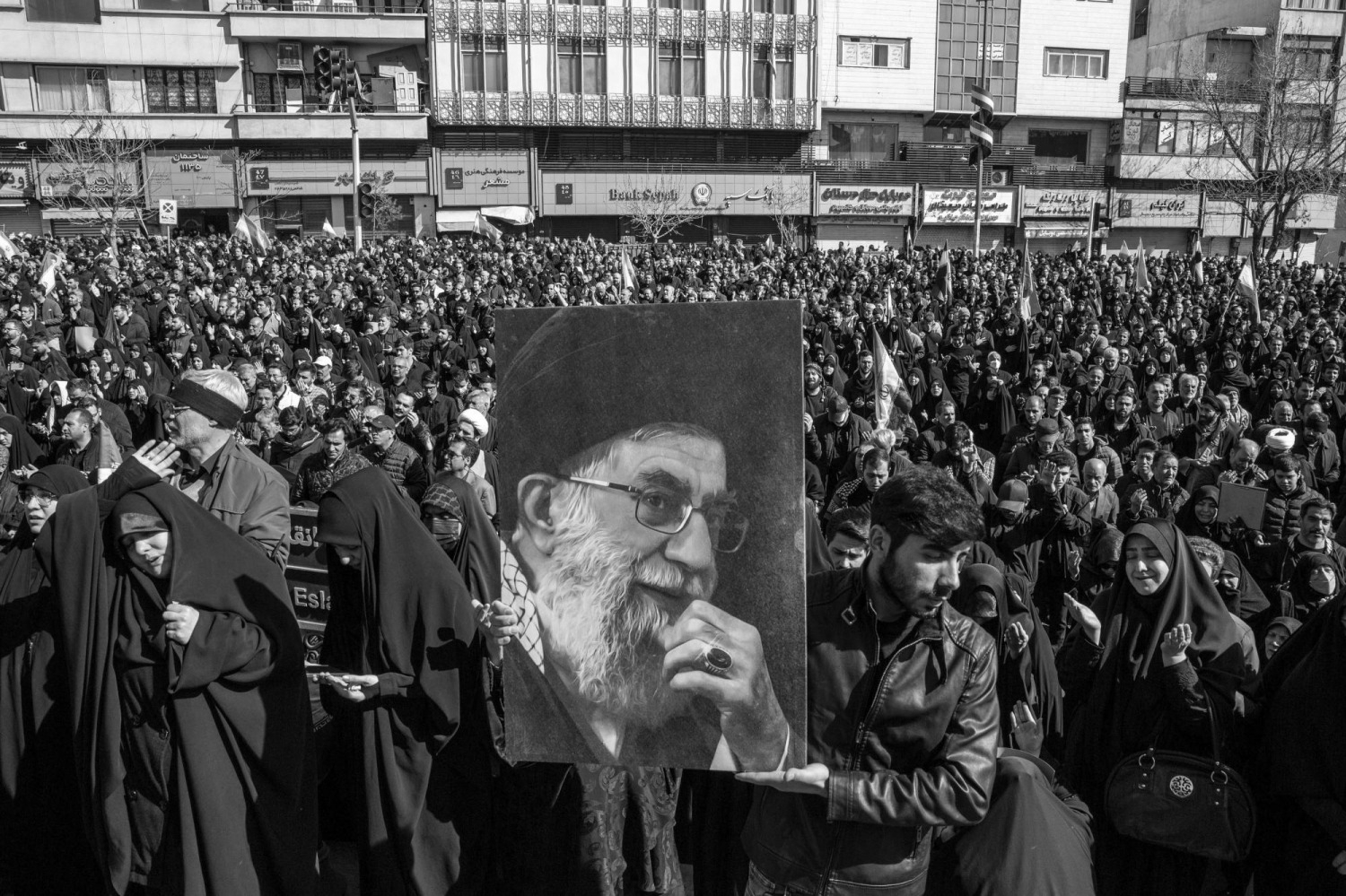
And in the rubble of Tehran, after Friday prayers, thousands took to the streets, not fleeing, not surrendering, marching, chanting, and carrying photographs of the man who started it all.