
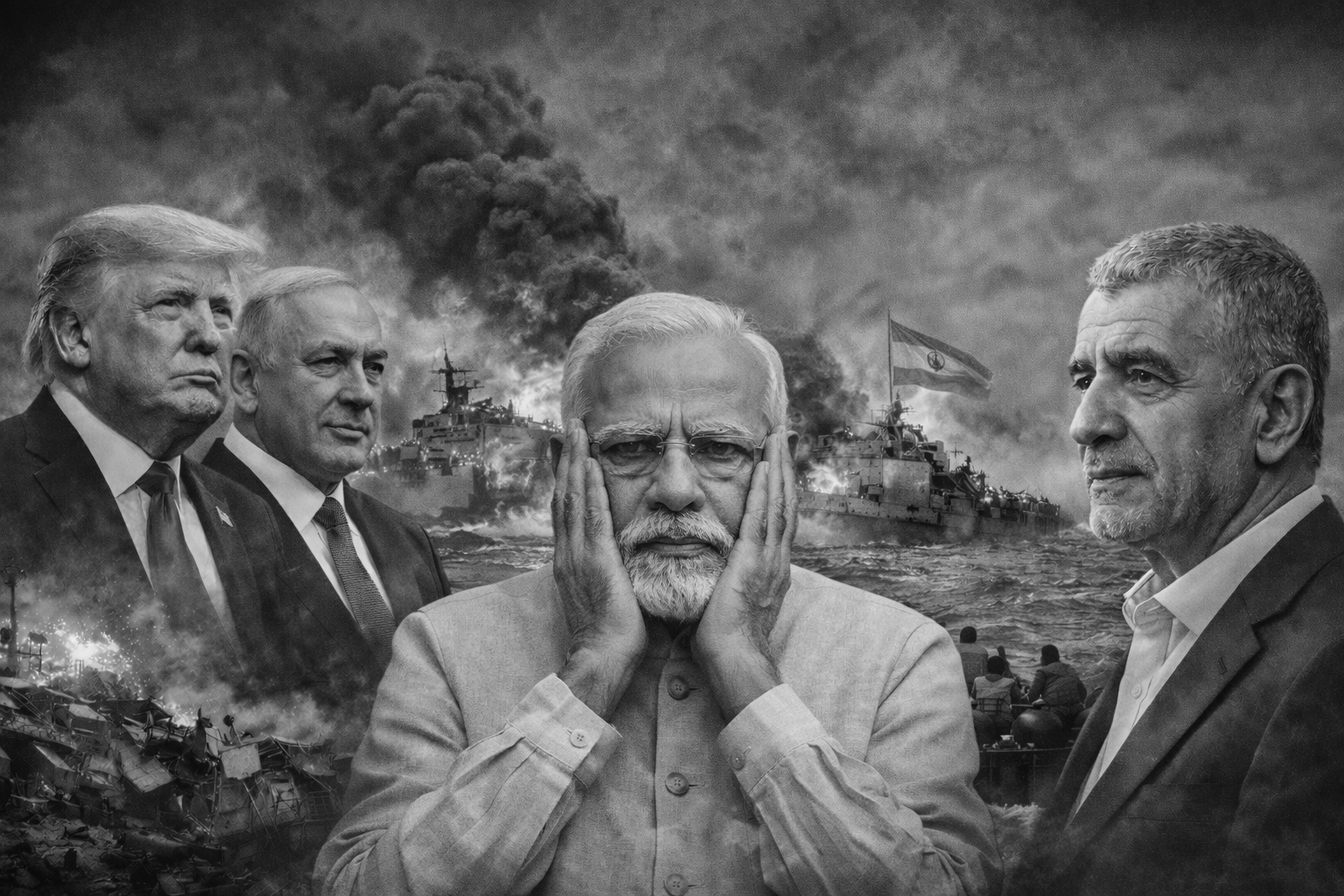
Middle East War, Day 6: Trump Rates 15/10 despite $2 B Lost vs Iran’s $700 M
The world woke up on Day 6 and the war had already moved . Not shifted — moved. Geographically, strategically, morally. What began six days ago as a joint American‑Israeli operation to kill a supreme leader and demolish a nuclear program has become something no war room in Washington or Tel Aviv fully modeled: a conflict without walls, without edges , without a country it hasn’t touched yet. It has reached the Indian Ocean . It has grazed NATO’s doorstep . It has set an airport terminal on fire in Azerbaijan . It has blinded America’s most expensive eye in the Gulf.
Day 6 opened with a statement . Iran fired 44 missiles and eight drones at Al Udeid Air Base in Qatar — the largest American military installation in the Middle East. But buried in that barrage was a precision ballistic missile aimed not at a runway or hangar but at the AN/FPS‑132 early warning radar system , valued at $1.1 billion and the backbone of American missile defence from Bahrain to Oman. In one strike, Iran didn’t just hit a base. It took America’s eyes . Analysts later confirmed Iran had pre‑planned this strike since last June — surgical, deliberate, first.
Then the UAE . One Iranian ballistic missile broke through. Six drones landed. Fragments damaged the Burj Al Arab while six Pakistani and Nepali nationals were injured. Iran unveiled the Fattah‑2 hypersonic glide vehicle , used in combat for the first time, traveling up to Mach 15 with a 200‑kilogram warhead . Unlike predictable ballistic missiles, it changes trajectory mid-flight , defeating tracking algorithms. Blind the radar, walk drones through the gap, then fire a missile nothing can catch. Day 6 was architecture , not retaliation. Total confirmed U.S. equipment losses now stand at $1.9 billion .
Sirens sounded across Tel Aviv and central Israel four times as Iran launched fresh ballistic missile barrages . The rhythm: phone alert, six minutes, siren, interception crack . A missile struck a synagogue and residential buildings in Beit Shemesh on Day 2, killing nine, injuring 49. Iron Dome and Patriot batteries catch most, but not all. Ten Israelis dead, dozens wounded. Tel Aviv is only about 1,600 km from Tehran. Israel cannot move like the U.S., so if the Iron Dome fails , the missiles will always find it . An Israeli F‑35I “Adir” shot down a Russian-made Iranian Yak‑130 over Tehran — the first F-35 aerial kill in combat history . Israeli strikes have killed 77 in Lebanon , injured 527. Hezbollah continues launching rockets; Israel pushes deeper into southern Lebanon. Hezbollah will not surrender. Not now, not ever.
The last time the U.S. sank a warship with a torpedo was 1945 . On Day 6 , that changed in the Indian Ocean south of Sri Lanka , when a U.S. submarine torpedoed the Iranian frigate IRIS Dena . Sri Lanka recovered 87 bodies, rescued 32; about 60 remain missing. The Dena was not on a combat mission. It had just finished MILAN 2026 , India’s multilateral naval exercise, sailing alongside 74 countries’ vessels, formally hosted by the Indian Navy . Nine days after leaving Indian waters, it was struck in international waters.The U.S. knew Dena's route and timing. Either it deliberately waited for it to clear Indian waters, or it struck knowing exactly whose guest it had been. India’s principle, Atithi Devo Bhava - the guest is god , had been violated.
A second Iranian vessel now sails in the Indian Ocean, leaving every tracker, government, and sailor asking the same question: will it be targeted too?
The war reached Azerbaijan . Iranian drones struck Nakhchivan International Airport , injuring two civilians. Over the eastern Mediterranean, NATO intercepted an Iranian missile aimed at Turkey — the first time NATO shot down an Iranian missile targeting a member state. Turkey reserved the right to respond. One errant missile could invoke Article 5 .
Trump called the operation “about a 15 out of 10.” Yet while Iran’s losses total around $700 million , the U.S. has lost nearly $2 billion , raising serious questions about the operation’s cost-effectiveness as Iran keeps firing.