
Middle East war, Day 33: While Trump and Iran trade words, Britain counts the cost at Hormuz
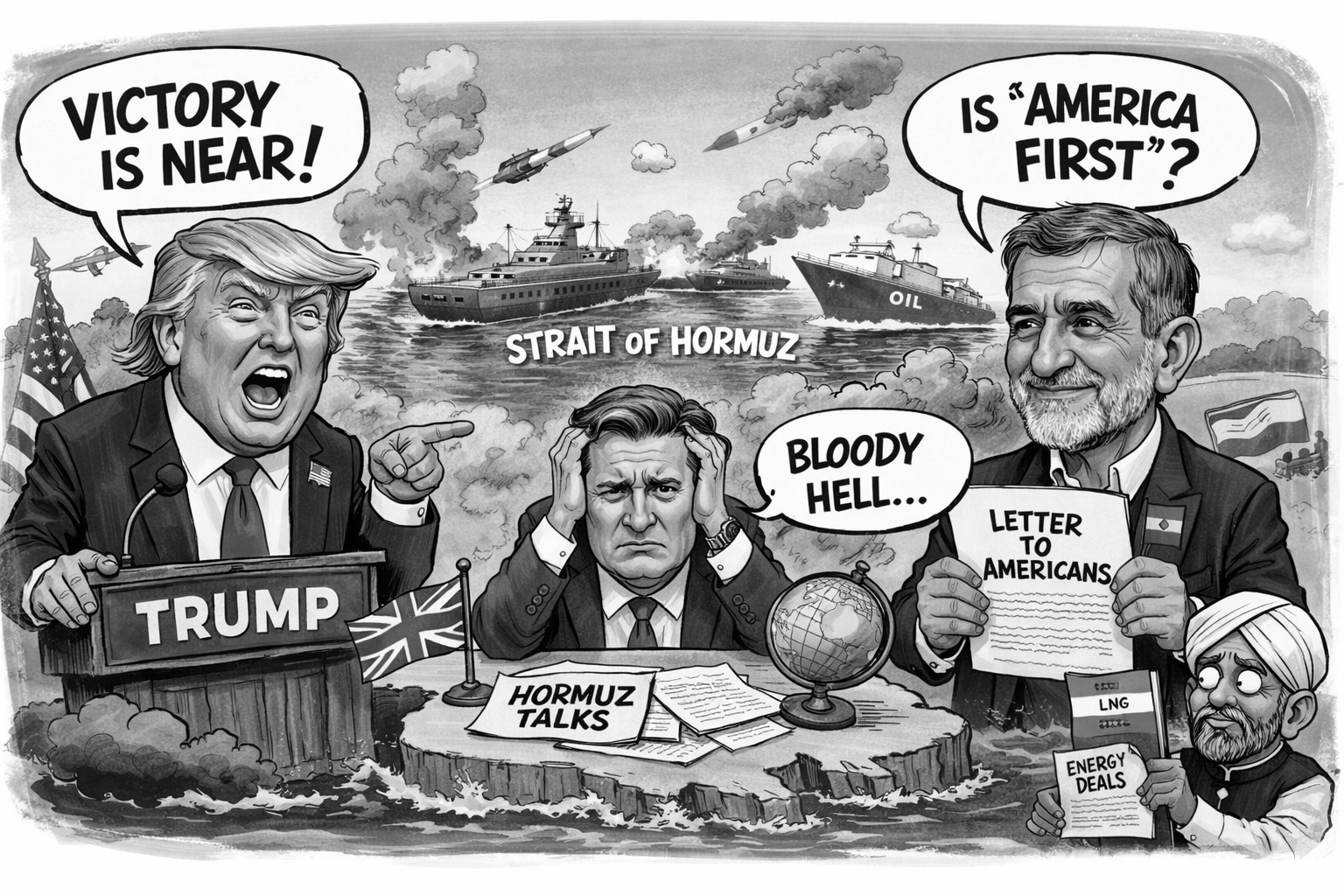
The 33rd day of the US-Israel war on Iran brought into sharp relief just how differently the two sides are telling this story. In Washington, President Donald Trump , addressing the nation from the White House , declared the United States was "very close" to achieving its objectives and that the war was "nearing completion." But even as he spoke, the missiles kept flying and it was Iran that fired the most memorable rhetorical shot of the day, not from a launcher, but from a letter .
Hours before Trump took to the podium, Iranian President Masoud Pezeshkian published an open letter addressed to the American people , pointedly asking: "Is 'America First'" truly among the priorities of the US government today? It was a calculated provocation, addressed directly to the same citizens Trump was about to address. Pezeshkian asked: "Exactly which of the American people's interests are truly being served by this war? Does the massacre of innocent children, the destruction of cancer-treatment pharmaceutical facilities, or boasting about bombing a country "back to the stone ages" serve any purpose other than further damaging the United States' global standing ?" He accused Washington of entering the conflict as a "proxy for Israel," and asked whether it was not evident that Israel "now aims to fight Iran to the last American soldier and the last American taxpayer dollar." The timing was surgical, the letter landed while Trump's approval ratings were sagging, gas prices had crossed $4 a gallon , and a majority of Americans had turned against the war.
Trump, for his part, was not conceding any ground. He told Americans the war was "nearing completion" and projected another two to three weeks of involvement. Iran responded to Trump's address with new missile attacks targeting Israel and Gulf Arab states , demonstrating Tehran's ability to strike even as Washington claimed the threat was nearly eliminated. On Day 33 , 14 Israelis were wounded , including an 11-year-old girl , in a missile attack in central Israel . A missile from Yemen , fired by the Houthis , was also intercepted over southern Israel . Saudi Arabia shot down two more drones , and an "unknown projectile" struck a tanker off the coast of Qatar . Iran also fired multiple salvos at Haifa , with sirens activated across northern Israel and Lebanon . Hezbollah fired barrages of over 50 rockets at northern Israel, continuing its involvement in the war as part of the axis of resistance , even as Israel prosecuted a ground operation in southern Lebanon . The front was, in every sense, still fully ablaze with Iran, Hezbollah , and the Houthis all active simultaneously.
Meanwhile, the world was urgently trying to figure out what to do about the Strait of Hormuz . Almost three dozen countries gathered Thursday for a UK-hosted virtual meeting to exert diplomatic pressure to reopen the vital shipping route , choked off since the war began. The US was not among them. British PM Keir Starmer said the talks, chaired by Foreign Secretary Yvette Cooper would focus on diplomatic options, not military force. Starmer was clear: "This is not our war" and "we're not going to get dragged into it." The 35 countries that signed the joint statement demanding Iran cease its blockade included the UK, France, Germany , Italy, Canada , Japan , and the UAE , notably, every G7 nation except the United States itself. Trump's message to the rest of the world was blunt: go "build some delayed courage" and take the strait yourselves.
India found itself navigating a delicate tightrope at the Hormuz meeting. The Ministry of External Affairs confirmed that Foreign Secretary Vikram Misri would represent India at the UK-led talks , with MEA spokesperson Randhir Jaiswal saying: "We are in touch" with Iran and other countries to ensure safe transit for ships carrying LPG, LNG, and other products. He confirmed that six Indian ships had safely crossed the Strait of Hormuz, even as 18 Indian-flagged vessels remained stranded in the Persian Gulf. India's position was carefully worded, it attended the meeting while maintaining a quiet channel with Tehran. When asked whether India was paying a toll to Iran, Jaiswal denied it: "There has been no discussion" of this nature.
On the Iran-India back channel, Tehran sent its own reassuring signal. The Iranian Embassy in New Delhi posted on X: "Our Indian friends are in safe hands, no worries." A similar message came from the Iranian embassy in Saudi Arabia , which added that "only Iran and Oman" will decide the future of the Strait of Hormuz . The Iran-Oman dimension has been quietly significant throughout this war, Oman's deep-water ports of Duqm, Salalah, and Sohar in the Arabian Sea technically offer an alternate route around the strait, but in March 2026 several drones struck Duqm and Salalah, damaging at least one fuel storage tank, effectively closing off that detour and tightening Iran's stranglehold on global energy flows.