
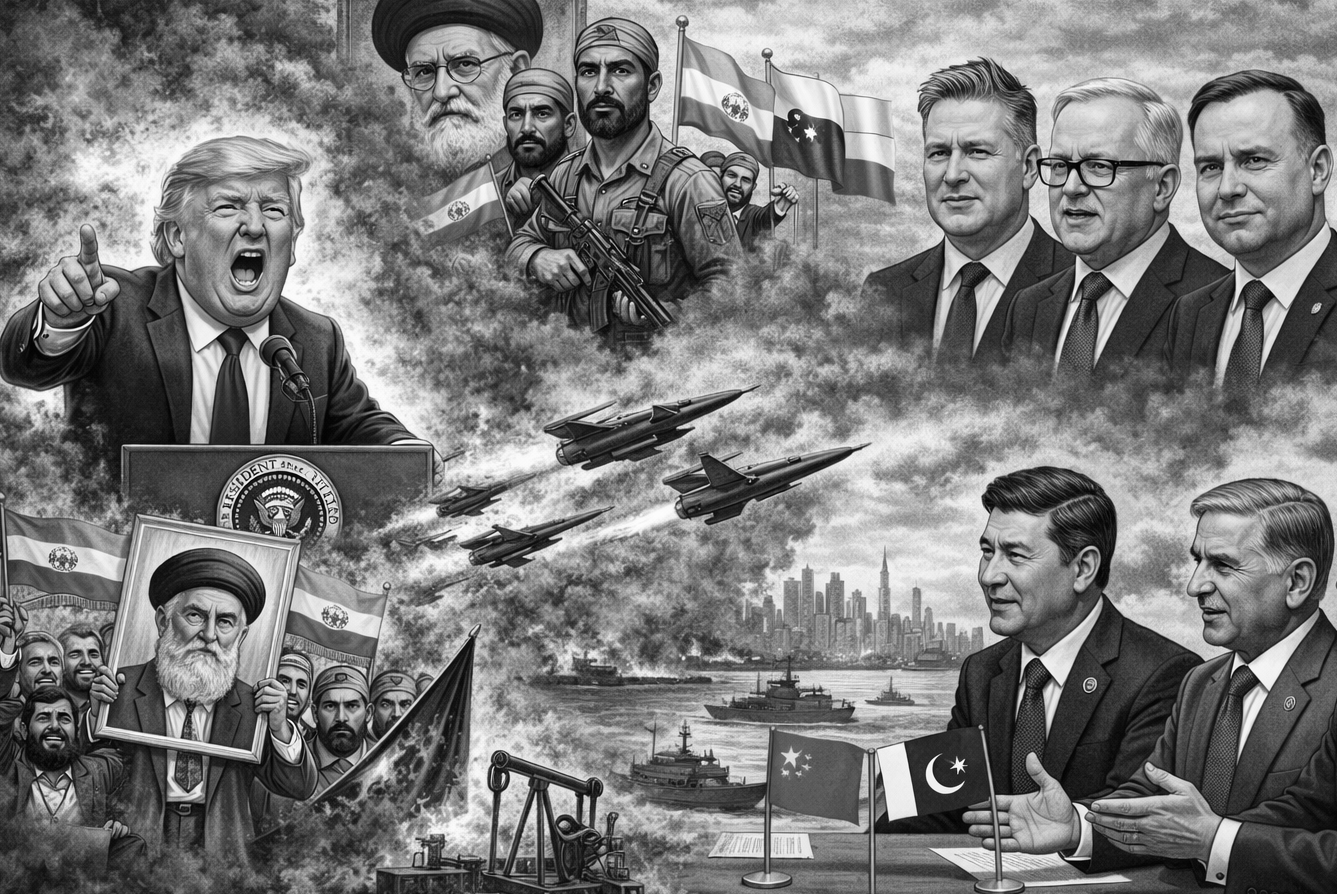
Middle East war, Day 32: World awaits Trump as Tehran power shift deepens
The world is watching Washington . A single question hangs over the globe: will Donald Trump end this war, or deepen it? The White House confirmed the president will deliver a prime-time address to the nation at 9 p.m. Eastern - 6:30 a.m. India Standard Time , his first such address since the US-Israeli assault began 32 days ago. But the hours before it offered few reassurances. Earlier on Wednesday, Trump posted on his Truth Social platform that Iran's president had asked the United States for a ceasefire, and said he would only consider the request after Iran reopened the Strait of Hormuz. The post sent markets soaring, then the reality landed. A senior Iranian official swiftly rejected Trump's claim, calling his remarks “false and baseless,” leaving the world to parse again whether Washington and Tehran are talking, or simply performing for their respective publics.
Trump's post had referred to Iran's “New Regime President, much less Radicalized and far more intelligent than his predecessors.” The characterisation is not incidental, it points to the most significant internal development emerging from Tehran on Wednesday. Iran's powerful Islamic Revolutionary Guard Corps (IRGC) has effectively taken control of key functions of the state, sidelining President Masoud Pezeshkian's administration and pushing him into what informed sources described as a “complete political deadlock.” A military council composed of senior IRGC officers is now exercising effective control over core decision-making, enforcing a security cordon around Supreme Leader Mojtaba Khamenei and preventing government reports on the country's situation from reaching him. Pezeshkian's repeated attempts to secure an urgent meeting with Khamenei have gone unanswered. The civilian government is, for all practical purposes, a ghost in its own machine.
US-Israeli air strikes hit six Iranian cities , Ahvaz, Shiraz, Isfahan, Karaj, Kermanshah and Bandar Abbas, targeting steel plants, pharmaceutical units, ports and a meteorology complex. Tehran’s Tofigh Daru pharmaceutical units were destroyed, disrupting research and the medical supply chain. In Bandar Abbas, the Shahid Haqqani passenger pier was struck, and a desalination plant on Qeshm Island went offline, threatening freshwater in the Strait of Hormuz . The IDF reports 800+ attack flights and 16,000 munitions dropped since the war began.
Despite bombings, Tehran staged a massive display . Tens of thousands marched for Islamic Republic Day, 47 years since the 1979 revolution , waving flags and portraits of Ali Khamenei . Foreign Minister Abbas Araghchi joined, declaring “Iranians will ALWAYS stand firm and NEVER cower.” Footage of bombed areas was called a “nightmare for aggressors,” signalling unity amid internal government erosion.
Iran’s regional strikes triggered alarms across Gush Dan, Sharon and Samaria in Israel, while a drone infiltrated Kiryat Shmona. The IDF intercepted a missile from Yemen , killed a senior Hezbollah commander in Beirut’s southern suburbs , and Lebanon reported 50 deaths in Israeli strikes over 24 hours. PM Netanyahu said Iran’s allies no longer pose an “existential threat” but vowed to continue the Iran campaign and Lebanon offensive, advancing ground forces under evacuation orders.
In the Gulf , attacks unsettled governments. Saudi Arabia intercepted seven missiles; Jordan and Bahrain issued alerts. In Qatar , a QatarEnergy tanker was hit. One person was killed in the UAE, which has endured hundreds of Iranian strikes. By March 28, Iran had launched 398 ballistic missiles, 1,872 drones and 15 cruise missiles at the UAE, the second most targeted country after Israel.
The financial damage now has a number. The UAE's stock markets in Dubai and Abu Dhabi have lost around $120 billion in value since February 28, with Dubai's benchmark index down 16 percent and Abu Dhabi's down 9 percent. Financial markets in Qatar and Bahrain have dropped approximately 4 percent and 7 percent respectively. Goldman Sachs estimates that if the conflict continues at its current intensity through April, Qatar and Kuwait's real GDP would each fall 14 percent this year. “Brand Dubai,” built as a financial hub beyond oil, is under severe pressure: real estate transactions have dropped 37 percent year-on-year, with sales down more than 50 percent compared with February.
On the diplomatic front, the architecture of Western support for the campaign is visibly buckling. France, Spain and Italy have held firm in restricting US military operations, denying base access, closing airspace and limiting logistical support. Trump accused France of being “VERY UNHELPFUL.” France responded bluntly that its position had not changed since day one.
US Secretary of State Marco Rubio* warned the United States may reassess the value of *NATO* , calling it a *“one-way street.”* Trump said he was *“absolutely” considering withdrawing the United States from NATO.
Poland refused a US request to redeploy one of its Patriot air defence batteries to the Middle East, saying the systems protect Polish skies and NATO's eastern flank .
China and Pakistan jointly proposed a five-point peace plan calling for an immediate cessation of hostilities, talks, protection of non-military targets, security of shipping lanes and adherence to the UN Charter .
The Strait of Hormuz is rapidly becoming the crux of everything. British Prime Minister Keir Starmer announced the UK would host an international diplomatic conference, with 35 countries backing efforts to restore maritime navigation .
In Australia , Prime Minister Anthony Albanese warned that the economic shocks from the war could last for months, urging people to use public transport while announcing fuel tax cuts and free transport in two states .
Around 20,000 seafarers remain stranded near the Strait of Hormuz , many running low on food and water, with the UN International Maritime Organization negotiating their evacuation.