
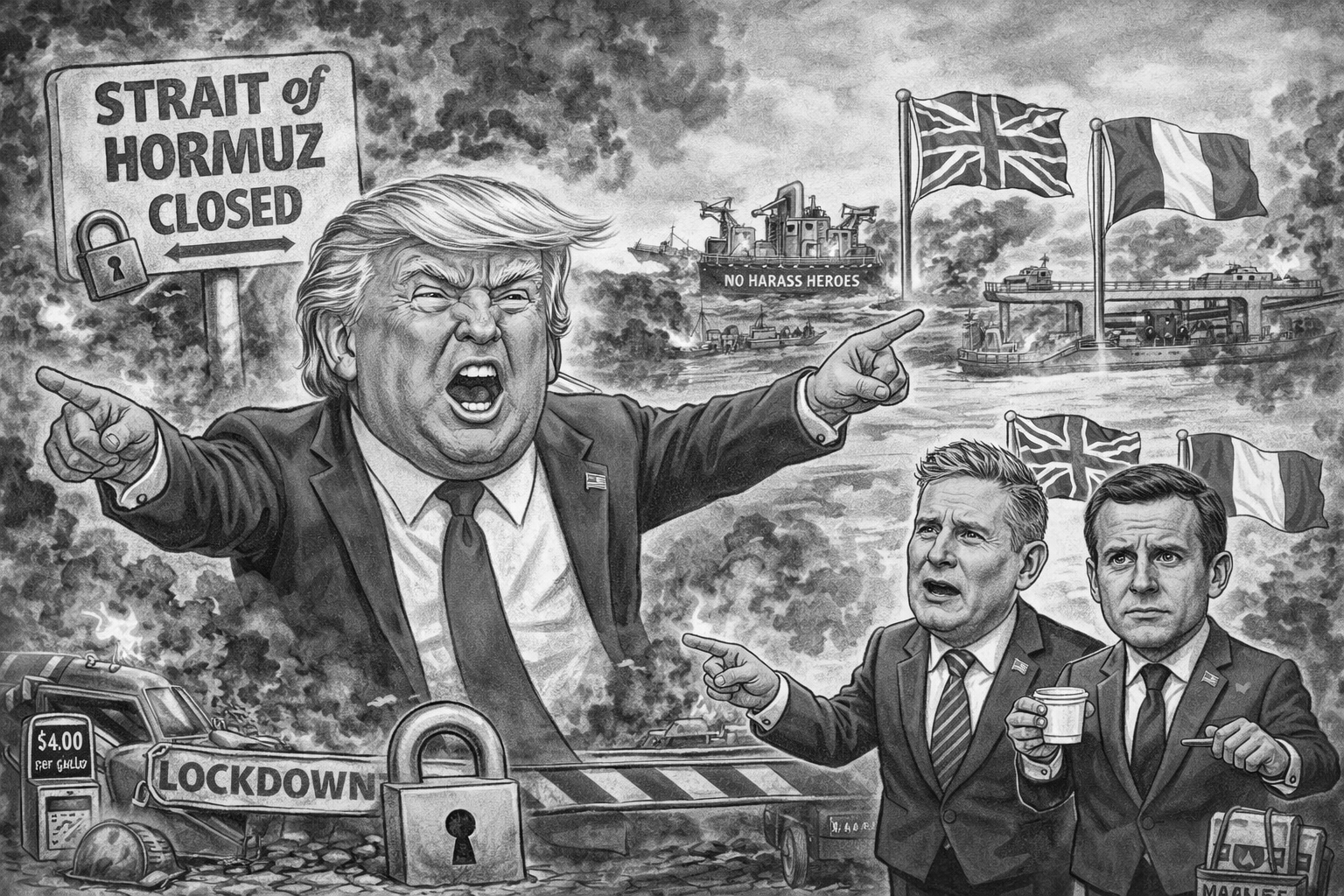
Middle East war, day 32: Trump's war closed the strait, now he's furious it's closed and blaming his allies
Thirty-two days into a conflict that has reshaped the geopolitical map of the Middle East, the US-Israel war on Iran shows no signs of exhausting itself. Thunderous explosions continue to rattle Tehran and Isfahan as American and Israeli warplanes prosecute relentless bombardment campaigns deep inside Iranian territory, while the war's shockwaves ripple outward, strangling energy markets, putting neighbouring capitals on edge, and drawing desperate pleas from world leaders scrambling to contain the inferno.
President Donald Trump levelled a chilling ultimatum at Tehran: reach a deal, or watch Kharg Island along with its oil wells and power plants, be reduced to rubble . His Defence Secretary, Pete Hegseth , arrived in West Asia to visit American troops stationed across the region, offering what the Pentagon framed as a morale-bolstering tour . Hegseth said , "If Iran is wise, it will make a deal."
Inside Iran , the scale of destruction being wrought is staggering. US and Israeli forces are no longer limiting their strikes to purely military infrastructure. In Isfahan , two massive explosions shook the city in rapid succession, their blasts felt across entire neighbourhoods. Among the targets hit were military installations , but also a cancer-drug manufacturing plant , a strike that drew immediate international condemnation , as well as a key Shia religious centre , damaged in an attack that risks igniting fury far beyond Iran’s borders .
Iran’s largest pharmaceutical plant , a state-run facility , was also struck, threatening to disrupt medicine supplies for millions of civilians . A desalination plant , critical to the civilian water supply , was likewise hit, underscoring that the campaign has moved far beyond the “surgical precision” its architects publicly claim.
The embattled government pressed ahead with almost defiant energy. State media confirmed that a parliamentary commission approved levying tolls on vessels transiting the Strait of Hormuz , a waterway now effectively choked by the war, signalling Tehran’s intent to weaponise every lever at its disposal . Iran is deeply suspicious of Washington’s willingness to negotiate. That decades-old mistrust may prove the most intractable obstacle to any ceasefire.
In a pointed show of staying power, Iran launched its 87th wave of regional attacks in a single month, this time carried out by its navy . The operation carried an unmistakable message: Washington’s claims that Iranian naval forces had been effectively annihilated were premature . The Islamic Revolutionary Guard Corps (IRGC) simultaneously confirmed a major loss , acknowledging the death of Admiral Alireza Tangsiri, its naval commander, killed in an Israeli strike, one of the highest-ranking casualties of the conflict so far.
Israeli forces struck the Imam Hossein University in Tehran , an IRGC-run institution that Israel claims was a hub of advanced weapons research. Back home, however, Israel's war is not without cost. A large blaze erupted at the Haifa oil refinery after debris from an intercepted projectile slammed into the facility, a reminder that no country in this conflict is beyond reach. Prime Minister Benjamin Netanyahu struck a tone of grim determination . The war, he said, had passed its halfway point , and Israel is prepared for weeks of further fighting . There was no talk of winding down. The Israeli military also announced plans to establish a permanent security presence in southern Lebanon , effectively an indefinite military seizure of territory , a move with consequences that could long outlast the current conflict.
The conflict’s geographic reach continues to stretch. NATO forces intercepted a fourth missile fired from Iran toward Turkiye . Pakistan’s Deputy Prime Minister Ishaq Dar flew to Beijing for talks with Chinese Foreign Minister Wang Yi , as regional diplomacy accelerates behind the scenes, following weekend meetings in Islamabad with senior diplomats from Saudi Arabia, Turkiye, and Egypt , countries deeply exposed to the war’s fallout.
In the Gulf , the situation grew grimmer. Iran launched what Kuwait called a “direct and criminal” attack on the Al-Salmi oil tanker docked at Dubai port , sending alarm through regional shipping circles. Dubai itself was not spared, explosions echoed across the city, injuring four people and shattering any sense of insulation the emirate may have held. Saudi Arabia scrambled to intercept at least eight ballistic missiles targeting Riyadh and the Eastern Province. At an emergency summit in Jeddah , the leaders of Saudi Arabia, Qatar, and Jordan jointly condemned Iran’s strikes on civilian infrastructure, unusually sharp language for a region often defined by diplomatic caution. Bahrain activated emergency sirens , urging residents to seek shelter immediately.
Iran's Foreign Minister Abbas Araghchi , unmoved by the mounting pressure, declared it "high time" for American troops to vacate their bases across Gulf states.
More than 200 US soldiers have formally filed complaints against superior officers accused of deploying religious rhetoric to justify the war, a simmering undercurrent of dissent that the Pentagon will find difficult to ignore indefinitely. The US State Department, meanwhile, publicly backed Israel following the Israeli parliament's passage of a law permitting the execution of Palestinians convicted of killings of Israelis.
Lebanon and Iraq , too, are bleeding. Three UN peacekeepers with UNIFIL were killed in southern Lebanon across consecutive days. In Baghdad , an intercepted drone targeting the US Embassy sent shrapnel into a residential neighbourhood, wounding a civilian.
In a moment of breathtaking audacity, Trump, whose war has effectively padlocked the Strait of Hormuz shut, turned on the world for struggling to access fuel through it. Countries desperate for energy, he declared, could either buy American oil or sail to Hormuz and "just take it" themselves . Britain and France , who declined to be dragged into the conflict, were singled out for particular scorn, told bluntly that they must now learn to secure their own energy supplies. The irony was lost on no one: the man who started the fire was furious that people were complaining about the heat. Back home, American drivers crossing $4 per gallon at the pump for the first time since Russia's war on Ukraine were perhaps less impressed by the bravado. The G7' s finance ministers, meanwhile, promised "all necessary measures" to stabilise energy markets.
Russian officials said Iran’s Supreme Leader Mojtaba Khamenei remains inside Iran but has avoided public appearances , describing his absence as due to “understandable reasons” amid the ongoing war.
The contagion is reaching far beyond the Middle East. Norway moved swiftly to slash fuel taxes, cushioning its citizens from the worst of the price surge. Bangladesh ordered its civil servants to cut lights and throttle air conditioning.