
Middle East War, Day 31: Too Big to Invade, Too Valuable to Ignore
Thirty-one days later, a full calendar month, the bombs have not stopped.
Powerful explosions shook Tehran as Iran's Ministry of Energy reported blackouts across the capital, surrounding areas, and Alborz province, following attacks on electricity infrastructure. The Israeli military confirmed it was "currently attacking the infrastructure" of the Iranian government 'throughout Tehran,'" claiming it was just days from hitting all Iranian targets classified as top priority . Authorities later restored power to the capital. Attacks were also reported in Karaj, Shiraz, Qom, Abadan, and Tabriz , where a petrochemical unit was struck, though the fire was later fully contained.
Two major aluminium facilities , one in Bahrain and one in the UAE, were also struck, and a huge blaze broke out at an industrial site in central Israel following an Iranian attack. In Iran, Israeli strikes damaged two steel plants , and buildings at an engineering university in Tehran were hit. The human cost continues to mount: Kuwait confirmed an Indian worker was killed after a building at a power and water desalination plant was damaged in an Iranian attack.In Lebanon, Israeli forces continued pushing south, exchanging fire with Hezbollah. Demolitions along the Litani river threaten tens of thousands.
Trump escalated rhetoric on Truth Social, warning that if a deal wasn’t reached and the Strait of Hormuz reopened, the US would destroy all of Iran's power plants, oil wells, Kharg Island, and possibly all its desalination plants . In the Financial Times, he said his "favourite thing" would be to take Iran's oil : "Maybe we take Kharg Island, maybe we don't. We have a lot of options," adding US forces would "likely need to remain there for an extended period."
Even as Trump threatened total economic destruction, he claimed Iran had agreed to "most of" the 15-point US demands via Pakistan: "We'll make a deal with them, I'm pretty sure." Tehran did not confirm. A senior Iranian security official told CNN that Tehran will determine when the war ends , signalling Iran is prepared to sustain operations, a direct rebuke of US projections. Iran's parliament speaker, Mohammad Bagher Ghalibaf , accused the US of secretly planning a ground invasion while negotiating, saying Tehran's forces were "waiting for them."
On Monday , the second day of Islamabad talks, Pakistan’s foreign minister confirmed that both the United States and Iran have expressed confidence in Islamabad’s role as a neutral intermediary. He said direct negotiations between Washington and Tehran are expected “in coming days” under Pakistan’s facilitation. The regional ministers reaffirmed unity to contain the situation, reduce the risk of military escalation, and create conditions for structured negotiations. Pakistan added it would be honoured to host “meaningful talks” aimed at a comprehensive and lasting settlement of the conflict.
Spain closed its airspace to all US military aircraft involved in the Iran war , extending a prior ban on base use at Rota and Morón. Foreign Minister José Manuel Albares said "Spain should not do anything that could escalate" the conflict. The closure affects overflights from UK and France bases . Prime Minister Pedro Sánchez described the war as illegal.
The IRGC issued a March 30 deadline demanding the US condemn strikes on Iranian universities , threatening attacks on US university campuses in the Gulf , including Texas A&M, Northwestern in Qatar, and NYU in the UAE. The deadline passed.
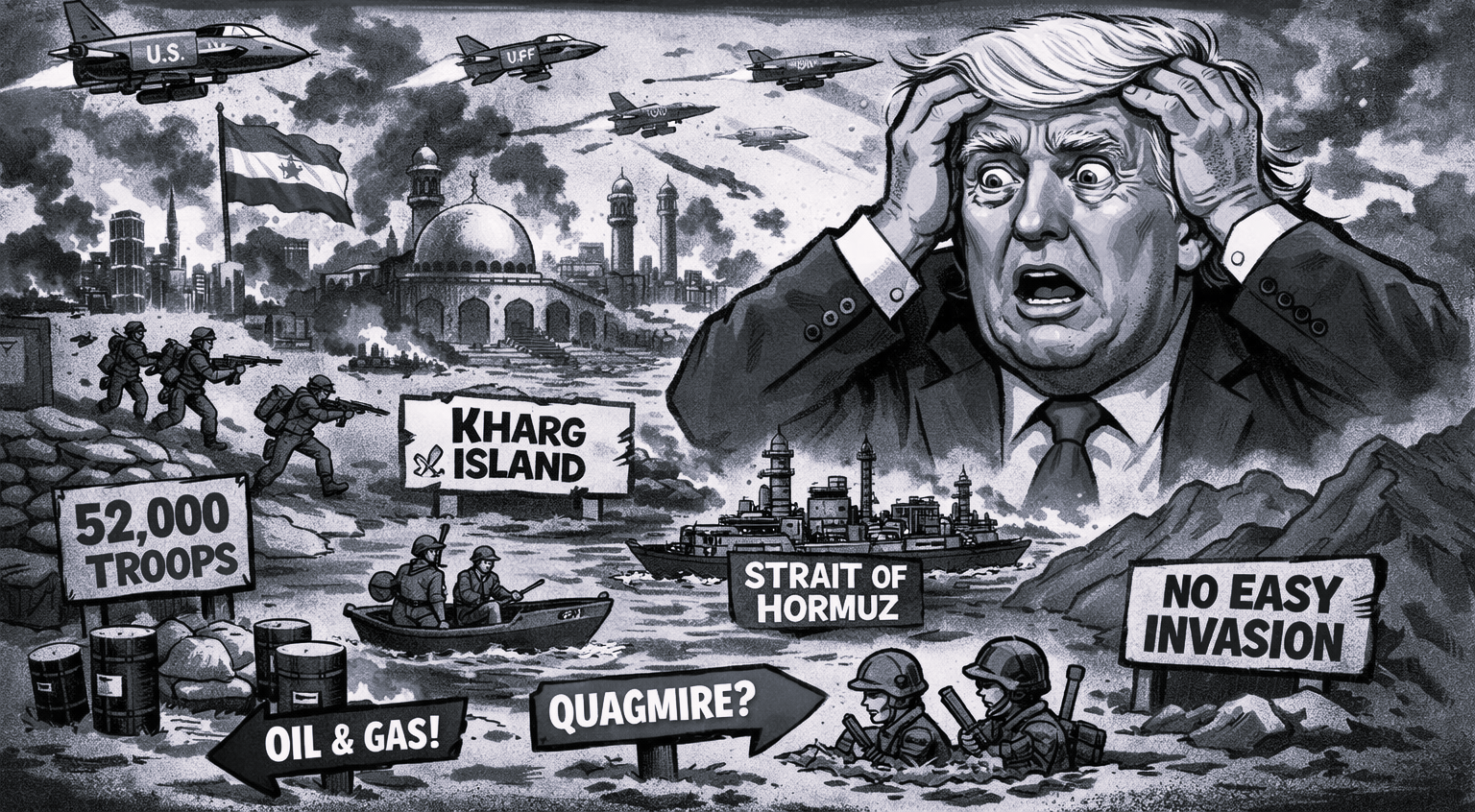
The US lacks sufficient troops to invade Iran. The USS Tripoli , carrying 3,500 sailors and Marines for amphibious operations, has arrived in the Middle East. On March 28, 2,500 Marines from the 31st Marine Expeditionary Unit joined the region, alongside 2,000 82nd Airborne paratroopers en route for potential air-drop operations. By week’s end, roughly 52,000 US troops could be positioned across West Asia, compared with a peacetime deployment of about 40,000. Most are at regional bases; the rest are aboard warships.
The hard strategic reality is clear: 52,000 troops is nowhere near enough to invade Iran. Israel used 300,000 soldiers in Gaza; the US deployed 250,000 in Iraq , up to 100,000 in Afghanistan , and over 500,000 in Vietnam . Iran would require far more. It is four times the size of Iraq , twice the size of Afghanistan, and five times the size of Vietnam. The 2003 Iraq invasion, which toppled a far weaker government in under three weeks, still required 150,000 coalition troops and Iraq had no serious geographical barriers.
Iran presents an entirely different challenge. Its borders create a near-impossible invasion corridor. From Iraq and Turkey, the only realistic staging grounds, the terrain rises quickly into the Zagros mountains , stretching from the northwest to the Gulf coast. This natural barrier of mountains, deep trenches, and narrow passes gives Iranian defenders devastating chokepoints. Armour cannot move at scale, and logistics cannot be sustained. The terrain itself becomes Iran’s greatest ally before a shot is fired.
Iran has mobilised over one million soldiers . The regime maintains full internal security, with army and paramilitary units equipped, dug in, and ideologically prepared for a prolonged defensive war. Unlike Iraq in 2003, where locals toppled Saddam Hussein’s statue within weeks, there will be no such scenes in Iran.
American public opinion also constrains action. In 2003, 72 percent of Americans supported the Iraq invasion , a post-9/11 war with overwhelming backing. This conflict is different: around 61 percent disapprove of strikes on Iran , and Trump’s approval has dropped to 36 percent , his lowest since returning to office. He lacks the political capital for a full-scale invasion, and the Pentagon appears aware. Iran has also launched a volunteer registration campaign , allowing participants as young as 12 to join security and support roles. The mobilisation is not rhetorical - it is institutional.
The Pentagon appears to be planning a narrower, more surgical operation: seizing or neutralising Kharg Island , the terminal handling roughly 90 percent of Iran’s oil exports and occupying strategic locations near the Strait of Hormuz using special forces and conventional infantry. The US already struck Kharg on March 13, hitting 90 targets , including naval mine storage and missile bunkers. This is not a plan to conquer Iran; it is intended to strangle it economically and force it to the negotiating table, yet even this carries enormous risks. Iran is preparing for exactly this scenario. American forces would not land on an undefended shore but drop into a killing field . Limited operations have a history of spiraling: thousands more troops may enter, missions expand, and the ground war no one wants could become inevitable. Trump has boxed himself in. He cannot claim victory from the air alone, and the ground option, limited or otherwise, could cost far more than Washington is prepared to admit.