
Middle East War Day 30: Talks in Islamabad, Boots Near Tehran?
The US-Israel war on Iran entered its 30th consecutive day, showing with brutal clarity that it has no intention of ending soon. The day began not with diplomacy but with sirens . Early Sunday, Kuwait faced missile and drone attacks for a second night, shooting down four as cities woke to the familiar warnings. Across the Gulf, Saudi Arabia intercepted ten drones in the pre-dawn darkness, part of a nightly cycle of defence and damage assessment. Bahrain, hosting the US 5th Fleet, reported twenty missile and twenty-three drone attacks in 24 hours, once apocalyptic, now routine and imposed a maritime curfew , striking at its economy. The UAE confirmed air defences were active throughout the night, describing the sounds as “engaging operations.”
As Sunday’s first light reached Tehran, powerful explosions rocked the city. Iranian media reported strikes on steel and cement factories , with residents sharing videos despite a nationwide internet blackout now in its 30th day. The IRGC claimed it used long-range and medium-range solid and liquid-fuelled systems and attack drones to hit industries linked to what it called the "Israeli-American enemy, " also claiming to have shot down a US MQ-9 drone and struck an F-16 jet. Iran's military additionally said it targeted a US logistics vessel near the Omani port of Salalah. In Israel, a total of eight impact sites were reported in Tel Aviv, including a university struck by Iranian missiles, killing one person and injuring two. The US Central Command released footage of its own strikes on Iranian naval vessels, declaring: "For decades, Iranian naval vessels have threatened and harassed global shipping in regional waters. Those days are over."
The IRGC issued a chilling ultimatum to Washington, demanding the US condemn the strikes on Iranian universities by March 30 or face expanded attacks on US university campuses across the Gulf, including Texas A&M and Northwestern in Qatar and New York University in the UAE. Iran also accused the US and Israel of attacking the residence of Kurdish region President Nechirvan Barzani, calling it consistent with a pattern of "cowardly assassinations." Both Syria and the UAE condemned the attack in a joint statement. The IRGC separately announced the blocking of three vessels over alleged links to US-Israeli allies, signaling that Tehran is prepared to selectively seize shipping it deems complicit in the campaign against it.
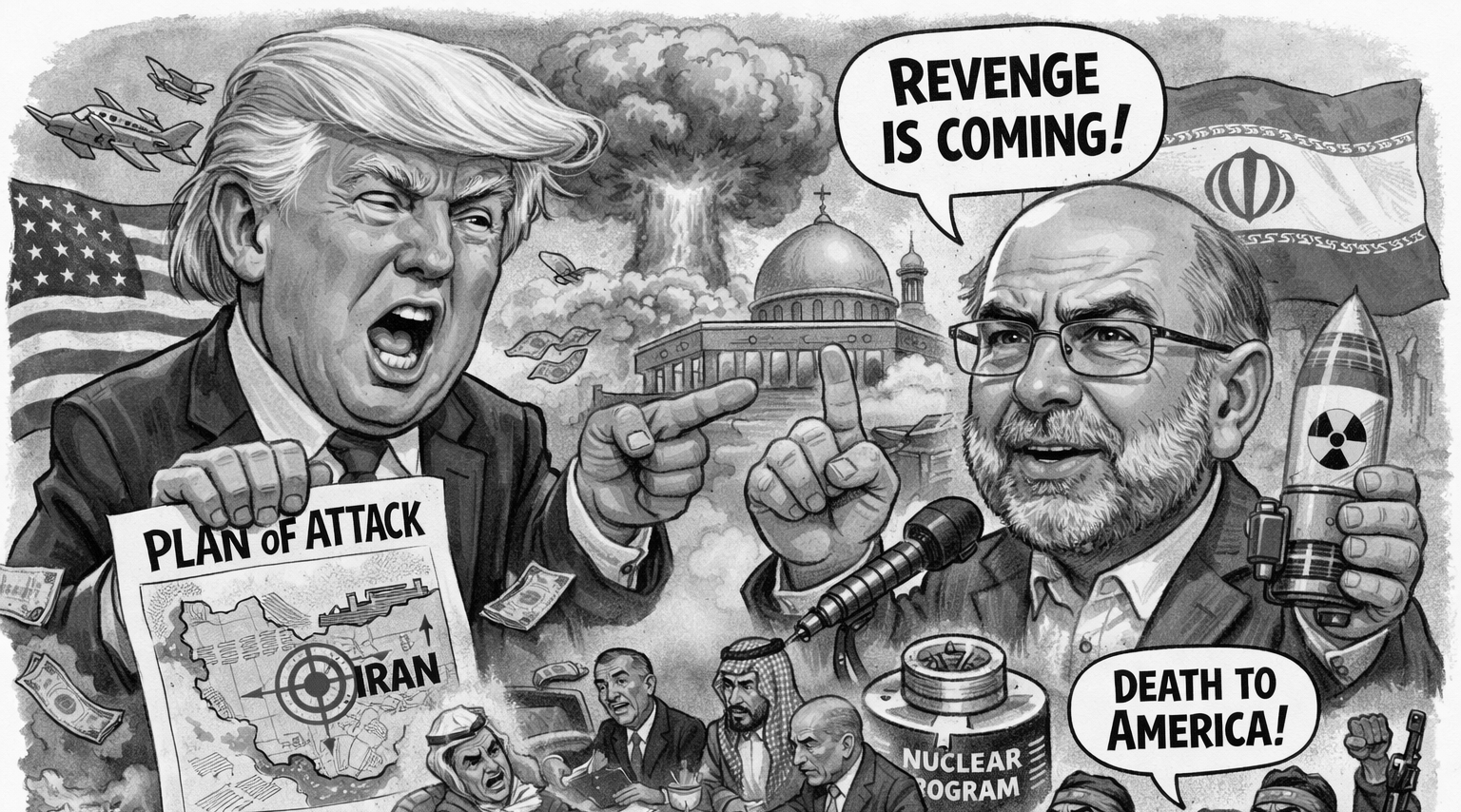
The Washington Post, citing unnamed US officials, reported that the Pentagon is preparing for weeks of ground operations inside Iran, short of a full-scale invasion but involving special forces raids and conventional infantry. Iran's parliament speaker Mohammad Bagher Ghalibaf , one of the most senior surviving civilian figures in the Islamic Republic and a man increasingly seen as a potential interlocutor with Washington, delivered one of the day's most explosive statements. In remarks carried by IRNA, Ghalibaf accused the US of publicly talking peace while secretly planning a ground attack , declaring: " Our men are waiting for the arrival of the American soldiers on the ground to set them on fire ." Iran's Foreign Minister Abbas Araghchi told his Turkish counterpart by phone that Tehran remained deeply sceptical of current diplomatic efforts , accusing the US of making "unreasonable demands" and exhibiting "contradictory actions." An Iranian official also added a provocative new condition to Tehran's peace demands: formal recognition of Iran's sovereignty over the Strait of Hormuz, a waterway through which twenty percent of the world's oil and gas passes daily, now being positioned as both a geopolitical pressure point and a potential multi-billion-dollar revenue stream.
In Yemen, the Houthis launched ballistic missiles at Israel, their first since the US-Israel war on Iran began and claimed a second wave soon after. A spokesman vowed attacks would continue until “ aggression on all resistance fronts stops .” Their involvement adds a grave risk: the Houthis can threaten the Bab al-Mandab Strait , a Red Sea chokepoint handling 12 percent of global trade . With Iran already constraining the Strait of Hormuz, a dual chokepoint crisis could trigger an unprecedented economic catastrophe. In Iraq , airstrikes hit Popular Mobilisation Forces sites near Mosul and Tuz Khurmatu, while Syria repelled drones targeting the US base in Qasrak. Tehran also launched two intermediate-range missiles at Diego Garcia .
The most consequential multilateral diplomatic effort of the war's first month was underway. The foreign ministers of Pakistan, Saudi Arabia, Turkiye and Egypt , the so-called Quad , gathered for two days of talks aimed at pulling the region back from the precipice. Egypt said discussions would focus on "ongoing diplomatic efforts to contain tensions and promote de-escalation," with participants "seeking to coordinate their stances and support political solutions." Pakistan's Foreign Minister Ishaq Dar said "dialogue, diplomacy, and confidence-building measures are the only way forward." Prime Minister Shehbaz Sharif confirmed holding "extensive discussions" with Iranian President Masoud Pezeshkian , describing Pakistan's mediation as "sincere and robust." Pezeshkian praised Pakistan's role and stressed the need to build trust before any formal agreement. Dar also confirmed a call with Iran's Foreign Minister Araghchi, reaffirming Pakistan's commitment to regional peace.
The day’s high-stakes diplomacy was slightly undermined by a human touch: Pakistan FM Ishaq Dar briefly fell flat on the floor during the talks, providing an almost literal metaphor for the precarious balancing act of negotiating with missiles flying overhead. Observers on Twitter were quick to note that if the talks “fall” anywhere, it might as well be in Islamabad.
Pakistan, the only Muslim-majority nuclear power without US bases , maintains a strategic defence pact with Saudi Arabia , shares a 900-kilometre border with Iran , and hosts the world’s second-largest Shia population . Dar revealed Pakistan pushed back against Washington's demand for zero uranium enrichment , proposing a monitored framework with oversight by two or three countries, reportedly accepted by Iran in principle. Iran also agreed, following a UN request, to allow humanitarian and agricultural shipments through the Strait, clearing 20 more Pakistani-flagged vessels with two crossing daily. Thailand reached a separate safe-passage agreement, showing Asian nations securing energy lifelines amid faltering global diplomacy. Trump has given Tehran until April 6 to reopen the Strait unconditionally or face military escalation, warning Iran would be hit "harder than they've ever been hit before." That deadline now hangs over Islamabad talks like a sword.
As all this unfolded, the USS Tripoli , carrying 3,500 US sailors and Marines , arrived in the Middle East, built for evacuations, amphibious operations, raids and assaults. The USS George H.W. Bush is expected to deploy shortly. The USS Gerald R. Ford , having suffered a non-combat fire on March 12, repositioned to Split, Croatia, after repairs in Crete. Three American aircraft carriers are now either in theatre or converging, a show of force whose implications are impossible to misread. The dual narrative of diplomacy in Islamabad, sometimes literally on the floor and boots near Tehran frames the precarious balance of Day 30, with the war’s trajectory hanging in the balance.