
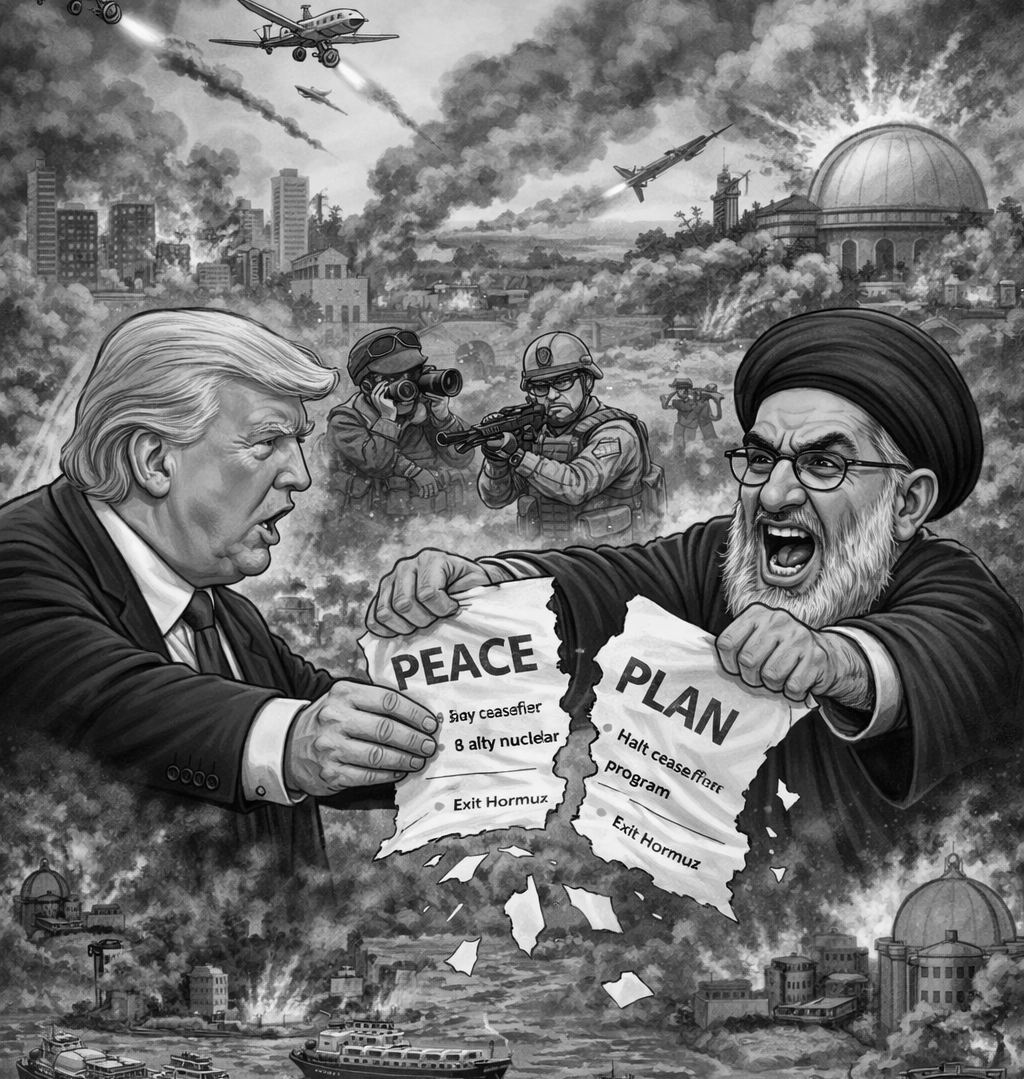
Middle East War Day 26: Trump's 15-Point Peace Plan Collapses on Contact
A fragile and deeply contradictory picture emerged on the twenty-sixth day of the war. The fifteen-point peace plan that arrived dead on arrival , rejected before the ink had dried on its leaked contents.
There are early signs, cautious and unconfirmed , that the intensity of bombardments from both sides is easing slightly after twenty-six days of relentless strikes . Missile launches and retaliatory drone attacks continue but appear to be declining , possibly due to depleted stockpiles, logistical strain , or as a signal ahead of negotiations . Yet the violence remains devastating . In southern Tehran , a raid killed at least twelve and wounded twenty-eight , while eastern Tehran saw explosions at a school and residential buildings. Iranian missiles struck Israeli territory, injuring more than a dozen including an infant in Tel Aviv, while Israel retaliated with a large wave of strikes across Iran, hitting Isfahan’s submarine facility and Bushehr nuclear plant , confirmed by the IAEA with no casualties.
The most significant development of the day was also its most telling failure . Washington delivered its fifteen-point proposal to Tehran through Pakistani intermediaries , a document never publicly released by the White House , but whose contents leaked swiftly through Israeli and Western media channels . The plan, as reported, demanded a thirty-day ceasefire, the full dismantling of Iran's nuclear facilities at Natanz, Isfahan and Fordow, a permanent commitment never to develop nuclear weapons, the handover of Iran's enriched uranium stockpile to the IAEA, an end to all enrichment on Iranian soil, limits on the range and number of Iran's ballistic missiles, the severing of Iranian support for regional proxies, and the immediate reopening of the Strait of Hormuz. In return, Washington was offering full sanctions relief , assistance in developing Iran's civilian nuclear programme at Bushehr , and removal of the snapback mechanism that had automatically reimposed international sanctions . An Egyptian official briefed on the proposal described it as a comprehensive deal.
That skepticism hardened, with remarkable speed, into outright rejection . Iran's state broadcaster Press TV cited an anonymous official confirming the proposal had been turned down flat . Tehran then put forward its own counter-conditions, war reparations from the United States, formal recognition of Iranian sovereignty, the closure of all American military bases in the region, and a new legal mechanism formalising Iranian dominance over the Strait of Hormuz. These were not the terms of a party edging toward compromise. They were the terms of a party signaling that no compromise , on Washington's framework , was possible.
The manner of the plan's delivery only deepened the confusion . Iran received the proposal via Pakistan , though the venue for any formal talks remained under discussion, and Tehran publicly denied that negotiations with Washington had begun at all. Iran's military spokesman was withering: the United States, he said, was negotiating with itself . Trump was talking peace in the Oval Office while the Pentagon was talking strikes in its operational briefings. For Iran's leadership, this was not a paradox to be managed, it was the fundamental reason they could not trust anything Washington said. You cannot credibly offer a ceasefire while simultaneously firing missiles , and Tehran had no intention of pretending otherwise.
The diplomatic picture was further complicated by the fact that the three parties nominally aligned , the United States, Israel, and Pakistan , were not operating from a shared script . Israel was briefed on the fifteen-point plan and found it broadly aligned with its positions , but remained deeply skeptical that Iran would accept Trump's full demands . More troubling for Washington , Israeli officials expressed concern that Trump might cut a deal that fell well short of Israel's core objectives , one that stopped the war without a clear resolution and constrained Israel's ability to continue strikes. Pakistan's Prime Minister Shehbaz Sharif publicly offered Islamabad as a venue for formal peace talks, and reports suggested that figures including Steve Witkoff, Jared Kushner and Vice President JD Vance could be involved in negotiations in Pakistan or Turkey in the coming days.
Even as diplomacy stuttered forward, the American military posture in the region was hardening. The United States was moving about one thousand troops from the 82nd Airborne Division and deploying two Marine units, raising questions about their role in seizing objectives, securing nuclear facilities, or controlling chokepoints. Iran's parliament speaker Mohammad Bagher Ghalibaf warned that Tehran was monitoring all American movements and advised Washington not to test Iran's resolve.
Meanwhile, Iran is waging an information war against its own population . The country has been largely without internet for twenty-six days, with Starlink systems seized and twenty-five people arrested for spreading information. Citizens face near-total isolation, unable to verify events, while the government claims diplomacy is advancing and the military says Iran is winning. Israeli strikes on senior officials forced rapid leadership reconstruction, with Mohammad Bagher Zolghadr now heading the national security council. The reshuffle matters because IAEA influence defines Iran’s hard limits, crucial for any negotiation.
At the centre of the conflict’s global impact lies the Strait of Hormuz , a 21-mile waterway carrying twenty million barrels of oil per day, about 20% of global seaborne trade. The strait has been effectively closed, with over 150 ships anchored and traffic down 70%, as major carriers like Maersk, CMA CGM, and Hapag-Lloyd suspended transits. A desperate, improvised shipping ecosystem emerged, including zombie vessels like the scrapped LNG carrier Jamal and Aframax tanker Nabiin, with one paying $2 million to transit via Iran’s designated channel. Tehran confirmed that non-hostile vessels could transit with coordination and fees, showing the strait is not only weaponised but monetised.
The economic fallout is spreading rapidly. In 2024, 84% of Hormuz oil went to Asia , with China, India, Japan, and South Korea taking nearly 70%. Japan, reliant on 87% imported fossil fuels, announced its largest-ever release of state oil reserves. South Korea launched emergency contingency planning, while Qatar halted LNG production at Ras Laffan, one of the world’s largest export terminals.
The human and economic cost of the Strait of Hormuz closure is spreading rapidly. 84% of its crude flows to Asia , with China, India, Japan, and South Korea taking nearly 70%. Japan, reliant on 87% imported fossil fuels, announced its largest-ever release of state oil reserves, while South Korea launched emergency contingency plans and Qatar halted LNG production at Ras Laffan. Oil prices have risen 45%, gas 55%, and fertilizer 35%, hitting Pakistan , Sri Lanka , the Philippines , and Nepal , where 1.7 million migrant workers are stranded, turning the crisis into a human as well as economic emergency. Europe, reliant on Qatar LNG, faces shortages after QatarEnergy’s force majeure, with warnings from Shell and Germany’s economic minister that supplies could tighten next month.
Markets reacted sharply:
every whisper of diplomacy sparked a rally, every sign of rejection a sell-off, with Brent crude above $100 a barrel, potentially rising to $130+. North Korea’s Kim Jong Un called the war a vindication of his nuclear program, while the UN Human Rights Council convened an emergency debate. Sweden expelled Iranian diplomats after Tehran executed a dual Iranian-Swedish national accused of spying, prompting the EU to condemn the killing as brutal and unjustifiable.