
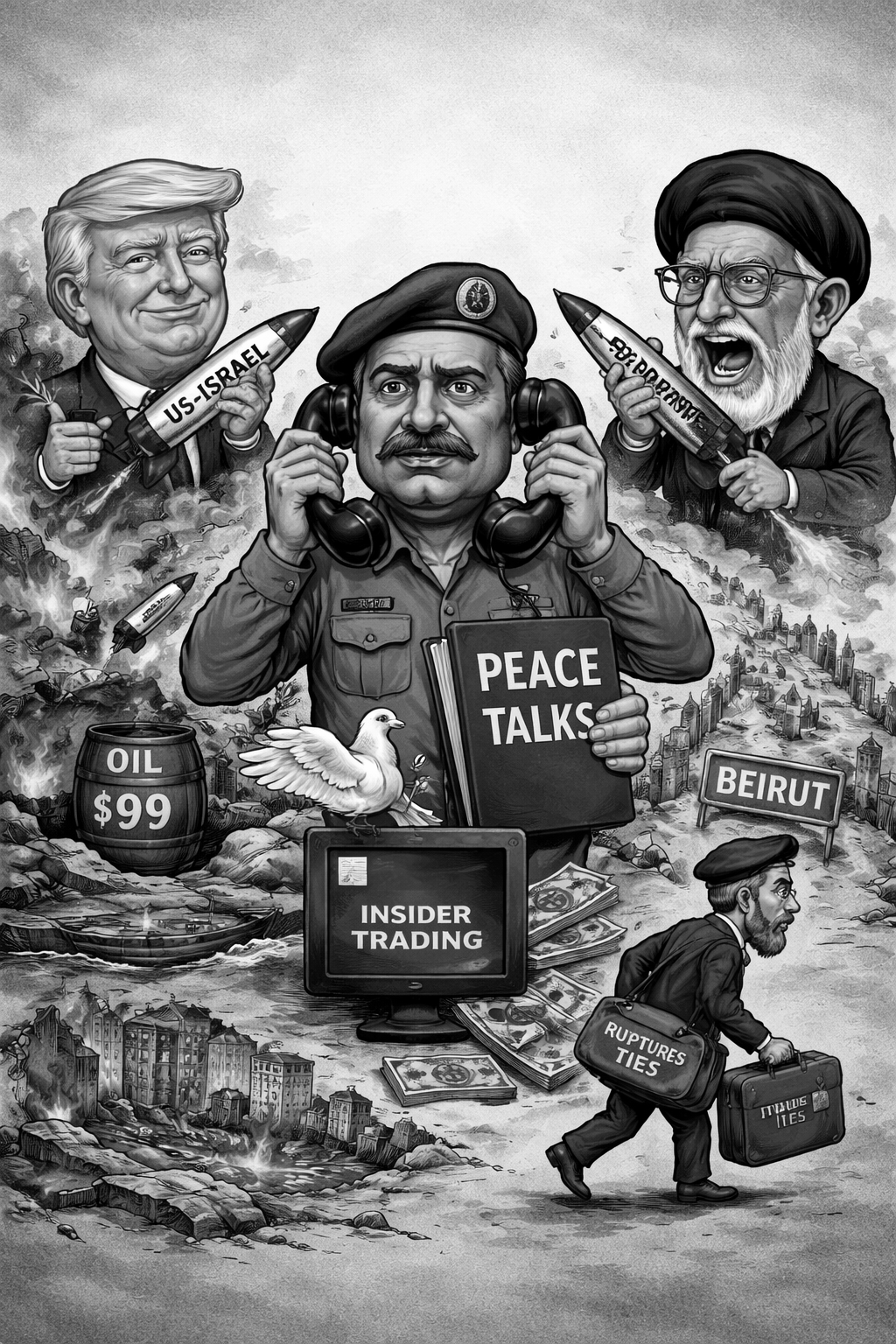
Middle East war day 25: Pakistan's lonely mediation - calling everyone, convincing no one
Day 25 of the war opens with a relentless conflict where missiles, markets, and political ambitions collide in real time.
Ali Larijani is dead, killed in the US-Israeli strike on March 17. Iran's message to the world is chillingly clear: officials can be eliminated, but institutions endure . Mohammad Bagher Zolghadr steps into the role at a moment where optics carry as much weight as authority itself. In Tehran, pro-government crowds braved the rain , waving flags as leadership projected unyielding defiance , while the Strait of Hormuz remains closed and Trump’s 48-hour deadline quietly stretched to five days, with Washington now calling the situation "fluid"; Iran imposed a near-total internet blackout as protests erupted, chanting "Death to Trump" , signaling deep anger and resistance. Tel Aviv has endured seven waves of missile fire since midnight, with sirens over Dimona , several buildings damaged, and at least four civilians killed , while Iranian missiles reportedly featured edited images of Trump , making clear that diplomacy is secondary to military strategy . Lebanon is in crisis : Israeli strikes on Beirut’s southern suburbs destroyed bridges and infrastructure, trapping civilians and blocking aid to over one million displaced people , while Lebanon expelled the Iranian ambassador and recalled its envoy, blaming Iran for dragging the country into a war it never chose.
Markets responded sharply* to the chaos. Oil prices plunged *7% below $99 per barrel* following Trump's dramatic "Iran Means Business" announcement, only to recover above *$100* once Iran denied any progress. More troublingly, reports have emerged suggesting *Trump associates engaged in insider trading* , placing bets on US-Israeli military moves on Polymarket. The deeply unsettling question looms large: *who truly profits from this war?
Talks are stalled - if they exist at all. Iran claims messages have been relayed through friendly nations, Pakistan, Turkey, and Egypt but veteran negotiators have flatly denied any direct peace dialogue with the US. Pakistan is visibly desperate to mediate: Asim Munir called Trump , Shahbaz Sharif called Iran , and the Prime Minister publicly touted Pakistan's "constructive role", a post Trump reshared. Pakistan's urgency is no mystery: it simply cannot absorb soaring oil prices while teetering on the edge of bankruptcy. Trump, for his part, appears fixated on reshaping Iran's leadership , imagining a degree of control reminiscent of Venezuela, something Iran has made abundantly and unmistakably clear is not possible . Israel wants to keep fighting, while Trump appears most concerned with being recognized as the "winner" of the war, regardless of what victory actually looks like on the ground.
Iran's Defence Council has warned that attacks on the southern coast could trigger sea mines across the Persian Gulf . Military targets continue to be struck despite Trump delaying attacks on power plants. The IRGC branded Trump a "deceitful American president," insisting his contradictory behavior will not distract them from the battlefield. The message is unambiguous: there is no ceasefire .
Across the Gulf, Kuwait, Saudi Arabia, and Bahrain continue absorbing missile and drone attacks. Qatar has called for talks, and the UK has deployed short-range defense systems . The ripple effects are being felt globally: South Korea has cancelled regional trips; Japan , which depends on the Strait of Hormuz for 95% of its oil imports , watches with grave alarm; the Philippines has declared a national energy emergency . The International Energy Agency has described the situation as "worse than both 1970s oil crises combined."