
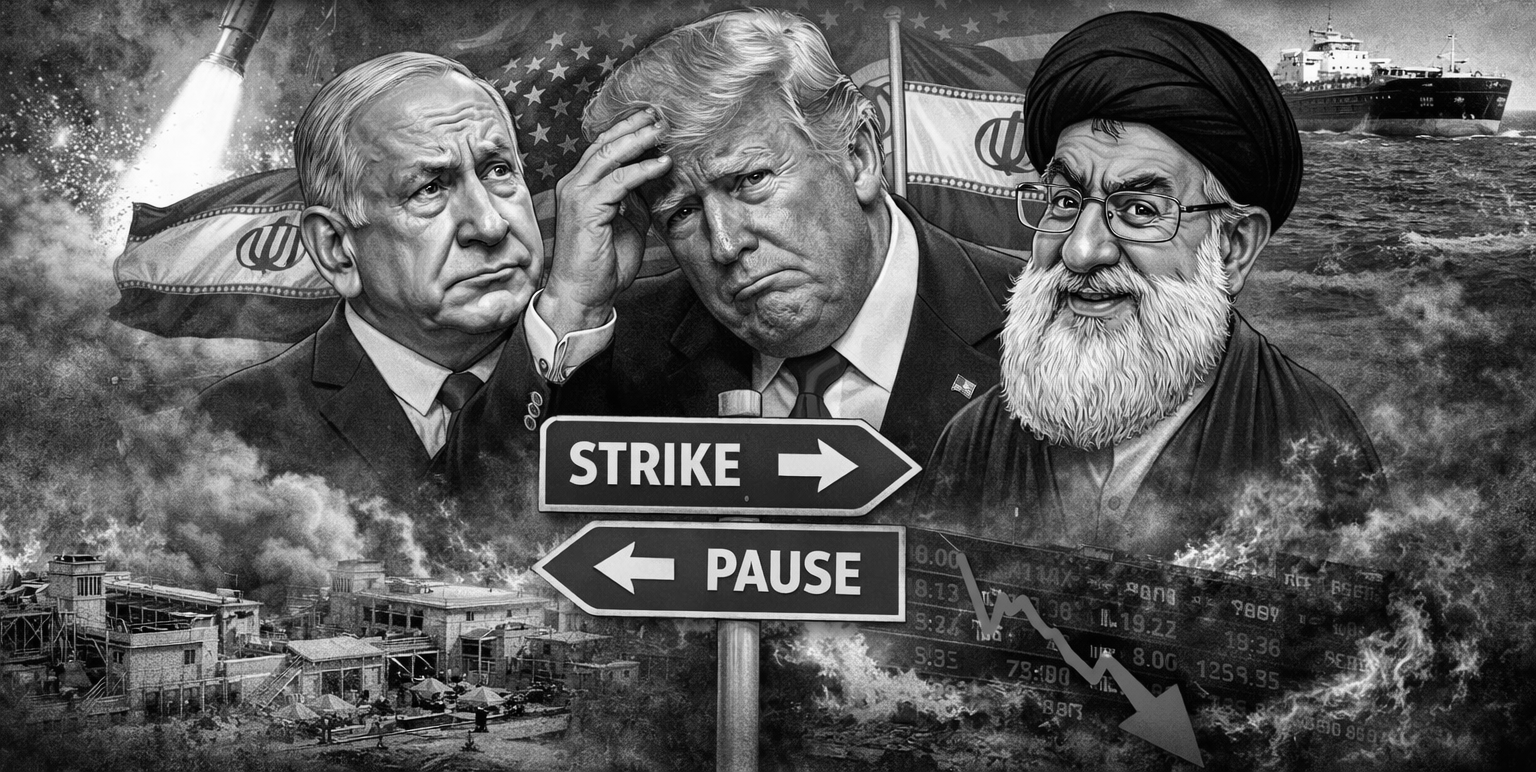
Middle East war, day 24: Trump signals first de-escalation - is the war ending soon?
The war launched by the United States and Israel against Iran lurched into its 24th day on Monday.
President Donald Trump had thundered into the week with a 48-hour ultimatum: Iran would reopen the Strait of Hormuz or face strikes on its electricity grid. The deadline expired Monday night at 23:44 GMT. What followed was not the promised hammer blow but a five-day pause , announced with characteristic Trumpian fanfare on Truth Social, written entirely in capital letters and graced with the kind of spelling that suggested the leader of the free world had not yet found the spellcheck button. "I AM PLEASE TO REPORT," the post declared, presumably meaning pleased , adding that negotiations were proceeding "WITCH WILL CONTINUE," a formulation that managed to evoke both a fairy tale and a witch hunt simultaneously. The pause, analysts suggested, was less a diplomatic masterstroke and more a panic break.
Beneath the bravado, a major strike had occurred. The US and Israel hit Iran’s Natanz nuclear facility , crippling vital infrastructure. Iran responded with missiles at Dimona , Israel’s secretive nuclear complex . The facility survived, but nearby towns were hit with lethal precision , injuring at least 180 people .It was, in the language of this war, a reply.
Iran’s approach has been cold and consistent : tit for tat without exception. Strike a nuclear site, face a strike near one. Hit power infrastructure, risk threats to your own. Attack drone facilities, find your fleet targeted. When the US hit a turbine engine plant in Qom, the IRGC responded with missiles and drones toward the Fifth Fleet in Bahrain. Israeli strikes that blacked out Tehran drew threats to Gulf energy and water facilities , from Riyadh to Abu Dhabi . Measured, deliberate, and utterly without sentiment, Iran has been playing chess while Trump has been flipping the board.
Which makes Trump himself the most dangerous variable in the room. His ultimatums materialize from nowhere, his deadlines expire into pauses , his pauses expire into threats , and his Truth Social dispatches , riddled with spelling errors and written in the caps lock of a man who has confused volume for authority , offer little clarity on what comes next.
Iran had no interest in playing along with Trump's narrative . Speaker Mohammad Bagher Ghalibaf called the pause announcement what it was: " fake news ," designed to calm markets and give Trump a false veneer of statesmanship . There were no US negotiations or talks with Supreme Leader Mojtaba Khamenei . Any back-channel discussions ran through Pakistan, Turkey, and Egypt , and Tehran refused to let Washington spin them into a summit . Trump's claim of " major points of agreement " on energy security was fiction, crafted for oil traders , not diplomacy.
On the ground, violence rebutted any talk of pause. The Israeli military struck Tehran’s infrastructure , with explosions tearing through central, southern, and eastern districts. Karaj , west of Tehran, appeared apocalyptic as fire and smoke rose over the city. One person died at a state radio transmitter in Bandar Abbas. In Urmia , air attacks flattened residential buildings, leaving rescuers to dig through rubble.
In Lebanon , Israel targeted bridges, cutting supply lines and shaping what looks like permanent occupation. Since March 2, strikes have killed at least 1,029 people , including over 100 children , per Lebanese authorities and the WHO . In Iraq , at least 60 were killed, mostly pro-Iran Popular Mobilisation Forces , with one foreign crew member dying near a port. Across the Gulf , the blast radius widened. Saudi Arabia intercepted one of two ballistic missiles; the IRGC claimed strikes on Prince Sultan airbase . In the UAE , air defenses downed a missile toward Abu Dhabi , injuring an Indian national . Kuwait protested Iranian airspace violations to the ICAO . In Qatar , a helicopter crash killed seven , including four military personnel and three Turkish nationals.
The Strait of Hormuz , a conduit for nearly a fifth of global oil, remained paralysed , sending China and Hong Kong stocks to year-low levels as stagflation fears spread. Rumors of Iranian transit fees on commercial vessels, denied by Tehran, unnerved markets.
In Washington, Senate Minority Leader Chuck Schumer called for an immediate end to US military operations against Iran. Senator Tim Kaine of Virginia accused Trump of sending Americans to war for political theatre, driven by a man still incapable of accepting he lost the 2020 election.
With Trump's chaos meeting Iran's cold, patient calculation, the region remains on edge, the world remains watching, and the pause, such as it is, holds for now, fragile as a ceasefire written in capital letters by a man who cannot spell pleased .