
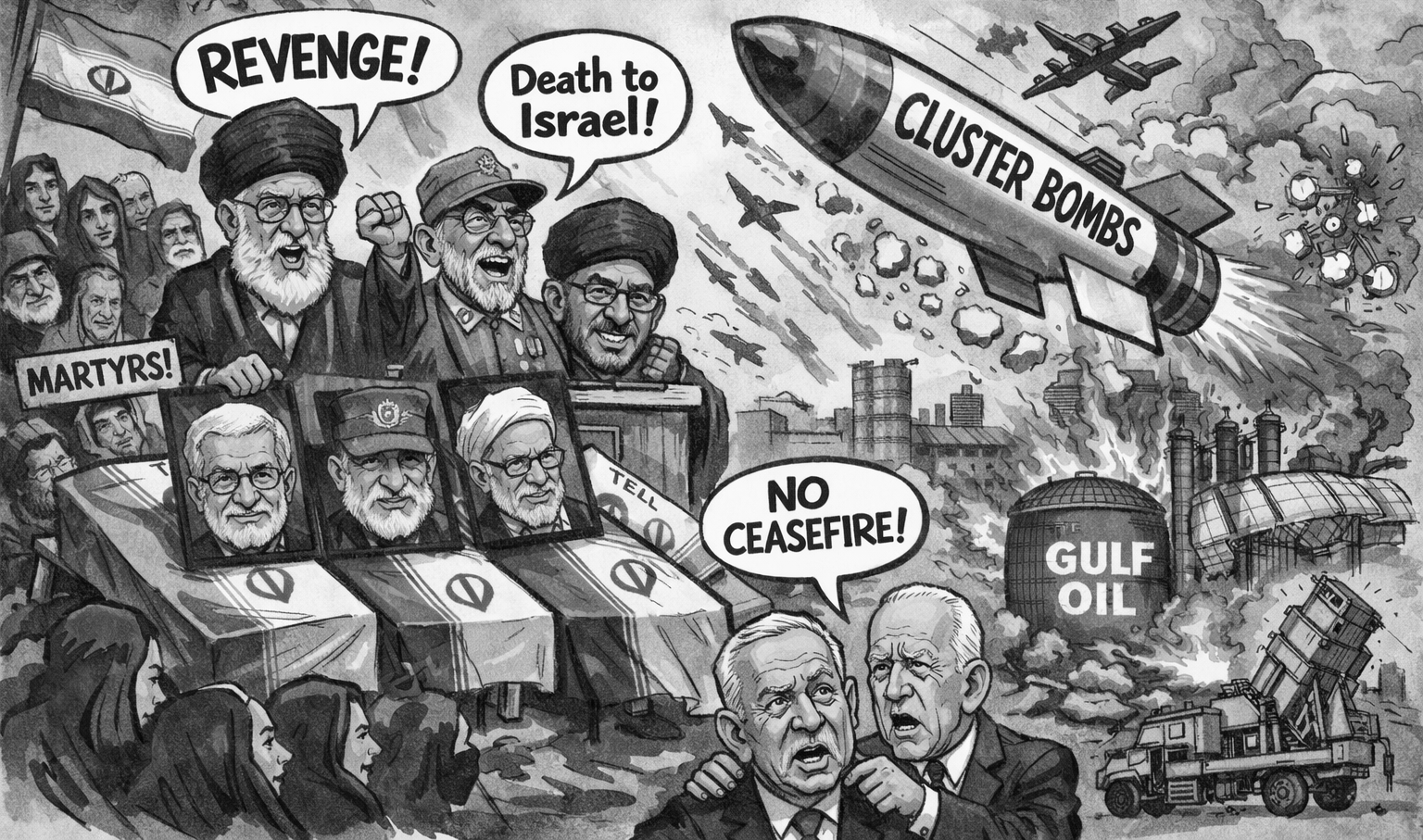
Middle East war, day 19: Iran buries its leaders and fires back harder
Day 19 of the US-Israel war on Iran has delivered the single most devastating cascade of leadership killings since the conflict began on February 28 - yet Tehran's response has not been to sue for peace. It has been to fire cluster bombs at Tel Aviv , threaten Gulf energy infrastructure, and slam the door on any ceasefire. The theory that decapitation leads to collapse is being stress-tested in real time, and so far, Iran is failing to oblige.
Three of the Islamic Republic's most powerful figures are now dead within 24 hours. Security chief Ali Larijani was killed overnight by an Israeli airstrike, confirmed by Tehran only after Israel announced itl1. Basij force commander Gholamreza Soleimani was killed alongside his deputy in a separate strike. And then, on Wednesday, Israel confirmed a third killing: Intelligence Minister Esmail Khatib . Iranian President Pezeshkian confirmed Khatib's death, calling it a "cowardly assassination," and vowed that severe revenge awaits the "terrorist criminals."
Mojtaba Khamenei has now spoken on Larijani's death: the criminals must pay, and soon. He has privately rejected all ceasefire proposals, reportedly telling Iranian officials it is not "the right time for peace" until the US and Israel "accept defeat and pay compensation." Israel's military has vowed to track Mojtaba down. Iran's army chief has warned the response will be "decisive and regrettable." This is not a regime in meltdown. It is a regime in revenge mode.
Revenge has arrived, exposing the fragility of the international rules-based order . Iran retaliated with cluster munitions —banned under international law and condemned by Amnesty International . Khorramshahr-4 missiles each release up to 80 bomblets across several miles, too fast and scattered for Israel’s Iron Dome to intercept fully. Two people in Ramat Gan , a couple in their 70s, were killed trying to reach shelter . Roughly half of all Iranian ballistic strikes on Israel have now used cluster bombs . The ban is unenforced; notably, the US has supplied cluster munitions to Ukraine . Like the Strait of Hormuz , the law is effectively closed .
Iran’s campaign is strategic . Its ballistic missile fleet has been degraded by three weeks of strikes, so it overwhelms Israel with geometry : one missile releases dozens of bomblets , depleting interceptors while terrorizing civilians . Hezbollah coordinates drone attacks from Lebanon to coincide with missile barrages, creating multi-front windows to saturate Israel’s defenses . Iran is built for this kind of dispersed, asymmetric war , designed to absorb decapitation and keep firing.
The US has deployed 5,000-pound bunker-buster bombs against hardened Iranian anti-ship missile sites along the Strait of Hormuz , which CENTCOM said threatened international shipping . Normally carrying 20% of the world’s oil , the strait has seen tanker traffic drop 70%. Eight non-Iranian vessels passed Monday, a tentative reopening that could reverse at any moment.
The energy war has escalated dangerously. US and Israeli forces struck South Pars , the world's largest natural gas field , shared with Qatar , along with nearby refineries . Qatar condemned the strikes as a "dangerous and irresponsible step" threatening global energy security . Iran's IRGC responded with evacuation warnings for workers at petrochemical facilities in Saudi Arabia , Qatar , and the UAE , signaling a direct threat to Gulf infrastructure. Alarmingly, a projectile struck the Bushehr nuclear power plant on Iran's Persian Gulf coast. The IAEA confirmed the hit but reported no radiation release . Bushehr, using Russian uranium , is operated by Rosatom technicians. Russia demanded immediate cessation of strikes on Iranian nuclear facilities, and the IAEA director general called for maximum restraint. No one is listening.
The chaos raises a bombshell question in Washington. DNI Tulsi Gabbard , in written testimony to the Senate Intelligence Committee, stated Iran's nuclear enrichment program was "obliterated" in last June's Operation Midnight Hammer" , with "no efforts since then to rebuild." She omitted this from her spoken remarks, seemingly to avoid contradicting President Trump . Senator Mark Warner pressed her: "You chose to omit the parts that contradict the president." The contradiction remains, under oath.
Before the war, Oman's foreign minister hailed a diplomatic breakthrough: Iran agreed never to stockpile enriched uranium , with full IAEA verification , and talks were set for March 2. Bombs fell on February 28. The talks never happened.
Markets are reacting. Bitcoin has risen ~7% to ~$73,500, outperforming traditional safe havens, while gold has fallen ~2%. The S&P 500 and Nasdaq are down. Institutional ETF inflows into Bitcoin hit $1.1 billion in three sessions. Meanwhile, Americans pay 86 cents more per gallon , a 29% spike in 18 days, as Hormuz disruptions throttle global oil supply. Russia's Deputy Prime Minister calls it "the worst energy crisis in 40 years."
Ukraine is involved in this war in both acknowledged and hidden ways . President Zelensky confirmed over 200 Ukrainian anti-drone experts are deployed across several Middle Eastern countries , helping Gulf states defend against Iranian-designed Shahed drones —the same drones Russia fires at Kyiv, now repurposed. Zelensky warned the Iran war is delaying Ukraine’s own peace prospects and draining Western attention .
Regionally, the conflict is total. Iranian missiles and drones have struck Saudi Arabia, Kuwait, Qatar, Bahrain, and the UAE . An Iraqi armed group claimed 28 drone strikes across three countries in 15 days. Israel struck Beirut overnight, killing 10, and issued its widest Lebanese evacuation orders since 2006, covering Tyre and three Palestinian refugee camps . At least four were killed in Israel’s strikes on the Bekaa Valley . Drones hit near the US embassy in Baghdad. Iraq is rerouting oil exports via the Kurdish pipeline to Turkey’s Ceyhan port , while Saudi Arabia hosts an emergency Arab and Muslim foreign ministers’ summit in Riyadh. NATO Secretary General Mark Rutte said the alliance is working to reopen Hormuz . US Central Command confirmed 13 American service members killed since the war began.
In contrast, FIFA confirmed the 2026 World Cup will proceed in the United States as scheduled, rejecting Iran’s request to move its matches to Mexico . British Airways extended its suspension of flights to Doha until April 30. Some things remain non-negotiable. Most things do not.