
Middle East war, day 18: Ali Larijani dead, does Iran still have anyone left to fight for it?
It began, as it has every morning for eighteen days, with sirens over Israel. Hezbollah launched a fresh attack on the northern Israeli city of Nahariya, wounding at least one person, while missile fragments - from interceptors and incoming rockets alike - rained down on Jerusalem's Old City, landing near the Al-Aqsa Mosque and the Church of the Holy Sepulchre , sending shockwaves through every faith community watching this war. Israeli Defence Minister Israel Katz declared that more than one million displaced Lebanese will not be allowed to return home until northern Israel is declared safe, as the Israeli military simultaneously announced "limited ground operations" inside Lebanon - a move German Chancellor Friedrich Merz swiftly condemned as an "error" that would "further exacerbate the already catastrophic humanitarian situation."
By nightfall, the war had grown darker and more unpredictable. Iran launched drones deep into Iraq, striking Baghdad's Green Zone with chilling precision. A luxury hotel for diplomats erupted in flames, and air defences barely stopped a rocket aimed at the US Embassy . Four were killed in a separate strike in Baghdad's Jadriya district. Kataib Hezbollah confirmed the death of senior commander Abu Ali al-Askari , while Iraq’s government, balancing Tehran and Washington, condemned the attacks as "terrorist acts," even as some factions quietly loaded launchers.
The UAE’s Fujairah oil zone was struck for the third time - same location, same smouldering infrastructure , same brazen message . Analysts call it Iran’s most self-defeating move : Fujairah lies outside the Strait of Hormuz , a vital alternative oil route that undermines Iran’s leverage. Each strike worsens the global oil crisis Iran seeks to weaponise , but hints at a worrying shift - Iran may now be hitting targets of opportunity rather than following a coherent strategy. Falling interceptor debris killed a Pakistani in Abu Dhabi’s Bani Yas . The UAE temporarily closed its airspace . Qatar shot down 13 of 14 ballistic missiles . Kuwait downed a drone and arrested 16 people, including two Lebanese nationals allegedly linked to Hezbollah , over a planned sabotage. Bahrain neutralised 129 missiles and 221 drones , while Saudi Arabia intercepted 12 drones over its Eastern region . The Gulf is ablaze . US forces struck Iranian missile launcher positions in retaliation, yet Iran pressed on .
In Washington, President Trump delivered what may be his most confounding performance of the war. He reversed course entirely on the Strait of Hormuz - declaring he does not need other nations to escort ships through the waterway, a stunning about-face from his demands just 24 hours earlier that Britain and France step up. More explosive was his admission that he was unsure whether Iran would target Gulf countries if attacked - despite Supreme Leader Khamenei having personally and explicitly threatened Gulf states in a direct address before the first bomb fell. Trump then went further, declaring: "All the leaders of Iran are dead. We don't know who we're dealing with." Tehran responded without flinching - Iran's leadership is alive, united, and prepared to fight "as long as it takes." Trump postponed his planned China trip by a month, telling reporters simply: "We've got a war going on."
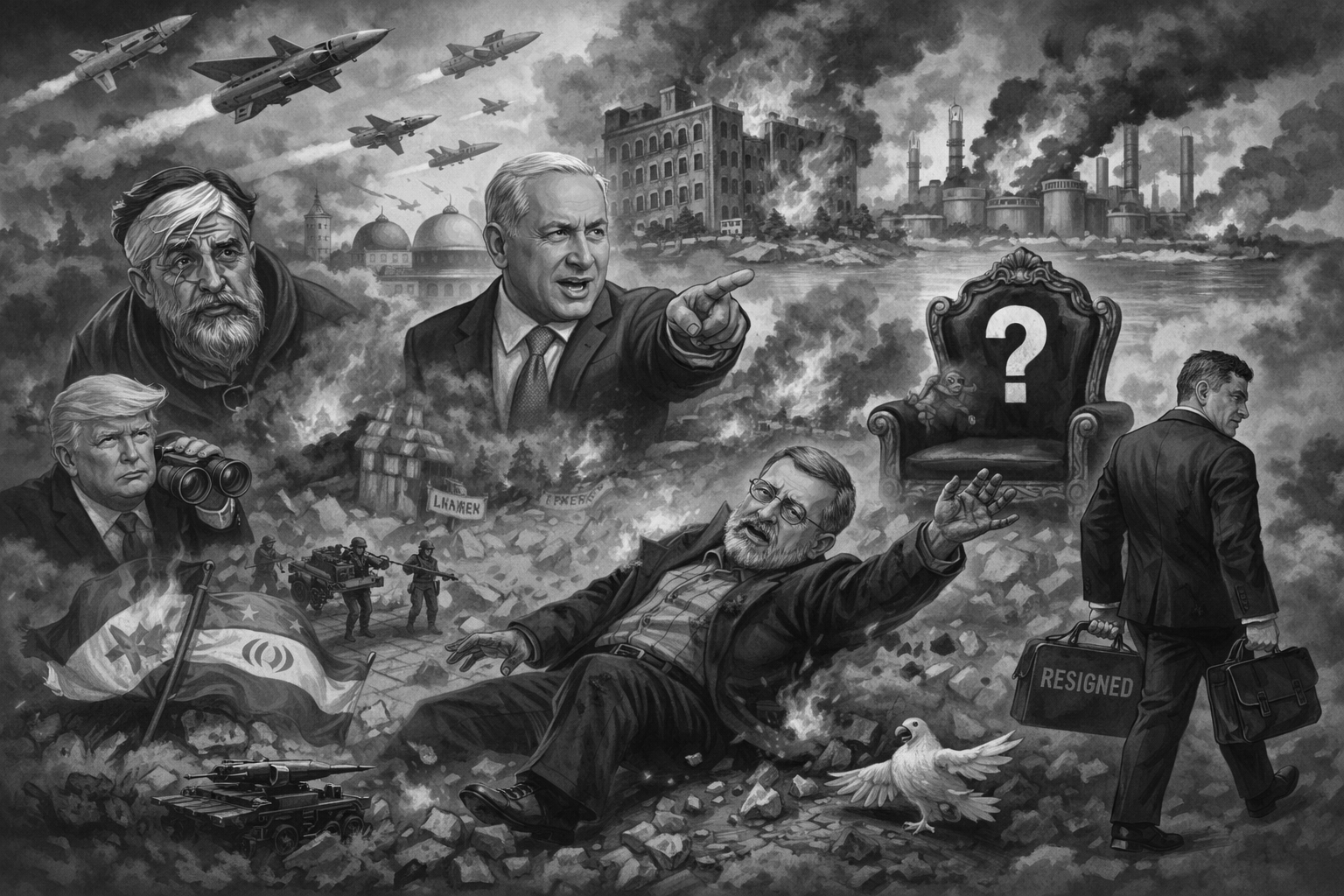
The most devastating blow to the White House, however, came not from Tehran but from within. America's Director of Counter-Terrorism resigned Monday , releasing a statement that landed like a grenade on Capitol Hill: Iran poses no imminent threat to the United States, he wrote, and Trump entered this war not out of national security necessity but under sustained pressure from Israel . Trump dismissed him with surgical coldness: "He is not a good person."
And then there is Ali Larijani . Netanyahu said Monday that Israeli forces tracked him to an apartment where he was sheltering with his son, and struck. "His loss," Netanyahu declared, "weakens Iran's entire structure." Tehran has neither confirmed nor denied it - but in a move dripping with symbolism, Iranian state media published a handwritten note bearing Larijani's signature , without date, without context, without explanation. To understand the magnitude of what may have been lost, understand who Larijani truly was: Speaker of Iran's Parliament for twelve unbroken years , the lead nuclear negotiator who faced down the West across conference tables, a philosopher, a hardliner, and a dealmaker rolled into one extraordinary man who could speak the language of war and the grammar of peace in the same breath. His family, one of Iran's most powerful and storied dynasties, is compared to the Kennedys . He was the irreplaceable one. The man who could talk to everyone and was trusted by all factions. With him gone, Iran loses not just a strategist but its most versatile bridge between hardliners and pragmatists , between the battlefield and the negotiating table.
Yet the name that haunts intelligence corridors even more tonight is Mojtaba Khamenei , the shadow architect of Iran's parallel power structure, and the most probable heir to the clerical throne . Rumours have swirled all day with mounting intensity: that he is dead, that he is gravely wounded, that Vladimir Putin quietly facilitated his transfer to Moscow for emergency medical treatment. Neither Tehran nor the Kremlin has uttered a single word. The silence itself is the story.
At home, Iran's casualties stand at 1,444 killed and 18,551 injured since February 28. Iranian President Masoud Pezeshkian declared that Iran did not start this war and will not surrender to "bullies." Israeli Prime Minister Netanyahu, in a move widely read as psychological warfare, sent Nowruz greetings to the Iranian people as the Persian New Year approaches - a message of peace delivered over the ruins of their cities.
If both Larijani and Mojtaba Khamenei are gone, Iran faces not merely a military crisis but a civilisational vacuum - its diplomacy, its succession, and its command structure fracturing simultaneously. The IRGC fires on. The drones keep flying. The missiles keep launching. But the question that no intelligence agency, no world leader, and no war room can answer tonight is the one that defines everything: Is Iran managing the fallout or has the fallout already begun managing Iran?