
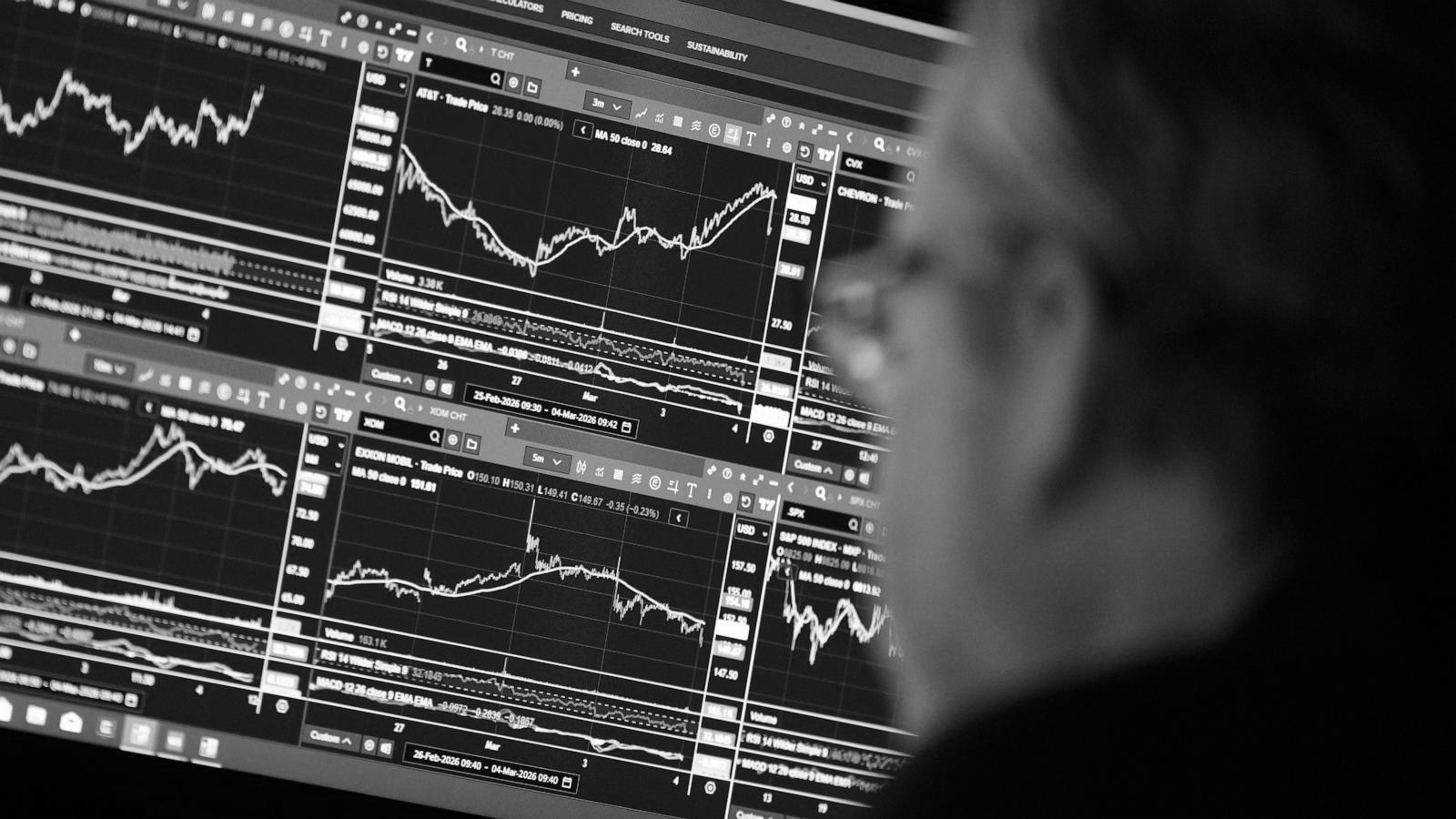
Middle East conflict sends Oil, Gas prices soaring, Markets mixed
Global markets remained on edge early Wednesday as rising tensions in the Middle East kept investors cautious, pushing oil prices higher and sending mixed signals across major stock markets.
Futures for the S&P 500 slipped 0.1 per cent before the opening bell, while futures for the Dow Jones Industrial Average fell 0.2 per cent. Futures tied to the Nasdaq Composite were largely unchanged.
Oil prices have surged about 11 per cent in global markets since the United States and Israel launched attacks on Iran five days ago, reflecting fears of possible supply disruptions from the Middle East. The tension is centred around the Strait of Hormuz, a critical route through which roughly one-fifth of the world’s oil supply passes. However, despite the overall surge in recent days, prices eased slightly in early trading , with the US benchmark crude slipping to about USD 73.94 per barrel and Brent crude falling 37 cents to around USD 81.03 per barrel, indicating short-term market fluctuations amid the broader upward trend.
US President Donald Trump said Washington could deploy naval escorts for oil tankers moving through the strait if needed. In a social media message shared by the White House, Trump also announced that the U.S. International Development Finance Corporation would provide political risk insurance and financial guarantees to support maritime trade amid the escalating conflict.
In the US, gasoline prices have already risen sharply, climbing 22 cents in a week, according to the American Automobile Association .
European markets showed resilience, with Germany’s DAX gaining 1.3 per cent, while France’s CAC 40 rose nearly 1 per cent and Britain’s FTSE 100 added 0.8 per cent.
Asian markets, however, saw steep losses. South Korea’s Kospi plunged 12.1 per cent, prompting temporary trading halts, while shares of Samsung Electronics and SK Hynix tumbled sharply. Japan’s Nikkei 225 dropped 3.6 per cent, reflecting concerns among economies heavily dependent on energy imports from the Persian Gulf.
Meanwhile, safe-haven assets gained ground, with gold rising 1.2 per cent and silver climbing 2.6 per cent as investors sought protection from market volatility.
Analysts said the measures may reduce immediate fears but are unlikely to eliminate the risk premium tied to the conflict. Mizuho Bank noted that higher insurance costs for shipping could add between USD 5 and USD 15 per barrel to oil prices.
The geopolitical uncertainty has rattled global markets, with investors worried that prolonged conflict could drive up inflation and limit the ability of the Federal Reserve to cut interest rates.