
‘Media publicity’: SC dismisses Jairam Ramesh’s plea on retrospective green clearances
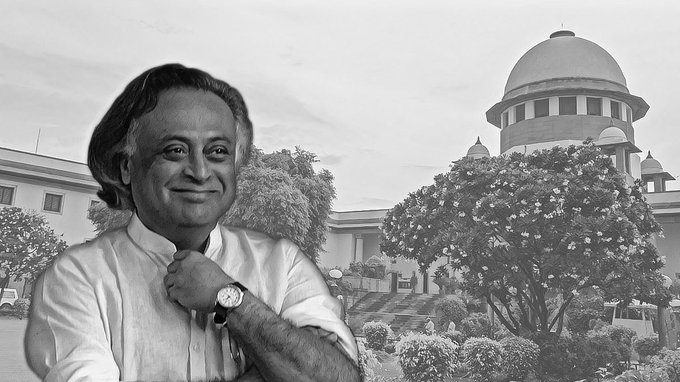
The Supreme Court on Thursday dismissed a writ petition filed by Congress leader Jairam Ramesh challenging the grant of retrospective environmental clearances to development projects, describing the move as an apparent attempt at “ media publicity .” A bench of Chief Justice Surya Kant and Justice Joymalya Bagchi questioned the maintainability of the plea, warning the petitioner of exemplary costs , and ultimately permitted him to withdraw the petition with liberty to pursue remedies in accordance with law. The court warned of exemplary costs and ultimately permitted the petitioner to withdraw the plea, granting liberty to pursue remedies in accordance with law.
The petition revolved around a matter of significant environmental policy: the grant of retrospective or “ex‑post facto” environmental clearances to projects that commenced operations without obtaining mandatory prior approval under India’s Environment Impact Assessment (EIA) framework. Retrospective clearances regularise environmental violations after a project has already begun, instead of ensuring compliance beforehand, which is central to sustainable development.
Retrospective clearances first emerged from a 2017 notification issued by the Ministry of Environment, Forest and Climate Change (MoEFCC), followed by a 2021 office memorandum and Standard Operating Procedure, allowing violators to apply for regularisation by paying heavy penalties. Proponents argued that this mechanism brought unregulated projects into compliance and preserved economic value, preventing wastage of investments in essential infrastructure.
However, critics including environmental lawyers and activists have raised fundamental objections. They argue that such clearances undermine the precautionary principle , weaken public participation in environmental decision-making, and reward willful violations. Many experts contend that ex-post facto approvals contradict the Constitutionally recognised right to a clean and healthy environment and the principle of equality before law.
The controversy reached the Supreme Court in the case of Vanashakti v. Union of India , where a two-judge bench in May 2025 struck down retrospective clearance, declaring it illegal and arbitrary. The ruling reaffirmed strict compliance with prior environmental assessment requirements. In November 2025, however, a three-judge bench reversed this position by a 2:1 majority, citing the potential demolition of vital public projects worth nearly ₹20,000 crore if clearances were barred. Justice Ujjal Bhuyan dissented, emphasising that ex-post facto clearance violates environmental jurisprudence.
Ramesh’s petition challenged the framework implemented through a January 2026 government memorandum following the Supreme Court’s majority ruling. During the hearing, the bench stressed that a writ petition cannot serve as a backdoor review of a judgment, leading to the withdrawal of the plea.
Observers warn that reinstating retrospective clearances risks diluting environmental credibility and could incentivise repeated violations of environmental law, while others argue that extreme rigidity could jeopardise critical infrastructure already under execution. The Supreme Court’s handling of such petitions, and the legal contours of retrospective environmental clearance , remain central to ongoing legal and policy debates.