
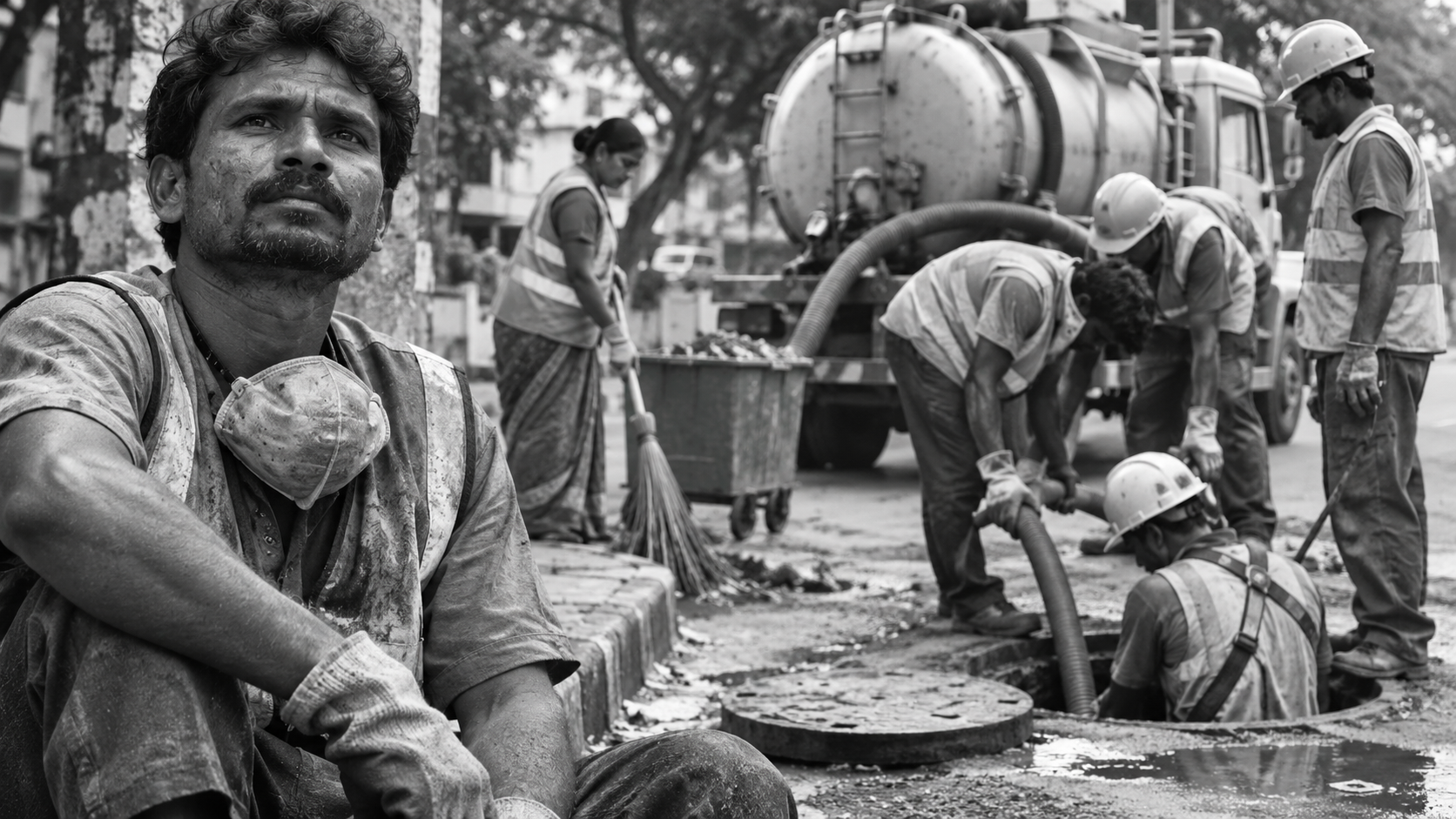
Mechanisation, Safety and Dignity: The Unfinished Agenda for Sanitation Workers
Even as the Telangana Government strengthens social security measures for gig and platform workers through a dedicated welfare framework, questions are emerging over the protection available to another section of the workforce that performs some of the country's most essential and hazardous jobs. Recent discussions by the National Commission for Safai Karamcharis with Hyderabad municipal authorities have brought sanitation workers' demands for better salaries, medical insurance, provident fund benefits and improved working conditions back into focus, highlighting the need for a comprehensive welfare mechanism.
At a meeting on November 22 involving GHMC and other municipal corporation representatives, National Commission member Karam Singh Karma reportedly called for salary revision proposals and medical insurance coverage for sanitation workers. Discussions also covered minimum wages, provident fund payments, equal pay for equal work, protective equipment, promotions and welfare facilities in workers' colonies. Opportunities in mechanised sweeping and electric vehicle charging infrastructure were also discussed. However, these remain proposals and directions requiring further administrative action.
The development comes shortly after Telangana launched the Platform-Based Gig Workers (Registration, Social Security and Welfare) Rules, 2026, on November 14. The framework provides for a dedicated welfare board, online registration, identity cards, ₹5 lakh life insurance and health coverage of up to ₹10 lakh through Rajiv Aarogyasri. With safeguards relating to minimum remuneration, payment transparency and arbitrary account deactivation, the state has established a dedicated institutional framework for platform workers. This raises a broader question about why comparable arrangements have not been developed for sanitation workers.
Central welfare schemes and their reach
At the national level, the National Action for Mechanised Sanitation Ecosystem (NAMASTE) is the principal initiative aimed at improving the safety, dignity and livelihoods of sanitation workers. Launched in 2023-24 by the Ministries of Social Justice and Empowerment and Housing and Urban Affairs, the programme seeks to eliminate hazardous manual cleaning of sewers and septic tanks through mechanisation, occupational training, protective equipment and health insurance. Its provisions include worker identification, PPE distribution, financial assistance for mechanised cleaning equipment and Emergency Response Sanitation Units.
The programme was expanded in 2024-25 to include waste pickers, extending support through protective equipment, skill development, health coverage and livelihood assistance. According to the Ministry of Social Justice and Empowerment, 90,186 sewer and septic tank workers had been validated by September 22, 2026, while more than 87,008 PPE kits and 753 emergency response sanitation equipment sets had been distributed. The programme had also profiled 2,51,756 waste pickers across 34 States and Union Territories. These figures indicate progress in identifying workers and extending safety assistance, although registration and equipment distribution do not necessarily establish improvements in working conditions.
The earlier Self Employment Scheme for Rehabilitation of Manual Scavengers (SRMS) has been subsumed under NAMASTE. Its rehabilitation provisions include one-time financial assistance of ₹40,000, skill development, training stipends and capital subsidies to help identified manual scavengers and their dependants move towards alternative livelihoods. While all 58,098 manual scavengers identified through the 2013 and 2018 surveys reportedly received the one-time assistance, only 5,632 manual scavengers and their dependants received skill training and 483 beneficiaries obtained capital subsidies during 2023-24 to 2025-26. The figures raise questions about whether financial assistance is translating into sustainable alternative employment.
Occupational deaths expose safety gaps
Despite the introduction of mechanisation and welfare initiatives, fatalities during sewer and septic tank cleaning continue to expose weaknesses in implementation. According to a Lok Sabha reply in August 2026, 498 sanitation workers died during hazardous sewer and septic tank cleaning between January 2019 and June 30, 2026. The country recorded 132 deaths in 2019, 34 in 2020, 62 in 2021 and 88 in 2022. The number subsequently declined to 65 in 2023, 54 in 2024 and 47 in 2025, while 16 deaths were reported during the first six months of 2026.
Independent figures attributed to the Safai Karmachari Andolan present a contrasting trend, recording 93 deaths in 2022, 102 in 2023, 116 in 2024 and 121 in 2025. The difference between the official and independent figures raises questions about the reporting and documentation of hazardous sanitation-related deaths. The two datasets have different reporting methods and should not be treated as directly interchangeable.
The distinction between manual scavenging and hazardous sewer cleaning is important. Manual scavenging, as defined under the Prohibition of Employment as Manual Scavengers and their Rehabilitation Act, 2013, involves prohibited handling of human excreta in specified conditions. Hazardous sewer and septic tank cleaning is a separate category involving dangerous operations, particularly when workers enter confined spaces without prescribed safety precautions. The Centre's fresh nationwide survey in 2024-25 did not identify any manual scavengers, but this does not mean that hazardous sanitation work has disappeared.
Compensation and legal protection
The Supreme Court's October 2023 judgment in Dr. Balram Singh v. Union of India strengthened protections by increasing prescribed compensation for sewer-related deaths to ₹30 lakh. It also provided for minimum compensation of ₹10 lakh for sewer-related disabilities and at least ₹20 lakh in cases of permanent disability resulting in economic helplessness. The judgment called for complete mechanisation, stronger contractor accountability and rehabilitation measures for affected families.
However, compensation remains an important concern. Between January 2021 and June 2026, the government reported 332 deaths during hazardous cleaning operations. Full compensation had been paid in 268 cases and partial compensation in 18, while 46 cases were not reported as having received full compensation. Another parliamentary disclosure recorded 123 FIRs in connection with hazardous sewer and septic tank cleaning between January 2023 and June 2026. These figures underline the need for stricter enforcement and timely assistance to affected families.
Budget allocations and expenditure gaps
Financial support for sanitation-worker rehabilitation has also witnessed considerable fluctuations. Under SRMS, allocations increased from ₹85.76 crore in 2018-19 to ₹99.93 crore in 2019-20 before falling sharply to ₹30 crore in 2020-21. Funding subsequently recovered to ₹43.31 crore in 2021-22 and ₹70 crore in 2022-23. Under NAMASTE, the budget estimate rose from ₹97.41 crore in 2023-24 to ₹116.94 crore in 2024-25 and ₹130 crore in 2025-26. However, it was reduced to ₹110 crore in the 2026-27 Union Budget, a decline of 15.4 per cent.
Actual expenditure also reveals gaps between allocations and spending. Against a revised estimate of ₹70 crore under SRMS in 2022-23, expenditure was only ₹11.10 crore. NAMASTE expenditure increased from ₹30.06 crore in 2023-24 and ₹35.64 crore in 2024-25 to approximately ₹97.68 crore in 2025-26. The Centre has also acknowledged that it does not maintain data on the average income improvement resulting from mechanisation, highlighting the need to assess welfare outcomes beyond financial expenditure.
Telangana's implementation and the way forward
Telangana initiated steps to implement NAMASTE through its municipal administration system, envisaging a State Coordinator and 55 Project Management Units to support urban local bodies. A parliamentary reply in July 2026 reported that 3,817 sewer and septic tank workers had been validated in Telangana and 3,807 PPE kits provided. The state also reported nine deaths during hazardous cleaning between 2021 and June 2026. Meanwhile, GHMC's substantial outsourced sanitation workforce raises questions about wage security, provident fund contributions, medical insurance and employment continuity when contractors change.
Although Telangana's 2026-27 Budget allocated ₹17,907 crore to Municipal Administration and Urban Development, ₹11,784 crore to Scheduled Caste Development and ₹998 crore to Labour and Employment, these are broad departmental allocations rather than funds exclusively earmarked for sanitation workers. The actual expenditure reaching this workforce needs to be established through detailed departmental records.
Telangana could consider establishing a dedicated Sanitation Workers Welfare Board and an integrated digital portal covering registration, health insurance, accident compensation, education assistance, pension support, skill development and grievance redressal. Stronger monitoring of contractors, occupational healthcare, mechanisation and alternative livelihood opportunities are equally important. The objective should be to ensure that every sanitation worker, irrespective of employment arrangement, has access to fair wages, workplace safety and long-term social security.
As governments expand welfare initiatives for different categories of workers, the people responsible for keeping cities clean should not remain outside the larger conversation on economic security and social justice.