
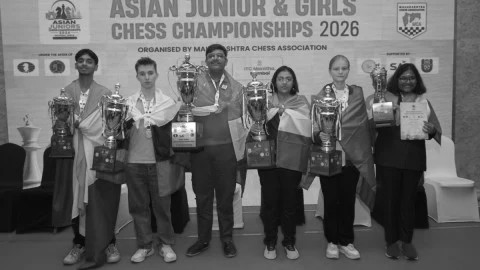
Mayank Chakraborty, Pratitee Bordoloi Lead India to Golden Double at Asian Junior Chess Championship
India’s junior chess contingent produced a standout performance at the Asian Junior Classical Chess Championship in Mumbai, completing a golden double and capturing four of six available medals.
Top seed Mayank Chakraborty lived up to expectations in the Open section, finishing the nine-round championship with 7.5 points. His gold-medal performance also brought another Grandmaster norm, strengthening the credentials of the GM-elect.
In the Girls section, Pratitee Bordoloi matched Mayank’s 7.5-point tally to claim the title and complete India’s double. Her triumph was particularly significant as she earned the Woman International Master (WIM) title and a Woman Grandmaster (WGM) norm, strengthening her international career.
India’s success extended beyond the champions. Daksh Goyal won Open bronze with 6.5 points, earning the FIDE Master (FM) title and an International Master (IM) norm. In the Girls event, Nivedita V C also scored 6.5 points to take bronze and secured a WIM norm.
The remaining silver medals went to Artem Pingin of Russia, who scored seven points in the Open, and Mariya Kholyavko of Kazakhstan, who finished on seven points in the Girls section. Mariya also earned a WIM norm.
India’s four-medal haul — two gold and two bronze — accounted for two-thirds of all medals in the Classical Championships. Russia and Kazakhstan shared the remaining two silvers.
The results underline that India’s junior strength is not limited to individual stars across Asia. Mayank’s title reinforces an established elite pathway, while Daksh’s bronze demonstrates the depth emerging behind the leading names. In the Girls section, Pratitee’s title and Nivedita’s bronze highlight a promising pipeline of young women capable of challenging strong Asian opposition.
The multiple FIDE achievements make the success even more encouraging. Norms and titles gained in a continental championship can provide crucial momentum as these players progress toward senior international chess.
Overall, the Mumbai campaign points to a broad and increasingly competitive Indian junior chess base. The next challenge will be converting this promising junior dominance into sustained success at the senior level.