
Maps That Moved, Reefs That Vanished: Rahul Gandhi Puts India's ₹81,000 Cr Nicobar Project in the Dock
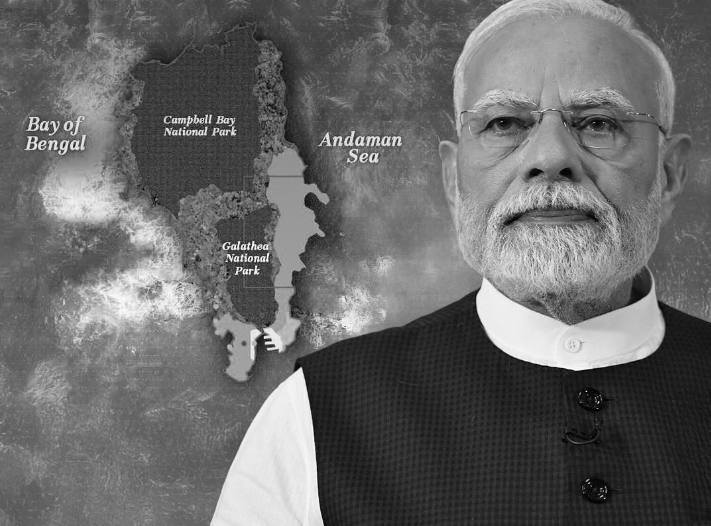
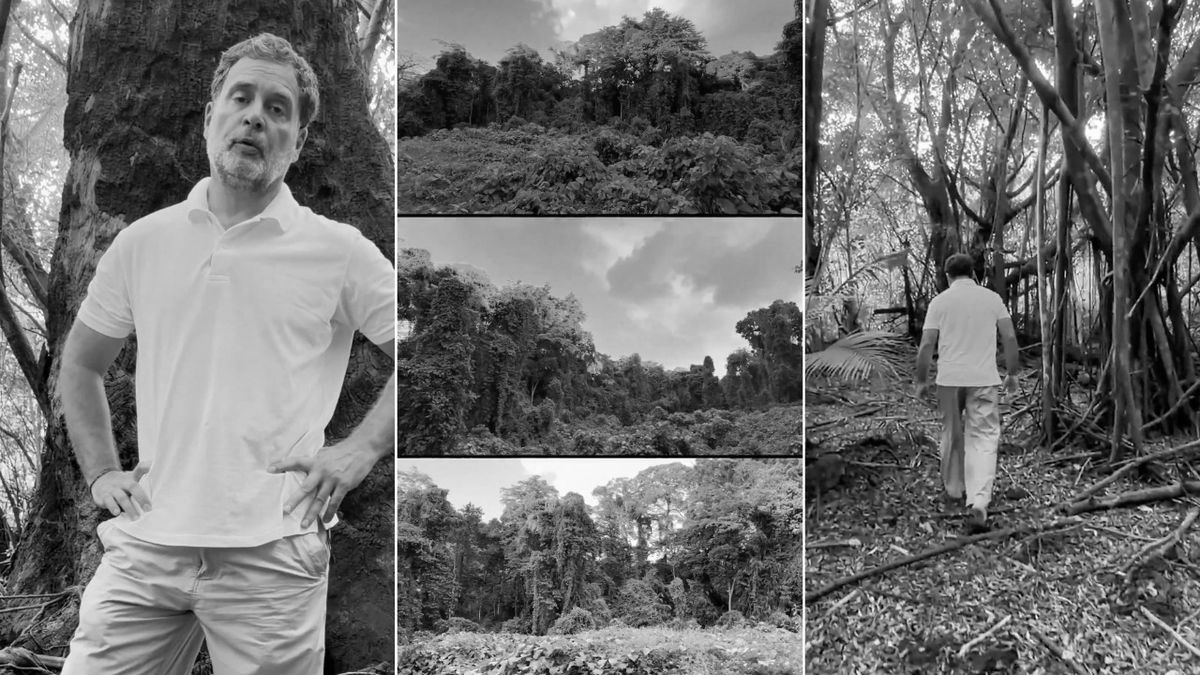
When Rahul Gandhi stood in the ancient rainforests of Great Nicobar Island and called the government’s ₹81,000 crore development project “destruction dressed in the language of development,” he was not speaking in a vacuum. Behind his words lies a long paper trail of altered maps, denotified sanctuaries, contested tribal rights, and fragile ecosystems now at the centre of one of India’s most debated infrastructure plans.
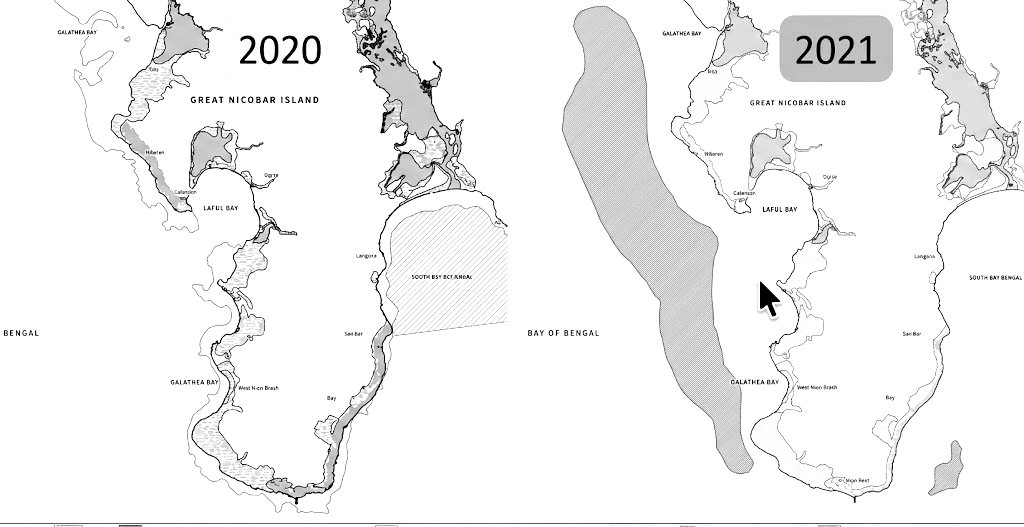
The controversy begins with a map. Between 2020 and 2021, official coastal charts of Great Nicobar prepared by the National Centre for Sustainable Coastal Management (NCSCM) under the Ministry of Environment, Forest and Climate Change were revised. In the 2020 version, coral reefs lined the southern and western coasts, including Galathea Bay , proposed for a major transshipment terminal. In the 2021 update, those same reefs appeared far offshore, away from the shoreline.
Marine scientists flagged the anomaly. Bathymetric analysis showed that the newly marked coral zones were in waters over 80 feet deep , where coral reefs cannot naturally survive.
The change carried major regulatory consequences. The 2020 map had classified much of the island as CRZ-IA , a zone where port construction is strictly prohibited. By 2021, Galathea Bay was removed from this classification. In the same period, the Galathea Bay Wildlife Sanctuary , earlier notified for marine turtle conservation since 1997, was denotified, clearing the way for infrastructure planning.
The government maintains that these updates were based on scientific reassessment and due process , and that environmental clearances followed established procedures.
What lies beneath Galathea Bay is ecologically significant. It is one of the key nesting sites for the giant leatherback turtle , a species that has existed for nearly 100 million years . These turtles travel vast ocean distances to return to the exact beaches where they were born. Scientists warn that disruption to this habitat could have irreversible consequences for the species in the Indian Ocean region.
Beyond the coastline, the geological risks are equally serious. Great Nicobar lies near the same seismic fault line responsible for the 2004 Indian Ocean tsunami , which caused parts of the island to sink by nearly 15 feet. Experts have also warned about earthquake and volcanic risks in the Nicobar region, raising concerns over the safety of large-scale coastal infrastructure projects planned in the area.
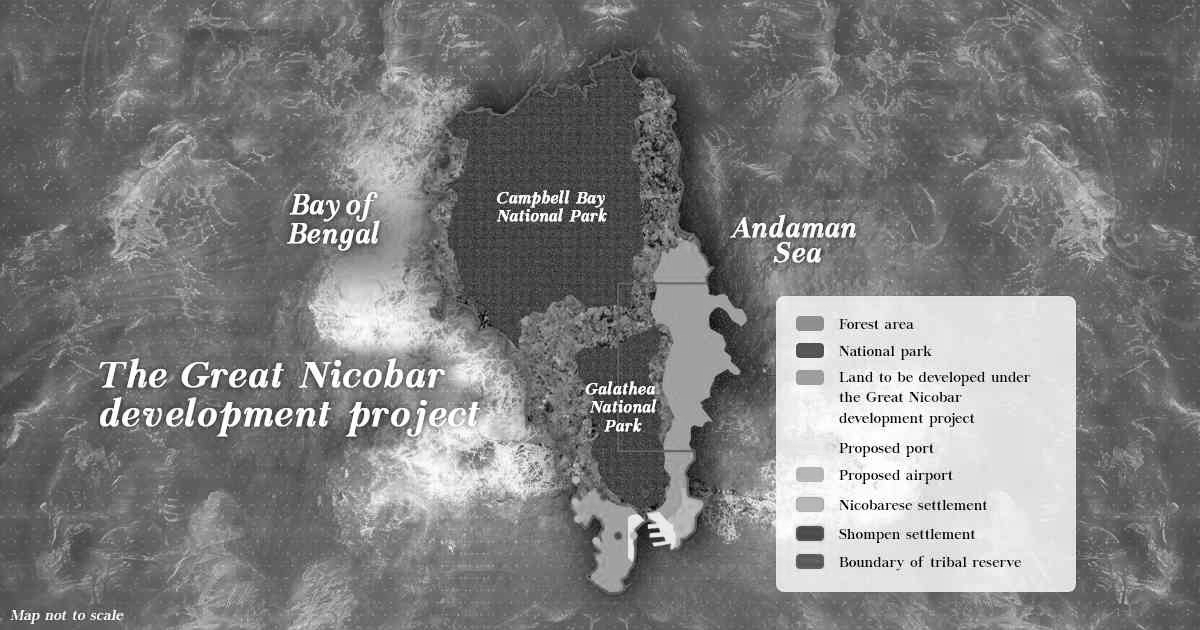
Ecologically, the island is among the most sensitive in India. Over 85 percent of Great Nicobar is a UNESCO-designated biosphere reserve , home to dense tropical rainforests and more than 1,700 endemic species . The project reportedly involves clearing around 130 sq km of forest , with initial estimates suggesting the loss of nearly one million trees.
The tribal dimension adds another layer of complexity. The project footprint overlaps with Shompen and Nicobarese tribal reserve areas , raising concerns under India’s Forest Rights Act, 2006 , which requires community consent before diversion of forest land. The issue of whether proper consent procedures were followed remains under examination, with tribal rights authorities seeking clarifications from the administration.
The most vulnerable group is the Shompen tribe , a Particularly Vulnerable Tribal Group with an estimated population of around 300. In 2024, international experts warned that large-scale population influx could pose existential risks to their survival due to disease exposure and cultural disruption.
On the commercial side, major port developers, including Adani Ports & SEZ , have shown interest in the Galathea Bay project. The government, however, defends the plan as strategically essential. It argues that India currently depends heavily on foreign transshipment hubs and that Great Nicobar’s proximity to the Strait of Malacca , one of the world’s busiest shipping routes, makes it crucial for maritime trade and national security.
That strategic argument carries weight in policy circles. But so do the environmental and human concerns raised on the ground.
The central question now is whether a project of this scale built over shifting maps, sensitive seismic zones, ancient ecological systems, and the homeland of one of the world’s most isolated tribes has been evaluated with the depth it demands, or simply with the urgency of development.