
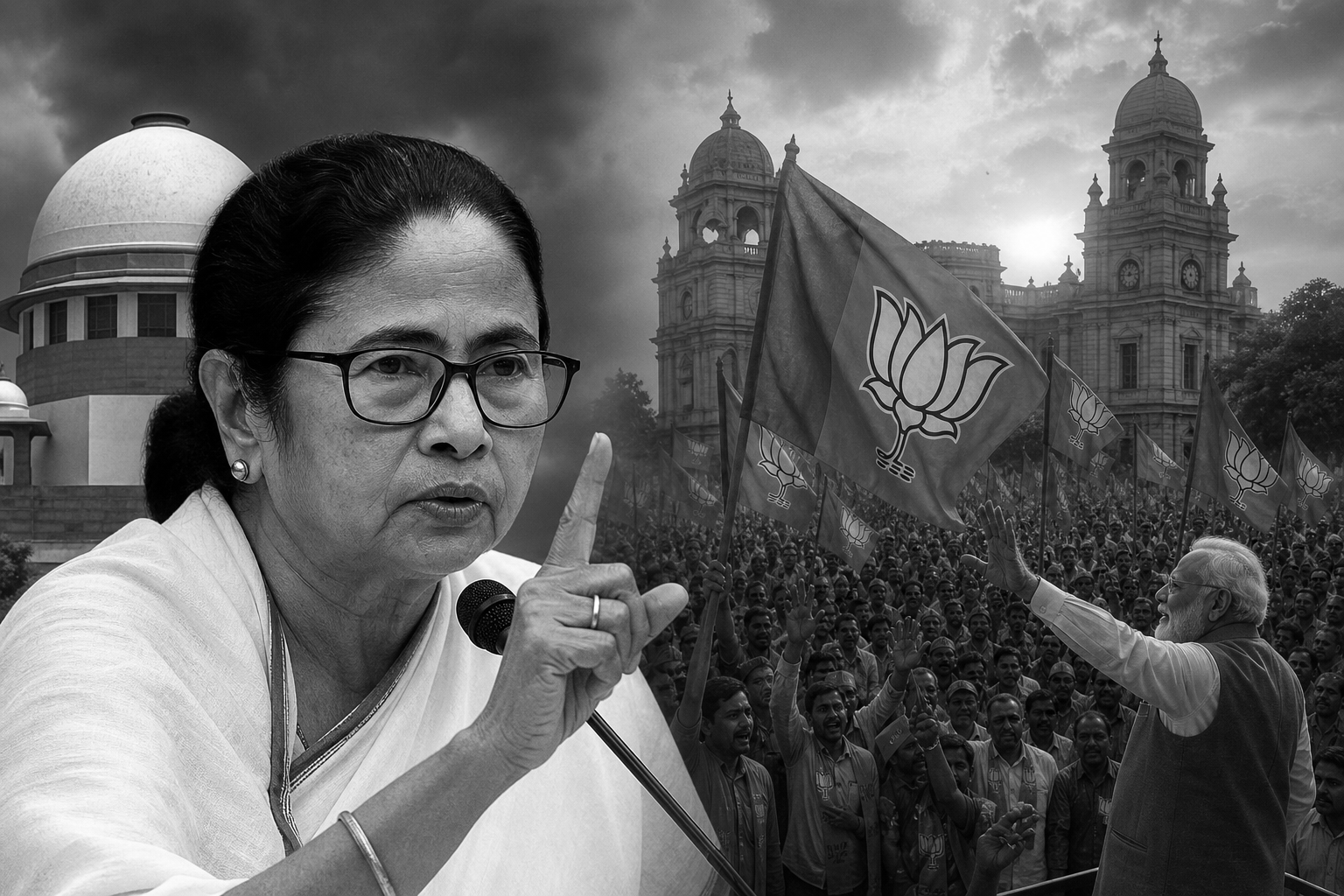
Mamata vs Mandate: Refusal, Resistance and a State in Transition
In a dramatic political turn, outgoing West Bengal Chief Minister Mamata Banerjee on Tuesday refused to resign after her party’s electoral defeat, alleging that the verdict was not a genuine public mandate but the outcome of a “conspiracy.” Her remarks came even as the Bharatiya Janata Party (BJP) secured a sweeping majority, ending the 15-year rule of the All India Trinamool Congress (TMC) in the state.
The setback was also personal. Contesting from Bhabanipur , Banerjee lost to BJP leader Suvendu Adhikari by a margin of over 15,000 votes , signalling a decisive swing even in her political stronghold and reflecting a broader erosion of TMC’s urban support.
At a charged press conference, Banerjee launched a direct attack on the Election Commission of India , alleging that her party’s fight was “not against the BJP, but against the Election Commission working for the BJP.” She claimed that results in nearly 100 constituencies were “looted,” accused authorities of deliberately slowing counting , and described the outcome as a “black chapter in democracy.” She also criticised Chief Election Commissioner Gyanesh Kumar , accusing him of undermining democratic rights.
Despite the clear verdict, Banerjee asserted, “The question of my resignation does not arise,” maintaining that she would adhere to constitutional norms while rejecting the legitimacy of the outcome. Constitutionally, a chief minister may remain in office until a successor is appointed. However, democratic convention requires stepping down after losing the majority placing the spotlight on Governor R.N. Ravi , who is expected to facilitate the transfer of power by inviting the BJP to form the government.
Historically, such refusals have occurred but rarely lasted. In 1998, Kalyan Singh resisted stepping down amid political instability, triggering a constitutional standoff resolved through a floor test. The same year, Jagadambika Pal briefly held office during a disputed majority, with the courts stepping in to restore order. More recently, B. S. Yediyurappa (2018) and Uddhav Thackeray (2022) delayed resignation until compelled by a floor test, while Nitish Kumar has navigated similar moments through strategic timing. These precedents underline a consistent pattern: constitutional mechanisms ultimately prevail , and no chief minister has retained office after conclusively losing majority.
Banerjee, meanwhile, announced a 10-member fact-finding committee to probe alleged post-poll violence and signalled a broader political pivot. She revealed that leaders of the INDIA bloc , including Sonia Gandhi and Rahul Gandhi , had reached out in solidarity hinting at her evolving role in national opposition politics .
The BJP’s emphatic victory crossing 200 seats in the 294-member assembly marks a historic shift in West Bengal’s political landscape. The surge is attributed to strong central leadership under Narendra Modi and Amit Shah , organisational expansion, and key defections led by Suvendu Adhikari. Analysts point to anti-incumbency , fragmentation of traditional vote banks , and a sharp voter shift in urban and semi-urban regions as decisive factors.
With the BJP set to form the next government, attention has turned to the chief ministerial choice , with Adhikari emerging as the frontrunner, alongside leaders like Dilip Ghosh and Samik Bhattacharya .
As West Bengal stands on the brink of a political transition , Banerjee’s refusal to concede despite losing both the state and her own seat has transformed the electoral outcome into a constitutional test . Whether through gubernatorial action, legal challenge, or political negotiation, the coming days are set to determine not just the state’s leadership, but also the contours of India’s evolving opposition politics.