
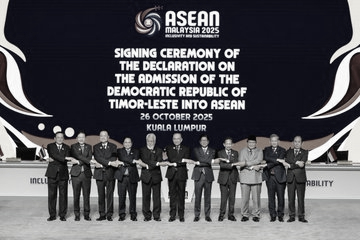
Malaysia hosts 47th ASEAN Summit 2025
The 47th ASEAN Summit 2025 in Kuala Lumpur, from October 26 to 28, showcased a landmark moment in Indo-Pacific diplomacy. From the five founding countries to the eleven members today, Malaysia continues to be a key driving force behind ASEAN’s growth, hosting the summit and facilitating high-level engagements. U.S. President Donald Trump arrived in Malaysia to kick off his first Asian tour of his second term, receiving a ceremonial welcome at the Kuala Lumpur Convention Center. In a display of cultural diplomacy, Trump joined Malaysian performers in a traditional dance alongside Malaysian Prime Minister Anwar Ibrahim, a gesture that captured global attention and underscored the informal yet strategic approach he brought to the summit.
ASEAN, founded in 1967 by Indonesia, Malaysia, the Philippines, Singapore, and Thailand, has evolved into a powerful regional bloc of eleven members, including Brunei, Vietnam, Laos, Myanmar, Cambodia, and most recently East Timor. It was created to promote economic growth, regional stability, and political cooperation amidst the Cold War era tensions in Southeast Asia. Over the decades, ASEAN has played a critical role in shaping regional multilateralism, facilitating conflict resolution, and advancing economic integration.
India’s engagement with ASEAN has had its own trajectory; initially underestimated, India was eventually recognized as a strategic partner and was invited to join ASEAN dialogues. In 2025, Prime Minister Narendra Modi participated virtually, emphasizing the ASEAN-India Comprehensive Strategic Partnership, welcoming East Timor as the bloc’s newest member, and declaring 2026 as the ASEAN-India Year of Maritime Cooperation. Modi’s address highlighted cultural ties, shared values, and the vision of a multipolar Indo-Pacific, while reinforcing India’s commitment to regional stability and economic collaboration.
President Trump actively engaged with Southeast Asian leaders during the summit, signing key trade agreements with Malaysia, Thailand, and Cambodia to reduce tariffs, enhance critical minerals cooperation, and counter China’s influence. One of the summit’s most notable outcomes was the expanded ceasefire agreement between Thailand and Cambodia, mediated by Trump, which included military de-escalation and prisoner exchanges, earning him international recognition and a Nobel Peace Prize nomination. Trump also discussed investment opportunities across the region, meeting with business leaders and regional officials to promote U.S. economic interests and demonstrate his trademark “trade touch” in Southeast Asia.
On the sidelines of the summit, Indian External Affairs Minister S. Jaishankar held discussions with South Korea’s Foreign Minister Cho Hyun, focusing on defense cooperation and semiconductor supply chain partnerships. The U.S. reiterated that its growing ties with Pakistan would not come at the expense of its relationship with India, as articulated by U.S. State Secretary Rubio, highlighting the balancing act in Washington’s South Asian policy. Public demonstrations in Kuala Lumpur concerning ongoing conflicts like Gaza reminded observers of the complex global reactions to U.S. foreign policy, underscoring the challenges of diplomacy in a globally connected world.
The 47th ASEAN Summit 2025 highlighted the dynamic interplay of diplomacy, trade, cultural engagement, and regional security initiatives. Malaysia’s role as host and key driver of ASEAN’s continued growth was evident throughout, while President Trump’s active presence and strategic agreements contrasted with Prime Minister Modi’s virtual but substantive engagement. The summit reinforced the significance of ASEAN as a platform for multilateral dialogue, highlighted India’s growing strategic importance in the region, and underscored the evolving geopolitical dynamics shaping the stability, economic growth, and strategic balance of the Indo-Pacific.