
Major blow to Maoists: Odisha leader surrenders, Jharkhand arms seized, Amit Shah vows eradication by Mar 31
India’s battle against left-wing extremism has entered a decisive phase, with coordinated security operations delivering major breakthroughs across Odisha and Jharkhand. The renewed momentum aligns with the Union government’s deadline of March 2026 to completely eliminate the insurgency, a target that officials say now appears firmly within reach.
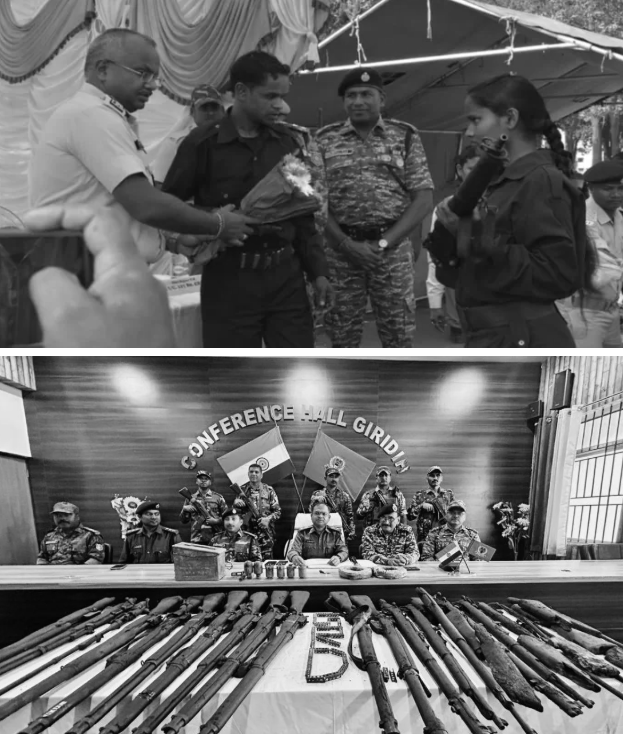
In one of the most significant setbacks to the Maoist movement in recent years, senior CPI (Maoist) leader Nikhil and his wife Rashmira Lenka alias Indu surrendered before the Odisha Police along with 13 other cadres. The mass surrender marked a major psychological and operational blow to insurgent networks operating in southern Odisha.
Both were state committee members carrying rewards of Rs 55 lakh each. The 15-member group, belonging to the Banshadhara-Ghumsar-Nagabali division, laid down 14 weapons, including two AK-47 rifles, five self-loading rifles, one INSAS rifle, one sten gun, one .303 rifle, four single-shot firearms and a large quantity of ammunition. The total reward on the surrendered cadres stood at Rs 1.98 crore.
They were formally welcomed into the mainstream at a function attended by ADGP (Anti-Naxal Operations) Sanjeeb Panda and other senior officials. Praising the sustained counter-insurgency efforts, Panda said, “ This surrender reflects the steadily weakening influence of Maoist ideology and the growing trust of misguided youth in the government’s development-oriented and people-centric approach. ” He added that Odisha is now close to becoming a naxal-free state, with only about 30 to 35 Maoists still underground.
Parallel operations in Jharkhand have further tightened the noose around extremist logistics and supply chains. In Giridih , a joint team of district police and the Central Reserve Police Force recovered a large cache of arms and ammunition from the Bhalki Hill area under Khukhra police station limits, acting on precise intelligence inputs. Superintendent of Police Bimal Kumar said 20 factory-made rifles, six grenades and one ammunition box were seized, all concealed in the hilly terrain.
In another breakthrough, Ranchi Police dismantled an illegal arms manufacturing unit in Sitadih village under Angara police station limits, seizing 19 fully manufactured single-barrel firearms, four partially manufactured weapons and equipment used to produce them. Police said the accused confessed during interrogation and was sent to judicial custody.
Adding to the momentum, Union Home Minister Amit Shah on Sunday emphasized that a combination of security-centric strategy, infrastructure development, disruption of Maoist financial networks and a robust surrender policy has yielded tangible results. Speaking after chairing a high-level security review meeting in Raipur, Shah asserted, “ Naxalism will be completely eradicated before March 31 .” The meeting was attended by Chhattisgarh Chief Minister Vishnu Deo Sai, Deputy Chief Minister Vijay Sharma, Union Home Secretary, top security officials, and directors general of CRPF, BSF, ITBP and NIA, alongside senior officers from Odisha, Jharkhand, Maharashtra, and Telangana.
Chhattisgarh’s Bastar region, a historical Maoist stronghold, has seen intensified anti-Naxal operations over recent years. Since January 2024, over 500 Naxalites, including senior cadres like CPI (Maoist) general secretary Nambala Keshava Rao alias Basavaraju, have been killed in encounters, around 1,900 arrested, and more than 2,500 surrendered.
Officials said the synchronized operations across Odisha, Jharkhand, and Chhattisgarh highlight the effectiveness of intelligence-led strategies, inter-agency coordination, and sustained pressure on extremist networks. With shrinking areas of influence, accelerating surrenders, and aggressive disruption of arms supply routes, the campaign against left-wing extremism appears to be approaching its final chapter.