
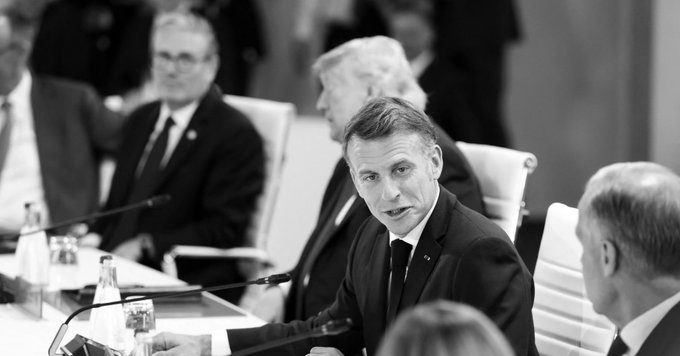
Macron, Carney Meet Off Canada Coast Amid Tensions With Trump
French President Emmanuel Macron and Canadian Prime Minister Mark Carney met Sunday in Saint Pierre and Miquelon, holding talks on economic, defence and strategic cooperation as Ottawa seeks closer ties with Europe amid strained relations with the United States under President Donald Trump.
The meeting in the tiny French territory off Canada’s Atlantic coast focused on energy, aerospace, critical minerals and advanced technologies, including quantum computing, satellites and supercomputing. Macron said Canada’s oil, natural gas, critical minerals and rare earths make it an important partner as France seeks to strengthen energy security.
Macron arrived Saturday, becoming the first French president to visit the archipelago since Francois Hollande in 2014. Home to about 5,800 people, Saint Pierre and Miquelon is France’s only remaining territory in North America and has strategic importance because of its location near North America and the Arctic.
The visit also reaffirmed French sovereignty after Trump recently posted a map depicting Canada, Greenland, Iceland, Mexico, parts of Central America and the Caribbean, as well as Saint Pierre and Miquelon, under a US flag. The territory also hosts a Galileo ground station and has broader significance for maritime sovereignty, climate issues and North Atlantic security.
Energy was a major focus as the war with Iran continues to disrupt global markets. Macron said France wants agreements to secure more liquefied natural gas from Canada for Europe’s Atlantic coast.
The push comes as France faces significant fiscal pressure. Public debt is projected to reach 119.3 per cent of GDP in 2026 and 121.7 per cent in 2027, the highest level since 1978. Its budget deficit is forecast at 5.4 per cent of GDP this year, while the government has proposed about 54 billion euros in 2027 spending adjustments and cuts.
The meeting also comes amid a bitter Canada US trade dispute. During a recent speech in Ottawa, Carney described a C$70 billion clean energy package as the “functional equivalent of 18 Hoover Dams” before mimicking Trump’s trademark “accordion hands” gesture, prompting laughter and applause.
Trade talks collapsed in August after Carney said Washington had “asked too much and they offered too little”. The US later imposed 50 per cent tariffs on about US$20 billion of Canadian goods, while Canada imposed retaliatory tariffs of 15 to 50 per cent on a similar value of US imports from September 8.
Carney has responded by seeking closer economic and strategic ties with Europe. European Commission President Ursula von der Leyen has proposed Canada become the EU’s first “associate member”, with cooperation potentially covering trade, defence, energy, critical minerals and technology. The two sides are expected to discuss the proposal at an EU Canada summit in Montreal in October.
The proposal faces hurdles, including the fact that the Canada EU Comprehensive Economic and Trade Agreement, or CETA, has still not been fully ratified by all EU member states.
Macron and Carney also discussed the changing North Atlantic security environment. Macron welcomed a recent Greenland agreement that would expand the US military presence while keeping the territory under Danish control, saying Danish sovereignty and international law were being respected.
The Saint Pierre and Miquelon meeting thus combines France’s sovereignty concerns, Canada’s push to diversify its partnerships and shared interests in energy, defence and strategic resources as both countries navigate a more unsettled relationship with Washington.