
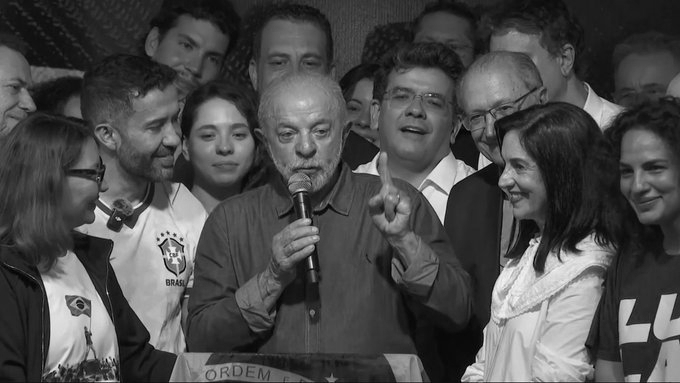
Lula Turns It Around! Brazil President Wins Fourth Term As Trump’s Latin America Push Faces A Test
Brazilian President Luiz Inácio Lula da Silva has secured an unprecedented fourth presidential term, defeating right-wing Senator Flávio Bolsonaro in a dramatic runoff election that carries major implications for Brazil’s economy, US relations, India and BRICS. The victory on October 25, 2026, also interrupted a recent wave of right-wing electoral gains across Latin America.
With 99.99% of polling stations reporting, Lula won 51.78% of valid votes, against Flávio’s 48.22%, securing a margin of approximately 4.4 million votes. The 80-year-old president overturned his first-round defeat on October 4, when Flávio received 47.03% and Lula 45.16%. Lula gained around 10.4 million votes between the rounds, compared with Flávio’s 3.7 million, as turnout increased and abstention fell from 21.08% to 19.21%.
Lula’s comeback drew on his political experience, social-welfare record and renewed campaign mobilisation. His promises included a 15% increase in Bolsa Família payments, benefiting nearly 50 million people, debt relief for households, support for small businesses and proposals for free weekend public transport. His campaign also expanded its digital outreach, including a WhatsApp network reportedly attracting more than 10 million members. Lula said Brazil would not become anybody’s “backyard”, presenting the result as a rejection of political denialism and foreign interference.
Flávio, who sought to carry forward his father’s political movement, refused to accept defeat and called for the result to be annulled. Former president Jair Bolsonaro is serving a 27-year prison sentence following his conviction over a plot to overturn the 2022 election. Flávio challenged a last-minute Supreme Court decision extending voting hours at polling stations still open after the scheduled closing time. However, both campaigns had sought extensions amid heavy rain and transportation concerns. Legal experts have questioned whether the circumstances provide sufficient grounds to invalidate the result.
The election also unfolded amid controversy over the Banco Master financial scandal, which intensified scrutiny of Brazil’s judiciary and became ammunition for the opposition. Social media and misinformation were another battleground. Lula’s campaign alleged that platforms restricted pro-government content, while reports highlighted questionable political advertisements and AI-generated material. Electoral authorities had imposed rules on AI-generated candidate depictions. These controversies underline growing concerns about technology’s influence on democratic contests.
Lula’s victory is a setback for US President Donald Trump, who threatened tariffs of up to 50% on Brazilian goods amid tensions over Jair Bolsonaro’s prosecution. It also challenges Washington’s efforts to strengthen conservative influence in Latin America. Nevertheless, Brazil must balance relations with the US against its close economic ties with China.
For India, Lula’s return offers continuity in bilateral cooperation and BRICS. India and Brazil have expanded collaboration in critical minerals, rare earths, digital technology, healthcare and industry. Bilateral trade exceeded $15 billion in 2025, with both countries aiming to reach $30 billion by 2030. Their shared support for United Nations Security Council reform and a more multipolar world also strengthens their diplomatic partnership.
Financial markets reacted nervously to Lula’s victory. In Asian trading, Brazilian real futures fell around 10%, while a Tokyo-listed Brazilian equities exchange-traded fund dropped approximately 15%. Investors fear rising public debt, costly spending commitments and the absence of a convincing fiscal consolidation plan. Brazil’s public debt exceeds 82% of GDP, adding pressure on the government to balance welfare programmes with spending discipline.
Lula’s fourth term will be difficult. Nearly 60 million voters backed Flávio, while a right-leaning Congress could obstruct legislation and economic reforms. Cost-of-living pressures, household debt, public security and institutional tensions remain unresolved. At 80, Lula will also face questions about succession and political continuity. His victory has secured his return, but governing a polarised country while managing fiscal pressures and competing international relationships will determine his legacy.