
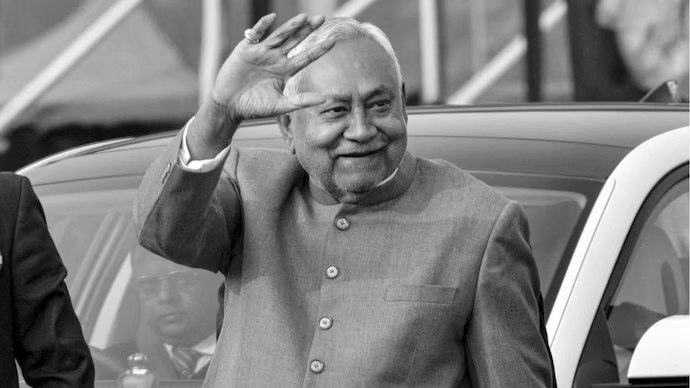
Longest serving CM of Bihar Nitish Kumar, whose party never got a majority
Bihar Chief Minister Nitish Kumar may well be remembered as one of the state’s most enduring political figures, having held office longer than any of his predecessors, despite his party, the JD(U) , never securing an outright majority in the assembly. Yet, recent developments have cast uncertainty over his legacy, leaving party loyalists stunned and opponents critical.
Madan Sahni, JD(U) Minister for Social Welfare, expressed disbelief over Kumar’s decision to seek a Rajya Sabha seat, saying it was “hard to believe that this could have been Nitish Kumar’s own decision. ” He noted that the party supremo had long harboured the ambition of representing both Parliament and the state legislature. JD(U) workers, barred by police from approaching the Chief Minister’s residence, vented their frustration through acts of vandalism at the party office, unwilling to accept that a leader once regarded as “Prime Minister material” by even BJP stalwarts like the late Sushil Kumar Modi would choose “such a disgraceful exit.”
RJD working president Tejashwi Yadav , Kumar’s former deputy, said, “BJP has done a Maharashtra in Bihar. But Nitish Kumar has only himself to blame. While in alliance, we supported him as Chief Minister despite having more MLAs, but he chose to walk away on two occasions.”
Kumar, who turned 75 last week, has had a long and varied political journey. Starting as an engineering student in the 1970s, he rose through the ranks of the JP Movement led by Jayaprakash Narayan . Electoral success came in 1985 when he won the Harnaut assembly seat in Nalanda, followed by a 1989 victory as MP from Barh. His political acumen earned him a ministerial berth under VP Singh after the Mandal Commission reforms boosted OBC representation.
Breaking away from Janata Dal in 1995 due to differences with Lalu Prasad Yadav, Kumar floated the Samata Party with George Fernandes and later allied with the BJP. His negotiation skills helped form the JD(U) in 2003. In alliance with the BJP, JD(U) achieved historic victories in 2005 and maintained strong governance, leading the NDA to its best-ever performance in 2020. Despite a potential Prime Ministerial trajectory, Kumar’s rivalry with Narendra Modi and the 2014 Lok Sabha setback led to a temporary resignation, only to reclaim power with Lalu Prasad Yadav’s support in 2015. The Mahagathbandhan experiment was short-lived, and Kumar returned to the BJP fold in 2017, earning the label “paltu ram” for perceived opportunism.
Although sworn in just three months ago after the NDA’s 2025 assembly victory, shifting political equations have prompted Kumar’s move to the Rajya Sabha. With the BJP emerging as the single largest party , it is expected to push for its own leader as Bihar Chief Minister. Leading contenders include Deputy CM Samrat Chaudhary , Union Minister Nityanand Rai , and senior BJP leader Dilip Kumar Jaiswal . This could mark the first time the BJP heads the Bihar government independently, while Kumar’s son Nishant prepares to enter politics, further testing the veteran leader’s enduring influence.