
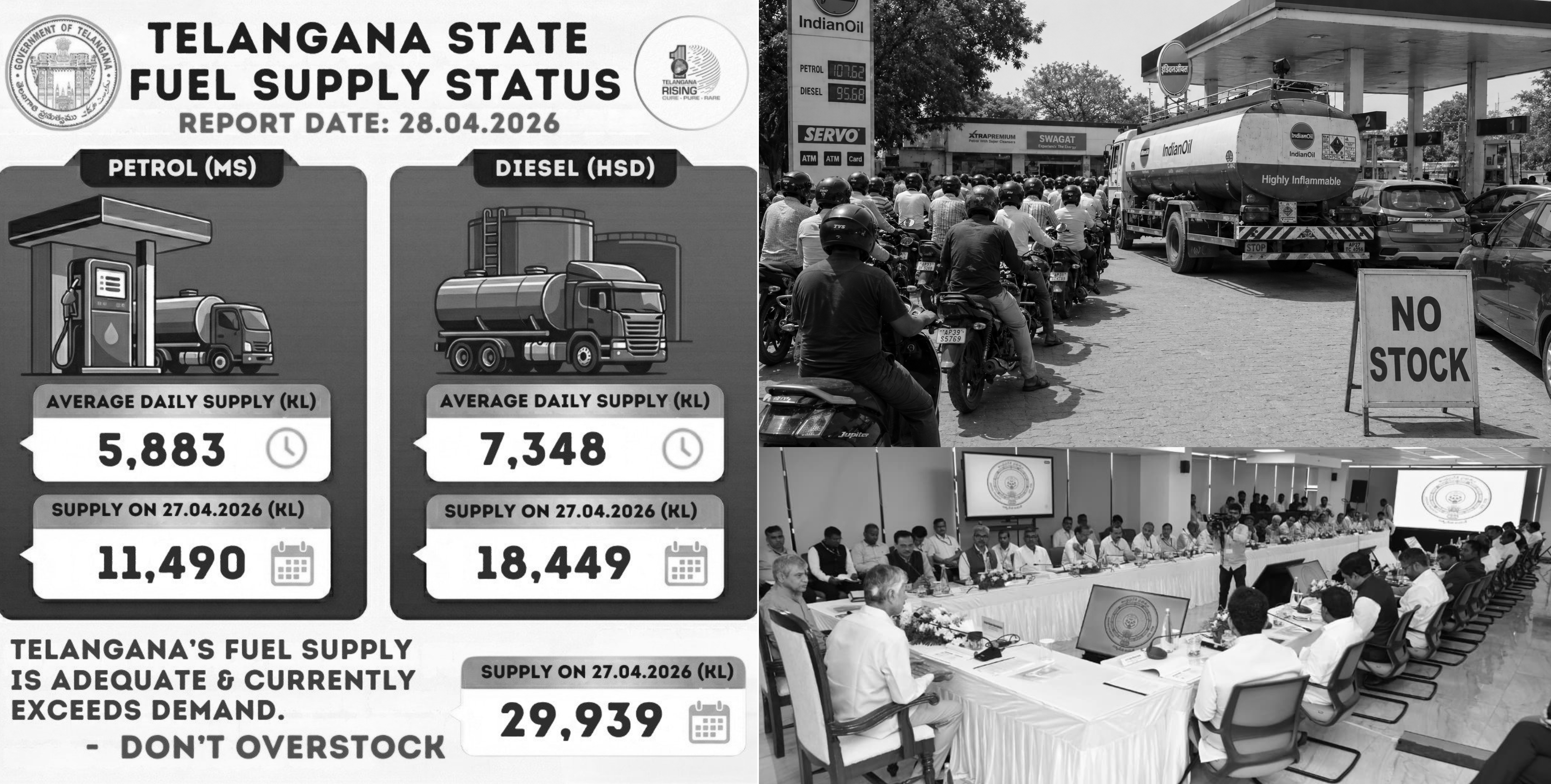
Long Lines In Front Of Fuel Pumps Belie Claims Of Adequate Supply in Telugu States
Concerns over fuel availability in Andhra Pradesh and Telangana have triggered visible public anxiety, with long queues at petrol bunks and “no stock” boards surfacing in several locations. However, both state governments have issued strong reassurances that petrol and diesel supplies remain sufficient , attributing the disruptions largely to panic buying and misinformation rather than any real shortage.
In Telangana , the Civil Supplies Department has categorically stated that there is no scarcity of fuel , urging citizens not to believe rumours circulating on social media. Under the supervision of Commissioner M. Stephen Raveendra , the state is maintaining a steady and robust supply chain in coordination with Oil Marketing Companies (OMCs) . Official figures indicate that daily fuel supply significantly exceeds regular demand , ensuring adequate availability for commuters, transport operators, and the agricultural sector.
Despite this, panic-driven behaviour has led to long waiting times at petrol bunks , particularly among two-wheeler riders, with some outlets temporarily displaying “no stock” boards. Officials clarified that such situations are often the result of sudden spikes in demand , not supply disruptions. The government has warned that hoarding, black marketing, or creating artificial scarcity will invite strict legal action, while urging citizens to rely only on verified information. A helpline (1967) has also been activated to address complaints and monitor irregularities.
A similar situation has unfolded in Andhra Pradesh , where initial supply disruptions prompted public concern. Chief Minister N. Chandrababu Naidu has taken direct control of the situation, ordering continuous monitoring of fuel supply until full normalcy is restored . Through high-level reviews and coordination with oil companies such as Indian Oil Corporation (IOCL) , Bharat Petroleum Corporation Limited (BPCL) , and Hindustan Petroleum Corporation Limited (HPCL) , the state has significantly ramped up distribution.
Large-scale dispatch operations running even during the night have been implemented to accelerate fuel deliveries across districts , with thousands of kilolitres of petrol and diesel already supplied. Authorities report that availability is steadily improving in multiple regions, though logistical challenges, especially in remote areas, have caused temporary delays. To ensure smooth transportation, each fuel consignment is being escorted by Revenue and Police personnel , highlighting the seriousness of the situation.
Interestingly, officials and market observers note that some petrol bunks have voluntarily limited visible stock availability as a crowd-control measure. This step aims to prevent panic-driven overconsumption and ensure more equitable distribution among consumers , even as supply lines remain intact.
At the broader level, the message from both state governments and reinforced by coordination with central agencies and public sector oil companies is clear : there is no systemic fuel shortage . The temporary disruptions are being managed through enhanced logistics, real-time monitoring systems like RTGS in Andhra Pradesh, and close coordination with OMCs .
Authorities across both states have appealed to the public to remain calm, avoid panic buying, and not hoard fuel unnecessarily , stressing that such behaviour only worsens localised shortages. With supply chains stabilising and proactive administrative measures in place, officials are confident that normalcy will be fully restored soon , provided public cooperation continues.