
Lok Adalats Reinforce People-Centric Justice in a Digital Age
As India’s judicial system grapples with mounting pendency and the rapid transformation of society through digitalisation, Lok Adalats have continued to play a decisive role in delivering speedy, affordable, and accessible justice. By resolving disputes through consensus rather than confrontation, these alternative dispute resolution forums have emerged as a practical bridge between citizens and the justice system.
Lok Adalats are statutory forums established under the Legal Services Authorities Act, 1987 , aimed at providing amicable settlement of disputes through conciliation. Unlike conventional courts, Lok Adalats follow an informal and non-adversarial approach. There are no court fees, procedural complexities are minimal, and settlements reached carry the same legal force as civil court decrees. The awards are final and binding, with no provision for appeal, ensuring quick closure of disputes.
The importance of Lok Adalats lies in their ability to make justice accessible to all sections of society, particularly the economically weaker and socially vulnerable. They handle a wide range of cases, including motor accident claims, bank recovery matters, matrimonial disputes, land and property issues, labour disputes, and service-related grievances. For many litigants, Lok Adalats offer timely relief that might otherwise take years in regular courts.
Institutionally, Lok Adalats operate through a four-tier framework comprising the National Legal Services Authority (NALSA) , State Legal Services Authorities, District Legal Services Authorities, and Taluk Legal Services Committees. This decentralised structure ensures nationwide coverage, extending justice delivery beyond metropolitan centres to small towns and rural areas, making Lok Adalats a significant grassroots institution in India’s legal landscape.
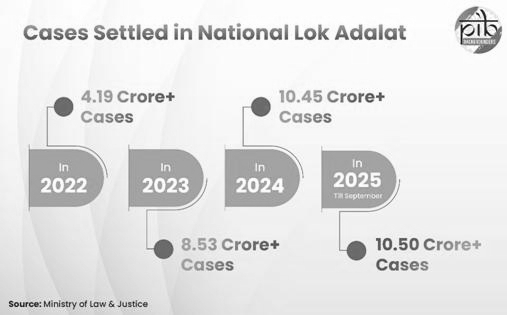
To accelerate dispute resolution on a large scale, National Lok Adalats are conducted on pre-announced dates across the country, with simultaneous sittings at all levels of the judiciary. These mission-mode exercises allow courts and legal services authorities to dispose of large volumes of cases in a single day. The justice delivery system further adapted during the COVID-19 pandemic through the introduction of E-Lok Adalats , enabling virtual hearings and digital participation.
Over the last five years
, Lok Adalats have resolved several crore cases nationwide , reflecting their growing relevance and effectiveness. Judicial and government data indicate that between 2020 and 2024 , more than 20 crore cases including both pre-litigation disputes and pending court matters were settled through Lok Adalats. In 2024 alone , National Lok Adalats disposed of over one crore cases , while a single round of National Lok Adalat in 2025 reportedly settled more than three crore cases , underscoring the scale at which the mechanism operates.
A key component of the system is the Permanent Lok Adalat , which deals with disputes related to public utility services such as electricity, water supply, transport, postal services, and telecommunications. With jurisdiction up to ₹1 crore, Permanent Lok Adalats have the authority to adjudicate disputes if conciliation fails, ensuring finality and timely relief in essential service matters.
In the contemporary digital era, the relevance of Lok Adalats is expanding further as cyber-related disputes and digital grievances continue to rise. While serious cybercrimes involving hacking, identity theft, or large-scale financial fraud remain within the jurisdiction of criminal courts and specialised cybercrime units, Lok Adalats are increasingly important in addressing the civil and compoundable aspects of cyber disputes. These include online banking and digital payment disputes, e-commerce grievances, service deficiencies by telecom and internet providers, and compensation-related claims arising from cyber fraud.
Lok Adalats offer a practical platform for resolving such disputes swiftly, particularly where victims seek compensation or settlement rather than prolonged criminal trials. By facilitating dialogue between affected individuals, banks, financial institutions, and service providers, Lok Adalats help deliver quicker relief and restore trust in digital systems. The role of E-Lok Adalats is especially significant in this context, as virtual hearings align naturally with the digital nature of cyber disputes and allow wider participation without geographical constraints.
Beyond dispute resolution, the societal significance of Lok Adalats lies in their contribution to social harmony and public trust. By reducing litigation costs, easing court congestion, and encouraging amicable settlements, they help prevent long-drawn legal conflicts that often strain personal and community relationships. For millions of citizens, Lok Adalats represent not merely a legal forum, but a humane and responsive institution where justice is accessible, dignified, and timely.
As India continues to navigate legal challenges arising from economic growth and digital transformation, Lok Adalats stand out as a flexible and people-oriented mechanism. By adapting to contemporary disputes while retaining their core principles of conciliation and fairness, they remain a vital component of India’s justice delivery system.