
Leave Your Phone at Home: The Digital Lockdown Behind the Trump-Xi Summit
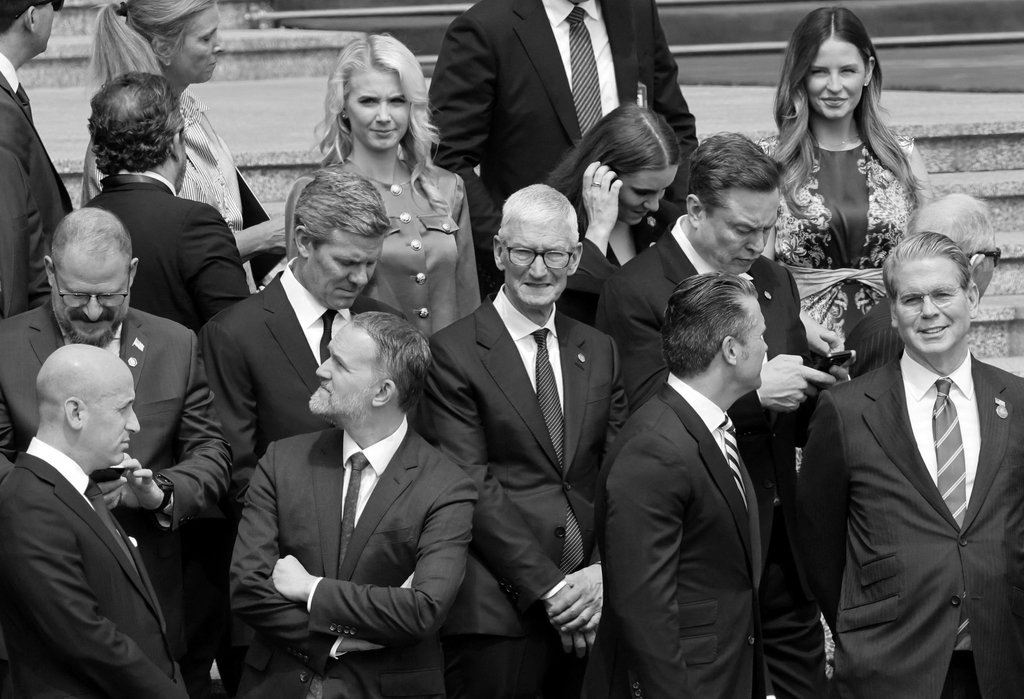
When the most powerful man in the world flies to meet his most formidable rival, he brings with him the full weight of American power, the diplomats, the generals, the dealmakers. This week, President Donald Trump arrived in Beijing accompanied by an extraordinary convoy of wealth and influence: Elon Musk, Tim Cook, Jensen Huang, Larry Fink , the titans of American capitalism, men whose combined net worth rivals the GDP of nations. They brought their ambitions, their agendas, and their leverage. What they did not bring was their phones.
According to Fox News, the Trump delegation was told in no uncertain terms before boarding : leave your personal devices behind. Not your iPhone. Not your laptop. Not your smartwatch. Nothing. It was, in the most literal sense, a digital lockdown and the reason behind it says everything about the world these men are operating in.
China, according to US intelligence officials, runs one of the most sophisticated and aggressive cyber surveillance environments on the planet. A place where your phone is never just a phone. It is a window into everything you know, everyone you talk to, and every secret you carry. And in China, someone is always looking through it. For individuals holding the highest levels of government and corporate power, people whose devices contain classified briefings, proprietary technology secrets, strategic communications, and financial intelligence , the risk is not paranoia. It is policy.
So what do you carry instead? A clean device. A phone so deliberately stripped down, so thoroughly emptied of anything valuable, that even if someone does get in, they find nothing worth taking. For US officials and executives on this trip, access to cloud storage is blocked, synced applications are disabled, and personal accounts are off-limits. The instructions go further still: do not connect to hotel Wi-Fi. Do not use public charging ports. That last point deserves particular attention, public USB charging ports can be weaponised to steal data or silently install malicious software onto a connected device. It even has a name in cybersecurity circles: "juice jacking." In China, trusting the wrong socket is the digital equivalent of handing over your secrets in person.
Only government-approved chargers, battery packs, and accessories are permitted on the trip. All sensitive communications are routed through tightly controlled channels or temporary accounts. If a conversation is truly sensitive, the kind that cannot be committed to any device at all, it must happen in person, face to face, with no technology in the room. And when the delegation returns home, every device will be subjected to a forensic examination: security teams will compare what is on each phone now against what was on it before departure, byte by byte, hunting for phantom files, rogue applications, hidden keyloggers, or any trace of interference. If something has changed, the conclusion is simple, you were hacked while shaking hands and signing trade deals.
At the heart of this protocol is something called a "golden image" , a carefully vetted, pre-approved software configuration loaded onto a temporary device before the trip. The phone is clean going in. It is checked out. The gap between those two moments is where the danger lives. This is not a theoretical exercise. It is a response to years of documented, escalating concern in Washington over alleged Chinese cyber operations targeting American institutions, infrastructure, and officials. The US has specifically cited campaigns it calls Volt Typhoon and Salt Typhoon , large-scale hacking operations it attributes to Beijing-backed actors - as evidence of China's willingness and capability to conduct aggressive digital espionage at scale.
But before Washington gets too comfortable on the moral high ground, it is worth pausing for a moment of uncomfortable symmetry. Digital snooping on foreign delegations is not a Chinese invention. In 2013, whistleblower Edward Snowden revealed that the NSA, America's own National Security Agency, had monitored the personal phones of 35 world leaders , including some of Washington's closest allies. The revelation was so explosive that Hollywood made a film about it. So when American officials point fingers at Beijing for cyber surveillance, Beijing points them right back and the history, inconveniently, gives it some ammunition.
China, for its part, has consistently and categorically denied state-backed cyber espionage. But this is Beijing we are talking about. Admissions are not part of the playbook. What matters is not what either side says publicly but what the intelligence communities of both nations do privately and the protocol surrounding this delegation makes Washington's private assessment crystal clear.
There is something almost poetic about the image of it. The richest, most connected, most digitally empowered group of individuals on earth, sitting in Beijing, the world's foremost surveillance state, by American reckoning, deliberately, voluntarily disconnected. No iMessages, no emails, no Slack notifications, no live stock tickers. Just the room, the table, and the conversation. In a world where technology has made secrets nearly impossible to keep, the most powerful men alive are protecting theirs the old-fashioned way: by leaving the technology behind.
Because the risk, as those intelligence briefings make abundantly clear, does not care how many zeros are in your bank account. It does not care if your name is on the side of a rocket or in the top five of the world's richest people. In China's cyber environment, power is not a shield. If anything, it makes you a more attractive target. And that is precisely why, when Air Force One touched down in Beijing, the phones stayed home.