
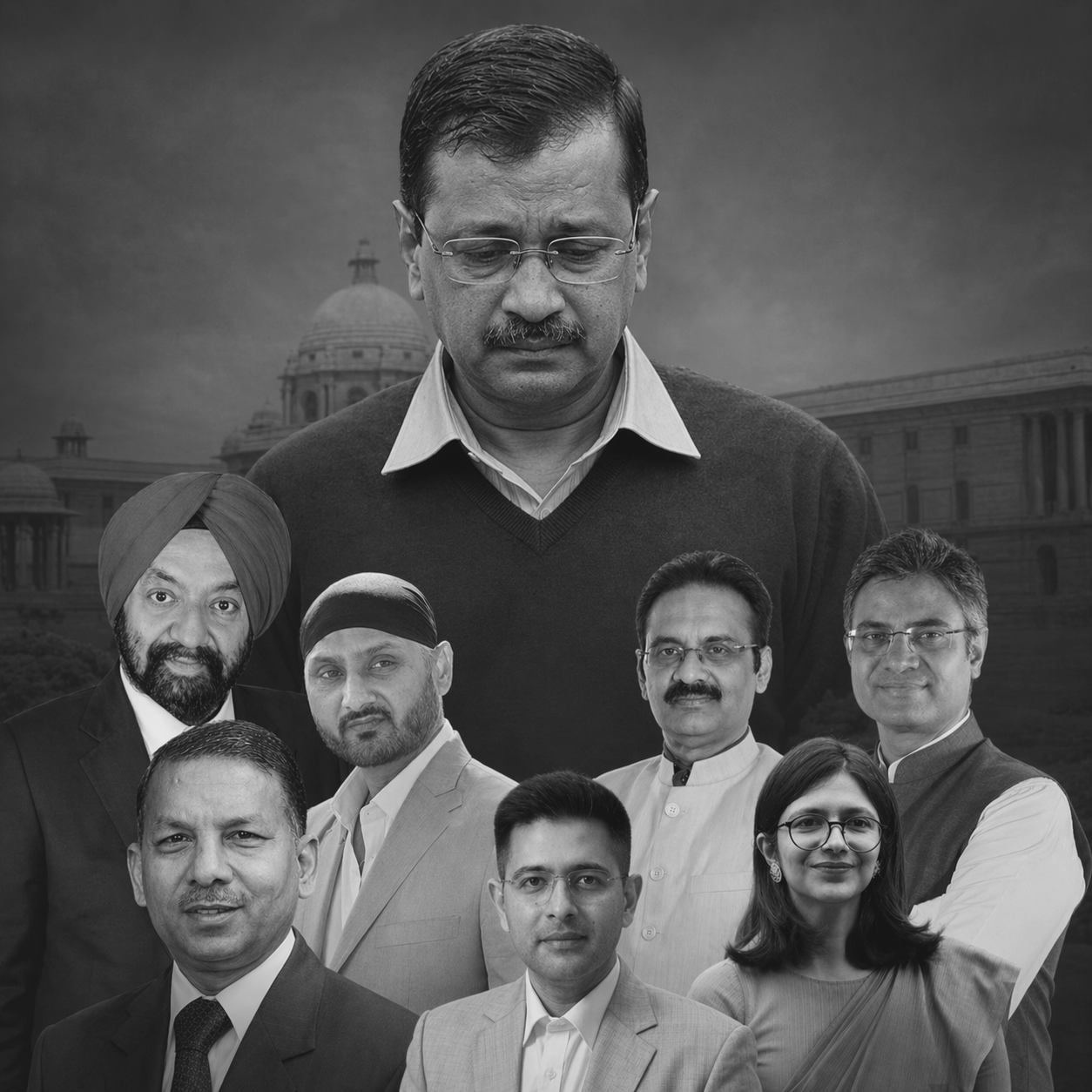
Leaders He Built Desert Him, AAP Hit by Biggest Rupture as Chadha and Six Rajya Sabha MPs Join BJP
In a dramatic and deeply unsettling turn for the Aam Aadmi Party, a group of leaders once nurtured and elevated within the party walked away in a coordinated exit that has left its Rajya Sabha presence severely depleted and its leadership grappling with a sense of betrayal.
At the centre of the storm is Raghav Chadha , long seen as one of the most articulate national faces of the party and a close associate of Arvind Kejriwal . Alongside Sandeep Pathak and Ashok Mittal , Chadha announced that seven of AAP’s ten Rajya Sabha MPs had chosen to merge with the Bharatiya Janata Party , invoking the two thirds rule under the Tenth Schedule to avoid disqualification. The paperwork, he said, had already been submitted to the Chairman earlier in the day.
The full list of those exiting includes Swati Maliwal , Harbhajan Singh , Vikram Sahney and Rajinder Gupta , leaving behind just three MPs, Sanjay Singh , N. D. Gupta and Balbir Singh Seechewal , to carry the party’s voice in the Upper House.
Yet beyond the arithmetic, the moment carries a far more personal and political weight for Kejriwal . Many of those who have now exited were handpicked, mentored, and given prominence by a leadership that sought to build an alternative political culture. Their departure, timed and executed with precision, has triggered questions not just about political strategy, but about loyalty and conviction in a party born out of an anti corruption movement.
Chadha, defending his move, said the party had strayed from its founding principles, declaring that he was “the right man in the wrong party.” But within AAP, the narrative is sharply different, one of trusted lieutenants walking away at a moment of vulnerability , choosing what critics describe as political convenience over ideological commitment.
The rupture did not emerge overnight. Chadha had been removed as Deputy Leader in the Rajya Sabha , a move he publicly criticised, while tensions simmered between factions within the party. The situation escalated further after Enforcement Directorate raids linked to entities associated with Mittal, adding pressure to an already fragile internal dynamic.
For Kejriwal, who built AAP as a platform for new generation leadership , the episode is a stark reminder of the risks inherent in rapid political rise. The exits of figures like Maliwal, who had long been in open disagreement with the leadership but remained within the fold until now, underscore the depth of internal fractures.
AAP has responded with anger, accusing the BJP of engineering defections through “Operation Lotus” , while the BJP has dismissed the charge and described the development as proof of AAP’s internal decay. The political battle lines are sharply drawn, but the emotional undertone remains unmistakable.
From a party that once aspired to reshape national politics, AAP now finds itself reduced to three MPs in the Rajya Sabha , confronting both a numerical setback and a crisis of trust. Whether this moment is remembered as political realignment or a rupture of faith, it leaves behind a lingering question, when leaders built within a system walk away together, what does it say about the system and the choices they made .