
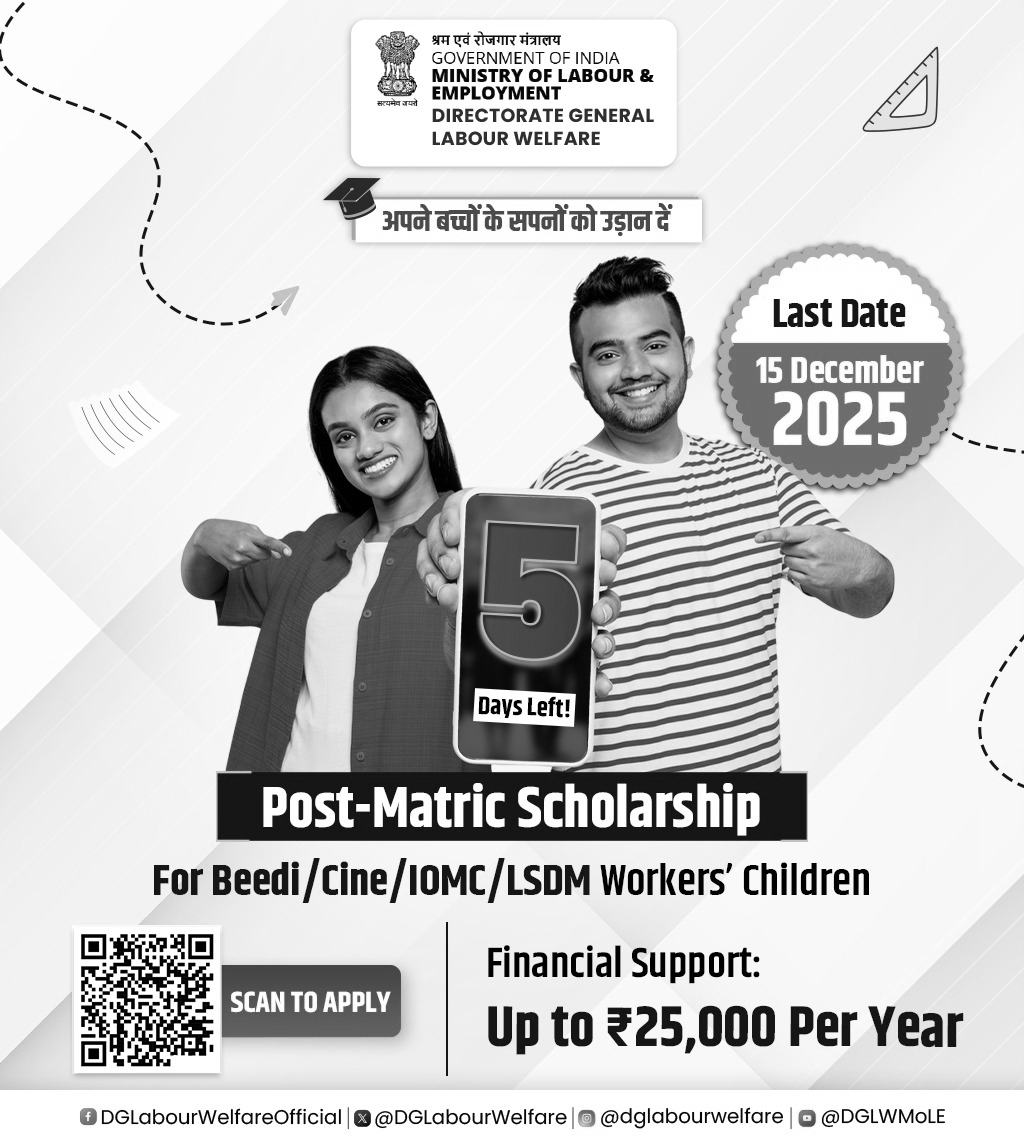
Last Chance: Apply for Post-Matric Scholarship 2025 by Dec 15
The Post-Matric Scholarship 2025, promoted by the Directorate General Labour Welfare (DGLW) under the Ministry of Labour and Employment, Government of India, is making a critical last call as the application deadline of December 15, 2025, approaches, with only a few days remaining as of 06:53 PM IST on December 12, 2025. Highlighted in a recent X post by @DGLabourWelfare on December 11, 2025, this initiative offers up to ₹25,000 per year to support the higher education of children from vulnerable unorganized sector families, including beedi workers, cine workers, and those in iron ore, manganese ore, chrome ore, limestone, and dolomite mines. The scholarship, accessible via the National Scholarship Portal (scholarships.gov.in) with a QR code provided in the post, aims to break the cycle of poverty by funding education from Class 11 through postgraduate and professional courses at recognized institutions in India, reflecting a broad and inclusive approach to educational support.
Eligibility for the scholarship requires that the applicant’s parent be a registered worker in the specified industries, with a family income not exceeding ₹10,000 per month, and the student enrolled in a post-matriculation course, having passed the previous exam on the first attempt and generally under 24 years of age for the general category. The application process, closing at midnight on December 15, 2025, involves registering on the NSP, uploading documents like income certificates and worker registration proofs, and awaiting verification, a process streamlined by the digital push but challenged by the tight timeline and potential technical issues. The scheme’s impact is significant, with ₹32.51 crore disbursed in 2024-25 to aid 92,118 students, enabling access to higher education in a country where over 400 million unorganized sector workers often cannot afford it beyond secondary level.
The scholarship covers a wide range of courses, including general degrees (e.g., BA, BSc, BCom), technical diplomas, and professional programs like engineering, medicine, law, and management, as long as they are offered by recognized institutions affiliated with bodies like the UGC or AICTE. However, it excludes pre-matriculation education and certain non-academic or short-term certificate programs, with correspondence courses’ eligibility depending on institutional recognition, details of which are available on the NSP. The financial support, tiered by course type, underscores the scheme’s flexibility, though the ₹25,000 cap may fall short for expensive professional courses, prompting calls for adjustments.
Despite its benefits, challenges persist, including low awareness in remote areas, the short application window, and the exclusion of unregistered workers, a significant portion of the workforce. The DGLW’s reliance on digital platforms also demands literacy and access, which may limit reach. Historically, the scheme evolved from welfare funds established in the 1970s and 1980s, with structured implementation via the NSP around 2015-2017, and the 2025 cycle’s notification likely began in late October or early November 2025, based on a typical 6-8 week window. As the deadline looms, the success of this transformative program depends on overcoming these barriers, offering a pathway to social mobility and aligning with India’s National Education Policy 2020 goals.
The Post-Matric Scholarship 2025 stands as a vital opportunity for the children of India’s unorganized workers, supporting diverse educational pathways with up to ₹25,000 annually. With the application portal open until December 15, 2025, families are urged to act quickly by visiting scholarships.gov.in or using the QR code from the DGLW’s X post. This initiative not only invests in individual futures but also contributes to the nation’s vision of an inclusive, skilled workforce, provided logistical and awareness hurdles are addressed effectively.