
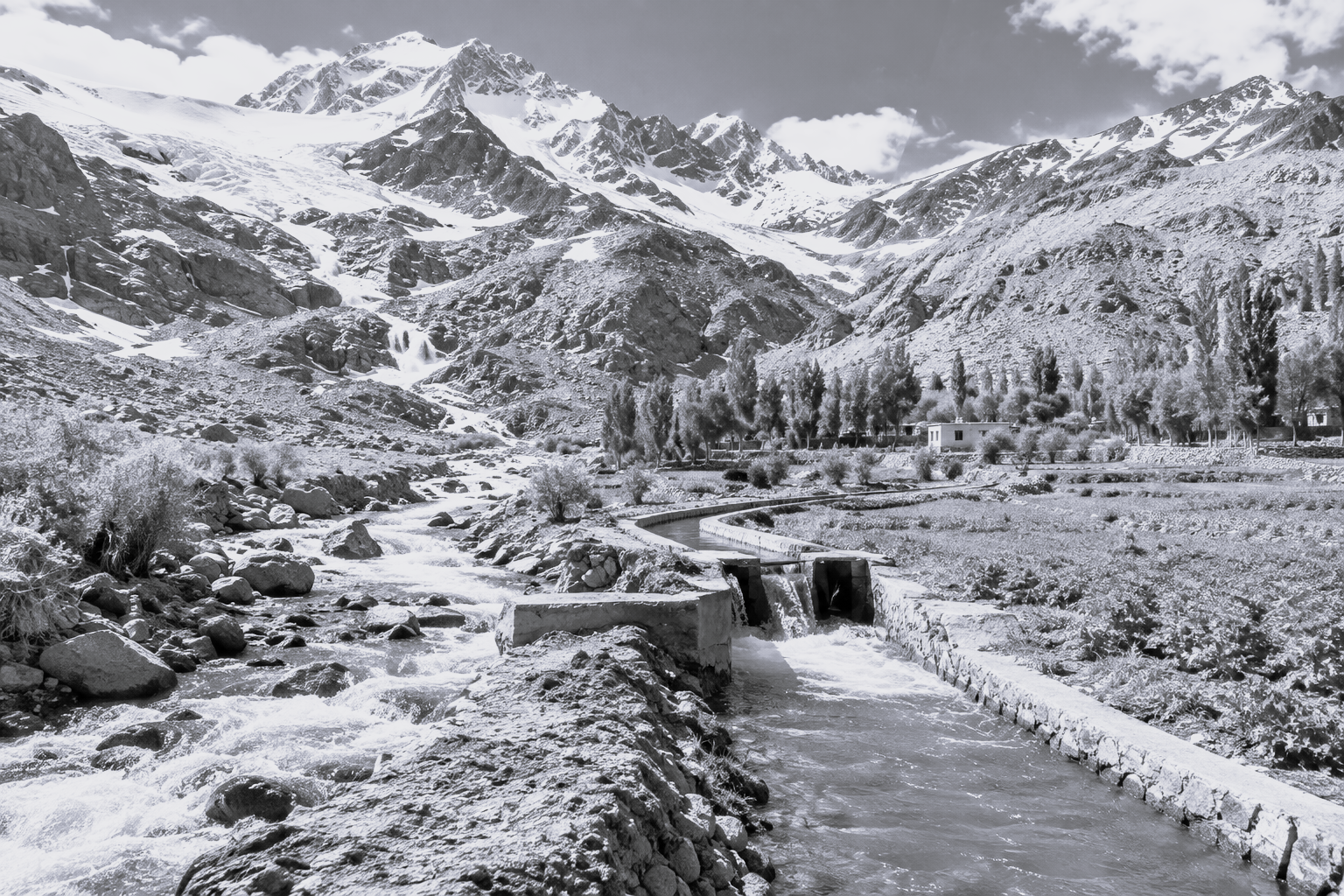
Ladakh Channels 90 Million Litres of Glacier Water Daily for Farms
In a significant push to strengthen water and agricultural security in the cold desert of Ladakh, the administration has begun harnessing nearly 90 million litres of glacier-melt water a day that previously flowed downstream into the Indus, channelising it into the Igoo-Phey irrigation canal to support farming across nearly 12 villages.
The initiative, spearheaded by Lieutenant Governor Vinai Kumar Saxena, is expected to improve irrigation across more than 1,000 acres of land that had remained parched because of inadequate water supplies. Officials said the intervention was carried out through simple earthwork without capital expenditure, offering a low-cost approach to addressing water shortages in the ecologically fragile region.
The water is being tapped from Stok nallah, fed by the Stok Kangri Glacier near Leh. On August 14, the Irrigation and Flood Control Department created two trenches using a JCB to divert excess water into the Igoo-Phey canal. The nallah's discharge was assessed at 36.60 cusecs, equivalent to nearly 90 million litres over 24 hours.
Of this, 26 cusecs are being diverted into the canal 19 cusecs towards Igoo and seven cusecs towards Phey while officials are planning to utilise the remaining 10 cusecs. The intervention is expected to increase the canal's flow from around 50 cusecs to nearly 80 cusecs, improving water availability for all 12 villages.
The 43-km Igoo-Phey canal, constructed between 1979 and 2005, had long suffered from inadequate supplies. Interestingly, around 200 metres of the canal was built underground so Stok nallah water could pass over it, indicating that the potential of the glacier-fed stream was known when the project was conceived. However, the resource remained largely untapped for decades.
The latest intervention comes amid a broader water-security push in Ladakh, including Project Him Sarovar and the Sindhu Jal Samriddhi Abhiyan, which focus on capturing snowmelt and improving local water storage and irrigation.
Scientific research underscores the importance of such measures. Snowmelt contributes about 65% of annual discharge in the Stok catchment, compared with 19% from glacier melt and 16% from rainfall. With glacier recession, declining snowfall and rising temperatures creating long-term uncertainty, experts caution that Ladakh will need storage, groundwater recharge and efficient irrigation alongside diversion projects.
The administration has identified Matho, Tuchik Chenmo, Tuchik Chon and Stakna nallahs for similar interventions. It is also using canal water to support the restoration of about 800 acres of barren land.
Officials expect improved irrigation to raise crop yields, farm incomes and employment, while strengthening rural economies. The broader strategy is to integrate scattered glacier flows with existing infrastructure through cost-effective, gravity-based engineering, turning seasonal runoff into a more dependable foundation for Ladakh's agricultural and climate resilience.