
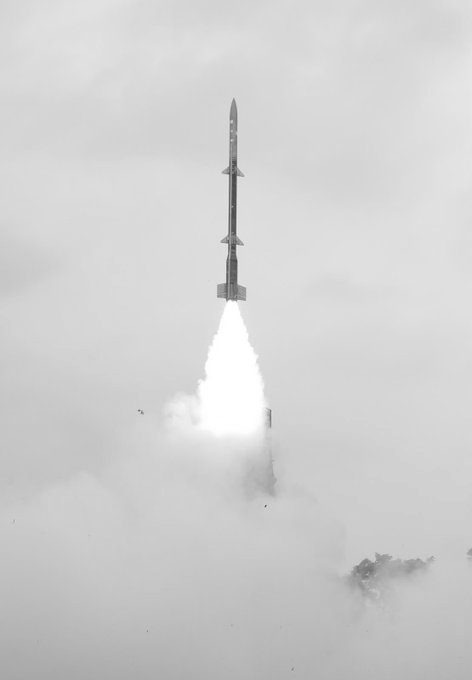
Kusha Missile Takes Flight! India Edges Closer to Building Its Own S-400-Class Defence System
India notched a significant milestone in its indigenous air defence journey on Thursday, with the Defence Research and Development Organisation (DRDO) successfully carrying out the maiden flight test of the Kusha missile from Dr APJ Abdul Kalam Island off the Odisha coast. Defence Minister Rajnath Singh confirmed that the trial validated the missile's propulsion, guidance and control systems, a critical benchmark for a programme years in the making.
The test involved the M1 variant, engineered to neutralise fighter jets, drones, cruise missiles and large aircraft up to 150 km. It is the first of three planned interceptors under Project Kusha, with the M2 and M3 variants expected to extend coverage to 250 km and 350-400 km respectively. Together, they are designed to form a multi-layered shield comparable to Russia's S-400, complementing existing assets like Akash and Barak-8.
Approved by the Cabinet Committee on Security in 2022 at a cost of roughly ₹21,700 crore, the project has been developed largely in-house by DRDO in partnership with Bharat Electronics Limited, with indigenous content exceeding 90 percent. The system will feed into the Integrated Air Command and Control System, forming a key pillar of Mission Sudarshan Chakra, envisioned as a nationwide air-defence grid by 2035. Phased induction is targeted between 2028 and 2030.
The programme's real value lies in reducing India's dependence on a single foreign supplier for long-range air defence, at a time when Russia's own production lines remain stretched. A shared kill-vehicle and electronics architecture across all three variants allows faster, cheaper development and fleet-wide upgrades. Lessons from Operation Sindoor in 2025 are widely cited as having added urgency to the timeline, given growing threats from Chinese stealth platforms and Pakistan's Chinese-origin systems.
Singh framed the test within the Atmanirbhar Bharat push for defence self-sufficiency. Reacting to the development, BJP leader Baijayant Jay Panda and several defence commentators hailed it as proof of India's growing scientific maturity, though many noted this validation comes after repeated timeline slippages since the project's original approval.