
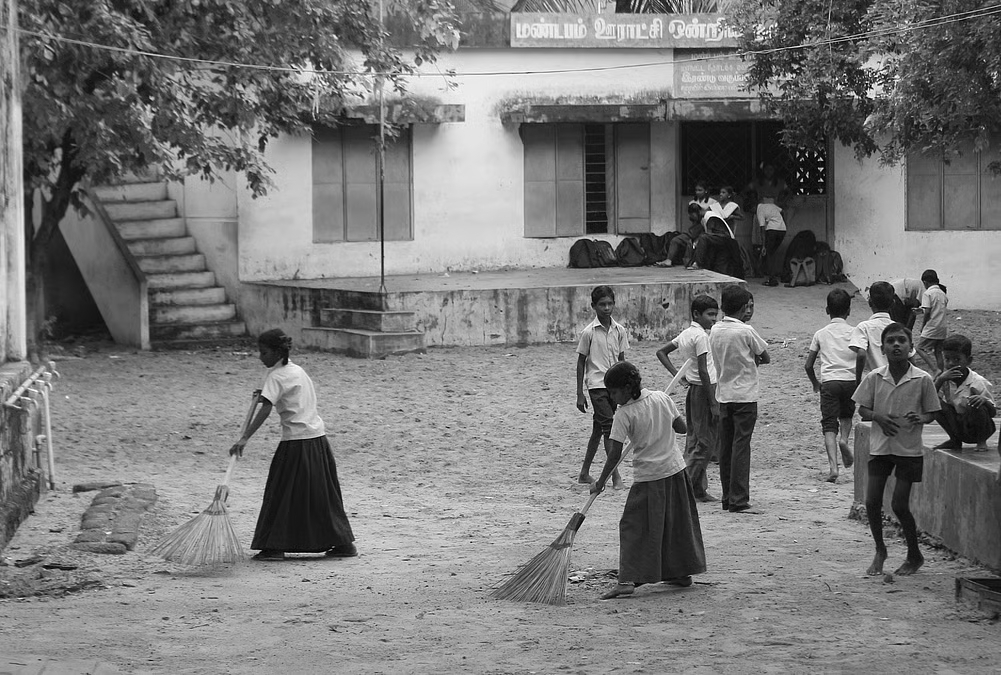
K'taka Assembly debates if students should clean school premises to foster hygiene
The Karnataka Legislative Assembly recently debated whether students should clean school premises to develop better hygiene habits and civic responsibility. The discussion, which took place during deliberations on the Karnataka State Civil Services (Regulation of Transfer of Teachers) (Amendment) Bill , drew attention to global practices and experiences in other Indian states where similar initiatives have been implemented or debated.
School Education and Literacy Minister Madhu Bangarappa said he would support legislation allowing students to participate in cleaning, but emphasized that child rights must be protected and proper supervision ensured. He stressed that such participation should be purposeful , not a replacement for official staff.
The debate was prompted by JD(S) floor leader C. B. Suresh Babu , who highlighted the shortage of ‘D group’ workers in government schools, where children are sometimes asked to clean out of necessity. He urged the government to either recruit staff or formally allow students to participate in a structured manner.
Speaker U T Khader recalled his own school experience, noting that cleaning classrooms, grounds, and toilets helped instill discipline and responsibility. He suggested that formalizing such activities could contribute to skill development and practical learning. Senior BJP MLA Araga Jnanendra cited Mahatma Gandhi ’s example of cleaning toilets as a lesson in humility and self-respect, suggesting students today can learn similar values.
The Assembly also considered global perspectives. Countries like Japan, South Korea, and Finland integrate student cleaning into daily routines, not as a substitute for staff shortages but as a structured educational activity . Children in these countries are taught from a young age to maintain cleanliness, respect shared spaces, and develop responsibility, ensuring such habits carry into adulthood.
Elsewhere in India, students have participated in cleaning under voluntary, structured programs . In Tamil Nadu , headmasters were suspended for forcing students to clean toilets, reinforcing child rights , while Jharkhand involved students in roads and school cleaning through Swachhta Hi Seva campaigns. Some Delhi government schools follow Japanese-style routines , where students clean classrooms under supervision. In contrast, private schools usually have dedicated staff, and student cleaning is optional, focused on hygiene, teamwork, and environmental awareness , not staff shortages. The Assembly also debated the medium of instruction , with Congress MLAs K M Shivalinge Gowda and Basavaraj Rayareddi advocating English and Kannada respectively, reflecting broader concerns about education quality. Karnataka’s discussion, still at the proposal stage, highlights how combining global best practices with local implementation could foster hygiene, discipline, and civic responsibility among students.