
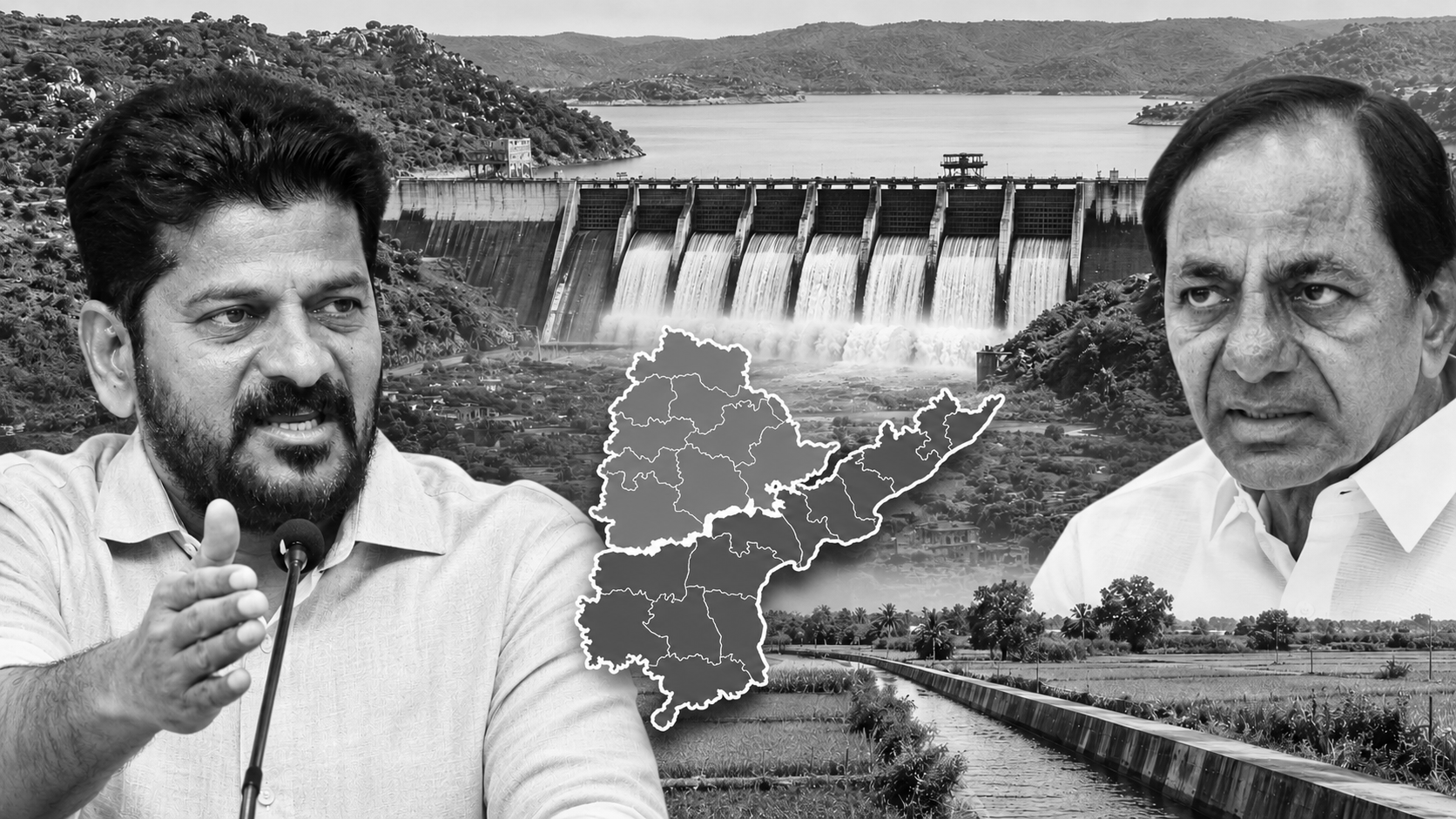
Krishna Water Row: CM Revanth Reddy Accuses KCR of Compromising Telangana's Rights
Telangana Chief Minister A Revanth Reddy has accused former chief minister K Chandrasekhar Rao of compromising the state's Krishna river water rights by accepting a substantially lower share for Telangana and allowing decisions that facilitated water diversion towards Andhra Pradesh, as fresh disagreements at the Krishna River Management Board (KRMB) have brought the decade-old dispute back into focus. The Chief Minister alleged that the previous BRS government accepted approximately 299 TMC for Telangana against Andhra Pradesh's 512 TMC, failed to oppose several irrigation projects and neglected Telangana's own schemes. The allegations come amid a fresh confrontation over the Palnadu Drinking Water Supply Scheme and competing demands for Nagarjuna Sagar water.
Revanth Reddy said his government was pursuing Telangana's claims before the KRMB, Centre, Supreme Court and Krishna Water Disputes Tribunal-II. He said Telangana was seeking approximately 575 TMC out of the 811 TMC allocated to undivided Andhra Pradesh, citing its share of the Krishna basin. He also referred to discussions with Prime Minister Narendra Modi, Union Jal Shakti Minister C R Patil and the Chief Ministers of Maharashtra and Chhattisgarh.
The dispute dates back to Andhra Pradesh's bifurcation in June 2014. The first Krishna Water Disputes Tribunal (KWDT-I), headed by Justice R S Bachawat, had allocated 811 TMC to undivided Andhra Pradesh under its 1976 award. A tentative arrangement reached in June 2015 provided 298.96 TMC to Telangana and 512.04 TMC to Andhra Pradesh. The KRMB subsequently continued a 66:34 sharing ratio in Andhra Pradesh's favour. However, a December 2022 parliamentary reply clarified that these were temporary arrangements and permanent shares had not been determined through an agreement or tribunal award.
Revanth questioned KCR's decisions concerning the Tummidihetti project and the expansion of the Pothireddypadu head regulator from 11,000 cusecs to 44,000 cusecs. He also cited Handri-Neeva, Muchumarri and Rayalaseema Lift Irrigation projects, alleging that Andhra Pradesh expanded diversion infrastructure while Telangana's schemes remained incomplete.
The latest flashpoint is Andhra Pradesh's approximately Rs 1,200-crore Palnadu Drinking Water Supply Scheme, which proposes to draw 1.865 TMC from Nagarjuna Sagar to serve 363 villages across 11 mandals, benefiting around 10 lakh people. Telangana objected to the proposed intake level of approximately 510 feet and approached the KRMB on November 16 seeking a halt to construction. In its November 19 communication, the Board highlighted jurisdictional issues and the requirement for technical appraisal and prescribed project clearances, but did not order a halt.
At its November 23 meeting, the KRMB committee considered competing Nagarjuna Sagar demands. Telangana sought 21 TMC until February 2027 and another 30 TMC for the following three months, citing Hyderabad's 15 TMC drinking-water requirement and five TMC in estimated evaporation losses. Andhra Pradesh sought 19 TMC, including 9 TMC for drinking water and 10 TMC for the Krishna Delta, covering over 13 lakh acres. The committee agreed in principle to release 9 TMC to Andhra Pradesh, comprising 8 TMC through the right canal and one TMC through the left canal, while referring the additional demand to the full Board.
The KRMB has also sought original approvals, canal capacities and technical records for Srisailam and Nagarjuna Sagar, including details of 11 Srisailam and two Nagarjuna Sagar components identified as unauthorised under the 2021 notification. The Centre has previously acknowledged deviations by both states from hydropower restrictions during 2020–21 and 2021–22.
Revanth accused the BRS government of neglecting SLBC, Kalwakurthy, Nettempadu, Bhima and Palamuru-Rangareddy projects. He claimed Andhra Pradesh's daily water-transfer capacity increased from 4.47 TMC to 13.17 TMC during the BRS tenure and said an additional Rs 10,000 crore investment could have accelerated Telangana's projects.
Rejecting the allegations, former irrigation minister T Harish Rao maintained that the 299:512 TMC arrangement was temporary and that the BRS had demanded a 50:50 interim sharing arrangement. He disputed Revanth's account of the 2015 agreement and cited the previous government's objections to the Rayalaseema Lift Irrigation Scheme before the KRMB, Apex Council and National Green Tribunal. He challenged the Chief Minister to convene a special Assembly session.
With permanent allocations still pending before KWDT-II, which received additional terms of reference in October 2023, the dispute continues to centre on water entitlements, project approvals and reservoir management. A legally settled allocation and effective coordination through the KRMB remain crucial to protecting the requirements of both states.