
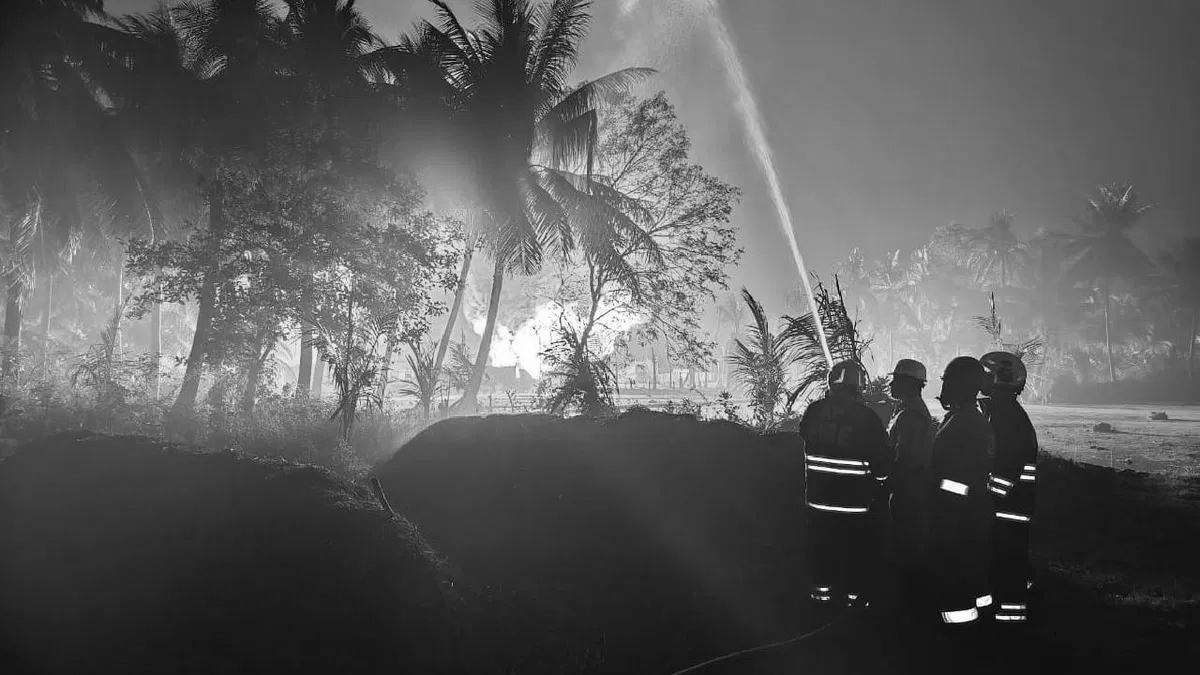
Konaseema boils, ONGC toils to tame Mori–5 blowout. Could take weeks
A fierce blaze continued for the second day at ONGC’s Mori–5 gas well in Malikipuram mandal of Dr B.R. Ambedkar Konaseema district , as specialist well-control teams worked round the clock to bring the situation under control. Officials cautioned that fully dousing the fire and stabilising the well could take several weeks , depending on ground conditions and the success of containment operations.
The incident occurred on Monday afternoon during drilling operations at Mori–5, when a gas leak triggered a blowout and ignited , sending flames reportedly rising up to 25 metres . As a precaution, authorities evacuated around 600 residents from nearby villages within a four-kilometre radius , shut two schools , and declared a restricted zone around the well site.
Senior officials and technical experts from ONGC rushed to the area, with specialist well-control teams from Delhi joining local crews. At least 10 fire tenders have been deployed, while cooling operations continue to allow safe access to the wellhead. ONGC has indicated that capping the well remains an option if initial control measures do not succeed.
Not the 2014 GAIL disaster
The Mori–5 incident has inevitably drawn comparisons with the 2014 GAIL pipeline explosion in East Godavari , which killed 22 people . That tragedy, however, was fundamentally different : it involved a midstream pipeline rupture running through inhabited areas, while the current emergency is an upstream drilling-well blowout , confined largely to the wellsite with no reported casualties so far.
Lessons from past blowouts
Past well-control operations show how timelines can vary. In Assam , ONGC capped a gas-well blowout in about 15 days in a recent case, while the Baghjan blowout of 2020 took several months to fully “kill”. Internationally too, major gas leaks have ranged from weeks to months before complete containment. Experts say the ability to safely access the wellhead is the single biggest factor that determines how long such fires last.
Cost and losses
Industry estimates suggest the value of gas burnt during the blaze is modest , but the real cost lies elsewhere. Well-control operations, specialist equipment, possible capping, and repairs could together cost ₹70–150 crore , while lost production during downtime may add tens of crores more , depending on how long Mori–5 remains shut.
Part of a much larger basin
Mori–5 sits within the Krishna–Godavari (KG) Basin , one of India’s most active hydrocarbon regions. The onshore KG basin hosts over 100 ONGC wells , while offshore KG fields add dozens more , spread across multiple clusters rather than concentrated at one site. Against this scale, officials say the present incident is localised and not indicative of a basin-wide failure .
Limited impact on fertiliser and power
Any disruption to gas flows may briefly affect fertiliser units near Kakinada and the 272-MW APGPCL gas-based power plant , both of which use KG gas. However, analysts note that gas-based power accounts for less than 2% of Andhra Pradesh’s electricity mix , meaning the incident is unlikely to significantly impact power supply or urea availability beyond the immediate region.
For now, authorities remain focused on safety and containment , stressing that evacuations will continue until the blaze is fully controlled and the well secured.