
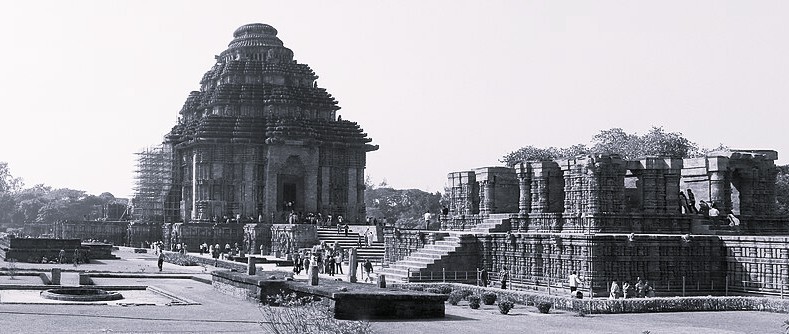
Konark Sun Temple: A Timeless Chariot Carved in Stone
On the eastern coast of India, where the Bay of Bengal greets the first light of dawn, stands a monument that seems to converse with the rising sun itself. The Konark Sun Temple in Odisha is not merely an ancient shrine. It is a story carved in stone — a story of kings, craftsmen, science, faith and the timeless human urge to capture the movement of the cosmos.
Every morning, when sunlight touches its giant stone wheels, Konark appears as though the chariot of the Sun God has just emerged from the sea. Even in its partially ruined state, the temple remains one of the most breathtaking creations in the history of Indian architecture.
A King’s Vision in the 13th Century
The story of Konark begins in the 13th century , when King Narasimhadeva I of the powerful Eastern Ganga dynasty decided to build a temple that would celebrate the glory of Surya, the Sun God . Around 1250 CE , thousands of craftsmen, sculptors and engineers gathered along the Odisha coast to create a monument unlike any the world had seen before.
The king’s vision was extraordinary. The temple would not be built as a traditional shrine. Instead, it would take the form of the celestial chariot of the Sun God , a structure that symbolized the movement of time and the rhythm of the universe.
Pulled by seven powerful stone horses , the chariot would appear to move across the sky. At its base would stand twenty-four giant wheels , each carefully carved with intricate designs. These wheels were not only decorative but also served as sundials , capable of measuring the passage of time through shadows.
In essence, Konark became a temple where architecture met astronomy .
A Marvel of Kalinga Architecture
The monument was built in the Kalinga style of temple architecture , known for its towering structures and elaborate stone carvings. The complex once consisted of several monumental structures.
At the centre stood the Vimana , the towering sanctum that once rose to more than 200 feet . In front of it stood the Jagamohan , the grand assembly hall where devotees gathered. The complex also included the Nata Mandir , where temple dancers performed, and the Bhoga Mandapa , where offerings were prepared.
Today, the towering sanctum has long disappeared, but the Jagamohan hall still stands like a silent guardian of history.
The temple was constructed using massive blocks of khondalite stone , transported from distant quarries and assembled with remarkable precision. The joints between the stones are so perfectly fitted that even today they appear almost seamless.
A Gallery of Life in Stone
Walking around Konark is like walking through an ancient illustrated manuscript. The temple walls are covered with thousands of sculptures that depict not only gods but the entire spectrum of human life .
There are musicians playing instruments such as the veena and mardala , dancers caught mid-performance, warriors marching to battle, kings holding court, and travellers embarking on long journeys. Scenes of village life, festivals and hunting expeditions reveal how people lived centuries ago.
Among these carvings are also the famous erotic sculptures that have drawn both admiration and curiosity. These mithuna figures represent human intimacy as part of life’s natural order. In traditional Indian philosophy, life is guided by four goals - Dharma, Artha, Kama and Moksha - and the temple reflects this holistic view of existence.
A Temple Beyond One Faith
Though dedicated to the Sun God, Konark is not confined to a single deity. The temple walls feature images of Durga, Vishnu, Shiva and several Vedic gods including Indra, Agni and Varuna . This diversity of divine imagery reflects the inclusive nature of Hindu spirituality, where multiple traditions coexist within a shared sacred universe.
The “Black Pagoda” of the Seas
Centuries later, when European sailors began navigating the Bay of Bengal, they noticed a towering structure rising above the coast. Because of its dark stone appearance, they began calling the temple the “Black Pagoda.”
Nearby, the Jagannath Temple in Puri , built from lighter stone, became known as the “White Pagoda.” Together, these landmarks served as navigational markers for ships approaching the eastern coast of India.
The Mystery of Its Ruin
Despite its grandeur, Konark did not escape the forces of time. Scholars still debate why the temple’s massive sanctum tower collapsed. Some suggest invasions during the 16th century, while others point to natural causes such as cyclones, shifting foundations and the corrosive effects of salty sea winds.
By the 19th century, much of the monument had fallen into ruin. Sand and vegetation slowly engulfed the remaining structures.
A Monument Saved by Sand
In 1903 , British administrators decided to protect the surviving Jagamohan hall from collapse by filling its interior with sand and sealing the entrances. Although the measure was controversial, it helped stabilize the structure. For more than a century, the interior of the temple remained hidden behind this protective barrier.
A Hidden Past Begins to Reappear
More than 120 years later , a new chapter in Konark’s story has begun. In 2022 , the Archaeological Survey of India started carefully removing the sand from the Jagamohan hall as part of a major restoration effort.
Using advanced technologies such as ground-penetrating radar and laser scanning , engineers and archaeologists are studying the structure to ensure that it remains stable during the process. As the sand is gradually removed, historians hope that hidden sculptures, inscriptions and architectural details that have not been seen for generations will come to light.
A Cultural Heart of Odisha
Today, Konark forms part of Odisha’s famous Golden Triangle of heritage , along with the Jagannath Temple in Puri and the Lingaraj Temple in Bhubaneswar .
The temple has inspired poets, artists and historians for centuries. Rabindranath Tagore once observed that at Konark, “the language of stone surpasses the language of man.” The monument has even found a place in everyday life across India - its image appears on the reverse side of the Indian ₹10 currency note , symbolizing the country’s architectural legacy.
Where Stone Meets the Sun
Though centuries have passed and parts of the temple have vanished, Konark remains alive in spirit. The stone horses no longer move, yet the chariot still seems ready to ride across the horizon. Every dawn, as sunlight spreads across the ancient wheels, the temple awakens once more.
Konark is not merely a relic of the past. It is a monument where science meets art, where faith meets imagination, and where a civilization chose to capture the journey of the sun in stone.