
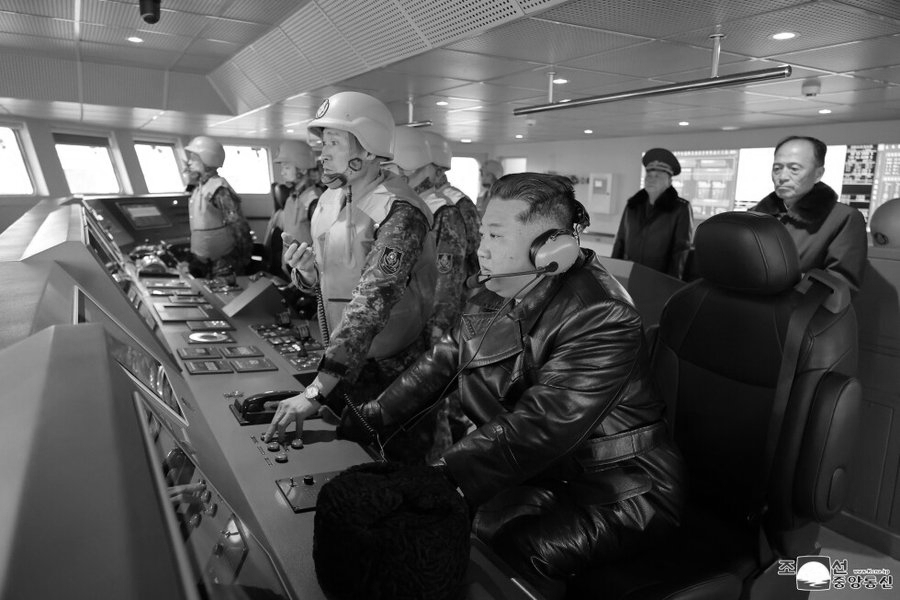
Kim inspects Missile-firing destroyer as NK boosts maritime strike capabilities
North Korean leader Kim Jong Un inspected his country’s new 5,000-ton destroyer, Choe Hyon , over two days at the Nampo shipyard , observing cruise missile tests and pledging to accelerate the nuclear armament of his navy, state media reported Thursday.
Kim also reviewed the construction of a third destroyer of the same class, expected to be completed by the Workers' Party’s founding anniversary in October , calling the Choe Hyon a “significant advancement” toward extending operational range and preemptive strike capabilities. The vessels are reportedly capable of deploying anti-air, anti-naval, and nuclear-capable ballistic and cruise missiles .
The developments have alarmed South Korea , the United States , and regional allies, who warn that nuclear-capable naval platforms could alter the balance of power in disputed waters, including the Northern Limit Line (a disputed maritime boundary in the Yellow Sea between North Korea and South Korea) , and pose a mobile, hard-to-detect threat to regional security. Experts note such ships enhance North Korea’s second-strike potential, complicating conventional and nuclear deterrence strategies.
South Korean analysts also suggest that the Choe Hyon class may have been built with Russian technical assistance , reflecting growing Russia-North Korea defense cooperation , though some experts question whether the vessels are fully operational. A prior destroyer, Kang Kon , was damaged during a failed launch in 2025 but later repaired and relaunched.
Kim’s naval push forms part of a broader military agenda outlined at last month’s Workers’ Party congress , including nuclear-powered submarines and underwater-launched intercontinental missiles . He framed these developments as vital for defending maritime sovereignty, asserting progress was “satisfactory.”
Analysts warn that North Korea’s expansion of nuclear-capable naval assets could intensify tensions on the Korean Peninsula and in the Indo-Pacific , risk triggering a regional arms race, and complicate diplomatic efforts with Washington and Seoul.