
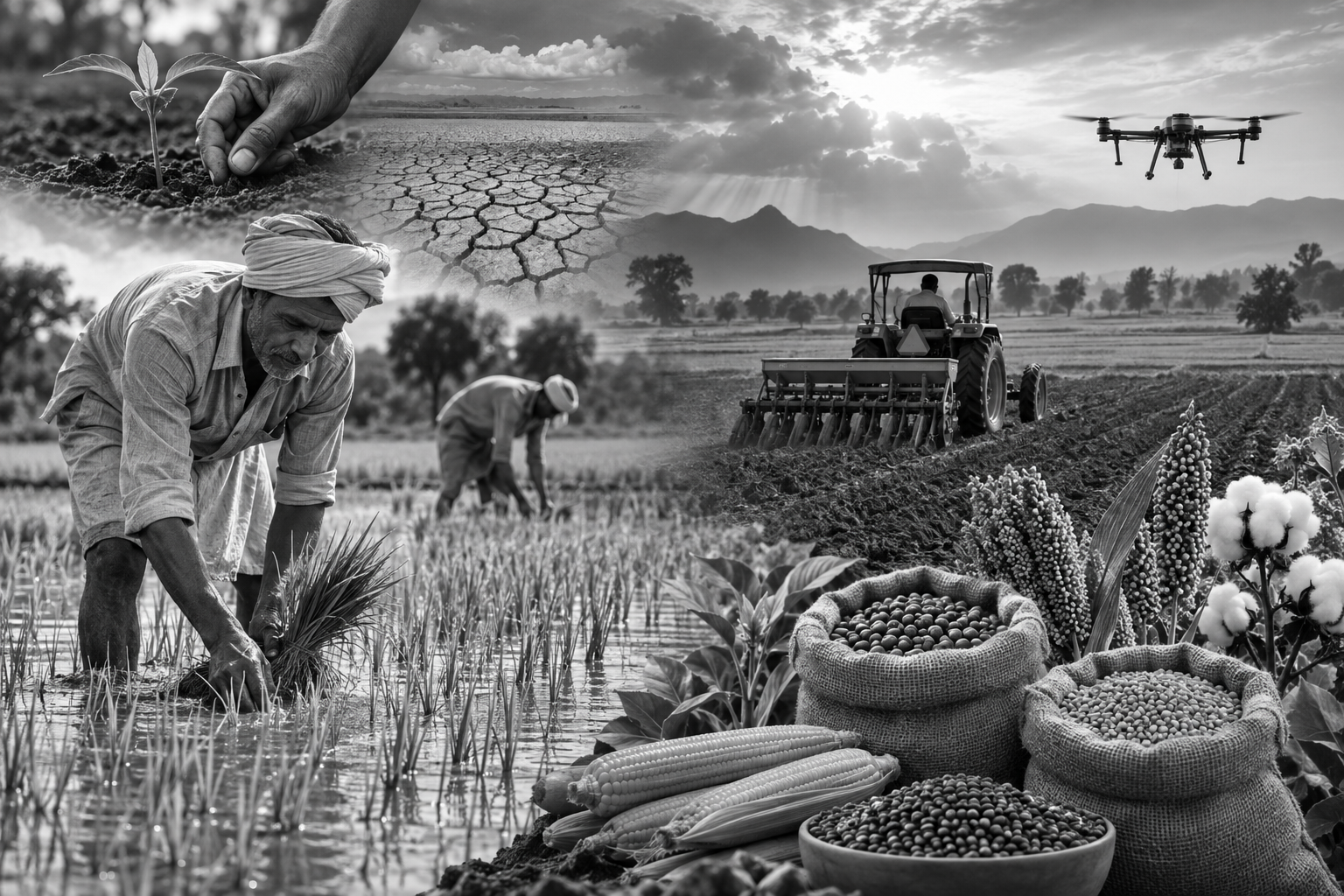
Kharif 2026: Rice Drives Acreage Deficit as Pulses, Bajra and Jowar Gain
India’s 2026 Kharif season is emerging as more than a story of shrinking acreage. The latest crop coverage data point to a subtle but significant shift in what farmers are growing, where they are growing it and how agriculture may need to adapt to increasingly erratic weather. As of September 4, farmers had covered 1,086.31 lakh hectares under Kharif crops, compared with 1,104 lakh hectares during the corresponding period last year, leaving a deficit of 17.69 lakh hectares. While the overall decline is relatively modest, the composition of the acreage reveals a sharper trend: rice accounts for most of the shortfall, while pulses have expanded and several other crops are moving in different directions.
The latest figures from the Crop Weather Watch Group need to be viewed against an increasingly uneven monsoon. Rainfall was significantly below normal in June and again in August, while September has become crucial for crops at important growth stages. Recent assessments have described the 2026 monsoon as unusually distorted geographically, with some regions receiving excessive rainfall while others face prolonged dry spells. This makes the distribution and timing of rain almost as important as the seasonal total.
Rice dominates the deficit
Rice is the biggest reason behind the national acreage gap. Paddy has been planted across 421.82 lakh hectares, against 438.19 lakh hectares during the corresponding period last year, representing a decline of 16.37 lakh hectares. The largest reductions have come from Karnataka, down 4.28 lakh hectares, Telangana by 3.61 lakh hectares, Uttar Pradesh by 1.84 lakh hectares, Andhra Pradesh by 1.91 lakh hectares, Madhya Pradesh by 1.75 lakh hectares, Jharkhand by 1.38 lakh hectares, Tamil Nadu by 1.32 lakh hectares and Maharashtra by 1.15 lakh hectares. Assam and Odisha have recorded increases of 0.52 lakh hectares and 0.29 lakh hectares respectively, but these gains are insufficient to compensate for the losses elsewhere.
Yet the five-year benchmark provides an important qualification. The current rice acreage remains above the Agriculture Ministry’s normal level of 412 lakh hectares. Therefore, the latest decline should not automatically be interpreted as a structural collapse in rice cultivation. It is more accurately a sharp year-on-year reduction from an unusually high base.
The longer-term data also demonstrate why acreage alone cannot predict the harvest. Official figures show rice area rising from 462.79 lakh hectares in 2021-22 to 478.28 lakh hectares in 2023-24, while production increased from 1,294.71 lakh tonnes to 1,378.25 lakh tonnes. Yield also rose from 2,798 kg per hectare to 2,882 kg per hectare. The equation is straightforward: production equals area multiplied by yield. A smaller planted area can therefore be offset by better productivity.
Pulses point to a changing crop mix
The clearest countertrend is visible in pulses. Their acreage has reached 117.13 lakh hectares, up 1.84 lakh hectares from 115.30 lakh hectares last year, although still below the 123.63-lakh-hectare normal. Tur covers 45.66 lakh hectares, urad 25.15 lakh hectares and moong 33.19 lakh hectares. Urad has recorded particularly strong growth.
Uttar Pradesh has added 3.97 lakh hectares of pulses, followed by Jharkhand at 0.98 lakh hectares, Telangana at 0.90 lakh hectares, Rajasthan at 0.57 lakh hectares and Madhya Pradesh at 0.38 lakh hectares. These gains have more than offset reductions in Maharashtra, Karnataka and Odisha. The shift matters because pulses are linked not only to farmer diversification but also to nutrition, food security, imports and soil health. Leguminous crops can contribute nitrogen through biological fixation and can fit into diversified rotations.
Millets and oilseeds tell a mixed story
The area under Shri Anna and coarse cereals stands at 181.39 lakh hectares, marginally below last year's 182.48 lakh hectares and the normal 182.63 lakh hectares. Jowar has increased by 0.97 lakh hectares and bajra by 1.99 lakh hectares, while ragi has fallen by 1.17 lakh hectares and maize by 2.99 lakh hectares. Karnataka and Maharashtra have recorded substantial declines, while Rajasthan, Chhattisgarh, Odisha, Madhya Pradesh, Bihar, Uttar Pradesh, Jharkhand and Uttarakhand have registered gains.
Oilseeds are similarly mixed. Coverage stands at 191.99 lakh hectares, down 1.07 lakh hectares from last year and below the 200.08-lakh-hectare normal. Soybean and groundnut acreage has declined, particularly in Rajasthan and Gujarat, but sesame has increased by 1.44 lakh hectares. Uttar Pradesh and Madhya Pradesh have also recorded higher oilseed coverage.
Cotton stands at 109.17 lakh hectares, down 0.69 lakh hectares, with reductions concentrated in Rajasthan, Haryana and Punjab but gains in Telangana and Gujarat. Sugarcane is marginally lower at 58.47 lakh hectares, although still above its normal area of 54.20 lakh hectares. Jute and mesta have edged up to 6.34 lakh hectares.
The new battle is productivity with less water
The changing crop map is unfolding alongside a transformation in farm management. In rice, technologies such as Direct-Seeded Rice (DSR) are reducing dependence on conventional nursery raising and transplanting, potentially lowering labour and water requirements. ICAR has promoted DSR as a resource-conservation technology, although its success depends on proper land levelling, sowing, variety selection and weed management.
Alternate Wetting and Drying (AWD) is another approach that challenges the traditional assumption that rice fields must remain continuously flooded. By allowing fields to drain before irrigation is reapplied, farmers can improve water-use efficiency. The System of Rice Intensification also combines younger seedlings, wider spacing, soil management and controlled irrigation to improve productivity under suitable conditions.
The broader shift is towards precision agriculture. Soil testing, weather-based advisories, precision fertiliser application, mechanised sowing, integrated pest management, satellite monitoring and drones are increasingly being explored to apply the right input at the right time rather than simply using more water, fertiliser or pesticides. Research using UAV multispectral imagery and machine learning is also examining ways to assess crop biomass and nitrogen status more accurately.
September could decide more than Kharif
The immediate concern is no longer just how much land has been planted but what yield that land will deliver. Rice, soybean, cotton, maize and pulses are entering critical stages, making September rainfall particularly important. At the same time, late-monsoon moisture will influence the next Rabi season, including crops such as wheat, chickpea and rapeseed. A dry September could therefore create a double challenge: weaker Kharif yields followed by poorer soil-moisture conditions for Rabi sowing.
The implications extend to consumers. A weaker pulse or oilseed harvest could increase import dependence, while disruptions in sugarcane and cotton could affect prices and downstream industries. Food inflation therefore remains part of the agricultural equation.
India's agricultural transformation is also visible beyond Kharif. The Economic Survey noted that horticulture production reached 362.08 million tonnes in 2024-25, exceeding estimated foodgrain production of 329.68 million tonnes, highlighting the gradual movement towards higher-value agriculture.
The September 4 acreage figures consequently tell a story much larger than a 17.69-lakh-hectare deficit. They show an agricultural system responding to water constraints, climate volatility, market signals and technology. Rice remains central, but pulses, millets, oilseeds and high-value crops are gaining importance in different regions. The next agricultural revolution may therefore be less about putting more land under cultivation and more about producing more from every hectare, every drop of water and every unit of input.
The real test for 2026 will be whether India's farmers can convert the acreage already planted into strong yields despite an uneven monsoon. And beyond Kharif lies an equally important question: will September leave enough moisture in India's soils for the Rabi season to begin on firm ground?