
Khammam Fort - History, Architectural Grandeur, and Tourism Significance
Khammam Fort, standing majestically in the heart of Khammam city, Telangana, is a symbol reflecting the region's history, culture, and valor. This fort has witnessed numerous political changes and the downfall of dynasties over the centuries, attracting people with its endurance. Built on rocky terrain amidst natural beauty, this fort has become the identity of Khammam city. Let's explore the details of this magnificent fort.
Over a Thousand Years of History
Khammam Fort is a hill fort with a history spanning over a thousand years. Historical accounts suggest it was built during the Kakatiya period. This place, mentioned in ancient inscriptions as "Khammamettu", is a historical center that blends spirituality, strategic importance, and architectural splendor.
• The foundation stone for the fort's construction was laid in 950 CE.
• Initially built with mud, the fort was later transformed into a permanent structure using granite stones.
• The construction was completed in 1006 CE.
Subsequently, Khammam Fort remained under the control of the Reddi dynasty for 300 years. Later, the Velama, Nandavani, Kalluru, and Gudluru dynasties ruled the fort. After the fall of the Kakatiya Empire, 74 feudal kings under the leadership of the Musunuri fought for ten years with the goal of unifying the Telugu land. In this struggle, the Oḍra Gajapati Raja conquered the Khammam Fort. Great warriors like Kapa Naidu and Pola Naidu (Musunuri Nayaks) took over the fort's administration.
In the 15th century, Seetapati Raju, who came to rule Khammam Fort, was appointed as the regent of Warangal with the help of the Bahmani Sultans. Fearing that the sculptural wealth would be destroyed by the Muslims, Seetapati Raju buried the idols of Shiva, Vishnu, gatekeepers, the royal dancer, and Surya Bhagavan (Sun God) to protect the Hindu sculptural heritage. These were later unearthed during excavations. Currently, the Archaeological Department has preserved them near the Ganapeshwara Temple. He is also credited with the restoration of the Panchalaraya Temple in Orugallu.
In 1531, Sultan Quli Qutb Mulk defeated Seetapati Raju and brought Khammam Fort under the control of the Qutb Shahis. In 1687, Aurangzeb attacked Golconda and seized the fort. Subsequently, Khammam Fort came under Nizam's rule. In 1722, Nizam ul-Mulk Asaf Jah I declared independence, and the Nizam government officially took control in 1937.
Historical evidence suggests that Khammam's former name was "Kambham Mettu" or "Sthambadri". The word "Mettu" in Telugu means a hill or elevated area. The name was also anglicized as "Kamomet" and "Khummummet". Khammam Fort is also referred to as Killa.
Architectural Style of the Fort
The architectural style of Khammam Killa is a fusion of various religious influences. The construction exhibits Hindu sculpture, Islamic towers, and Buddhist influences.
• The fort spans an area of four square kilometers (approximately 4 square miles).
• The wall height ranges from 40 to 80 feet, with a width of 15 to 20 feet.
• The fort has 10 gateways, of which the main entrance, known as Patter Darwaza, is the largest.
• The fort had the capacity to deploy 60 cannons.
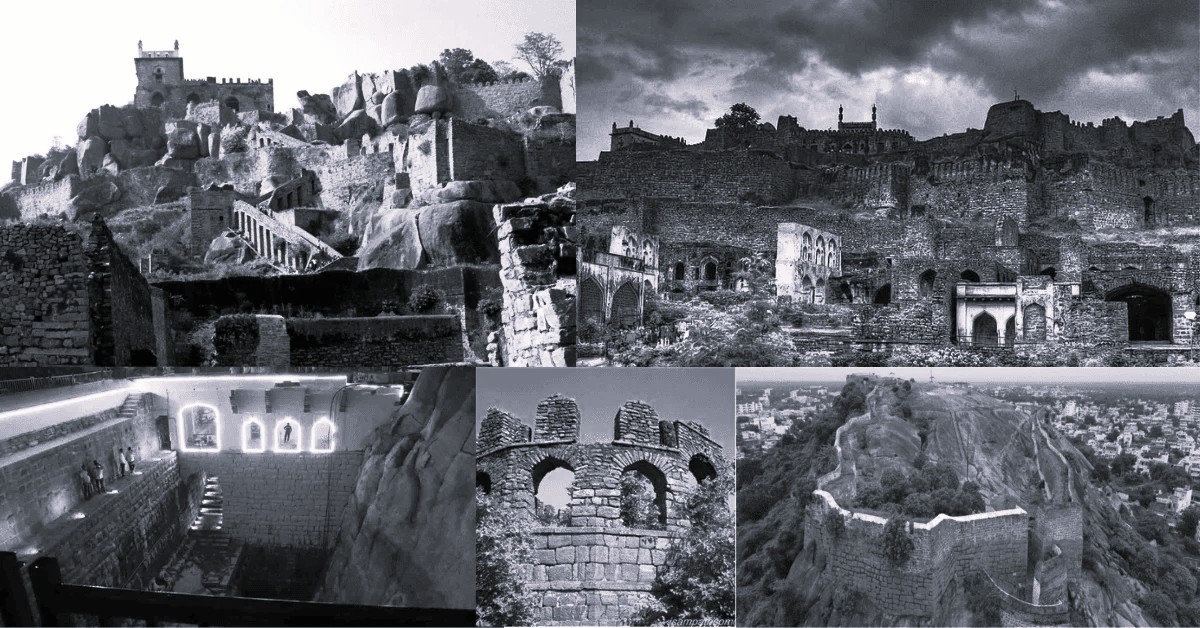
Inside the fort, there are an old Masjid (mosque) and a Mahal (palace) built during the time of Zafar-ud-Daula. There is also Zafar-ud-Daula's well, which is 60 feet long and 20 feet wide. Water channels, stone steps, and watchtowers for storing rainwater were constructed very scientifically. Local narratives also speak of a secret tunnel for escape in case of a siege.
The fort is situated on a massive granite hill in the heart of Khammam city, covering an area of 4 square miles. There are steps carved from this hill to reach the top of the hill fort, starting from each Buruju (bastion). Numerous balconies and windows were built along the wall for using cannons during warfare, many of which are now in ruins. Cannons were mounted on every gate, along with a stone water pot. They were built to be so strong that they would not break even from a cannonball strike. They are now partially damaged due to the neglect of the Archaeological Department.
During the time of Zafar-ud-Daula, known for tank construction during the Qutb Shahi dynasty, a massive rainwater drainage system and a well were constructed on the Killa. This huge reservoir is now called 'Zafar Baavi' (Zafar's Well). It is 60 feet high and 30 feet long, with a bridge over it for men and horses to traverse.
Upon entering the Killa Darwaja (gate), the fort is visible at a distance of 300 feet. Small steps were carved from the hill to reach the top of the hill fort. Later, in 2005, during the 1000th-anniversary celebrations of this historical fort, the Tourism Department and the Archaeological Survey of India restored the steps with railings. Very small doorways called 'Dalohishwar' surround the fort walls. As a military strategy, at least 15 bastions with two massive walls were constructed in the fort to withstand the impact of cannonballs and engage enemies from above. In some places, a 15-foot-deep trench was dug to be used as a storage and hiding place for the army. The massive stone blocks used for the walls are 10 feet long. No mud or limestone was used in this massive wall; only the stones were firmly placed. Visitors are astonished by its construction.
On this prominent hill fort, a well-like structure for carrying out permanent hanging (capital punishment) was built. It is possible that the court was located inside the fort. This structure is made of stone and looks like a well, which is why locals call it 'Neyti Baavi' (Ghee Well). This stone structure is visible from all corners of Khammam city.
It is believed that the fort has secret tunnels leading to the Warangal Fort, with multiple entry points in different parts of the fort. One such entrance has a diameter of 10 feet. The steps to enter the tunnel have been closed due to damage over the years. Local folklore includes stories about the transfer of valuables between kings using these secret passages and escaping enemy attacks through them.
Culture
The fort appears as a reflection of the cultures of the Hindu and Muslim rulers who governed the city. The Lakshmi Narasimha Swamy Temple in Brahmin Bazaar, the Sri Ramalingeshwara Temple (the most ancient Shiva Temple) are some of the oldest Hindu temples in Telangana, older than the fort itself. During the Qutb Shahi dynasty, many new places of worship, such as the Killa Masjid, were built inside and around the fort.
Seetapati Raja, with the help of his grandfather, worked extensively for the restoration of the Telugu Empire. During his time, Khammam became a major center for Telangana.
Srikrishnadevaraya, the Andhra Bhoja, also conquered it as part of his victorious campaign and acquired it from the Gajapatis in 1615. In Nukka Timmana's Parijatapaharanam , the work is described as "Grakamba Prabandham" on a literary basis when describing the valor of the patron, Krishnadevaraya.
Encroachments and Development
Once a strong fort for the royal dynasties, the fort is now facing a greater risk of encroachment due to a lack of proper monitoring mechanism. Large settlements have occupied the areas inside and around the fort due to inadequate supervision of encroachments. The destruction of the granite hill and the construction of houses continue around the fort area even today.
• On Tourism Day, rock climbing activities are organized at the fort.
• Many festivals take place on the fort during national holidays.
• In 2010, on the occasion of Sri Krishna Devaraya's coronation ceremony, the then Collector installed a statue of Rayala on the fort. That statue is also now in a state of disrepair.
• When Renuka Chowdhury was a Union Minister, a railing was installed and steps were carved to ascend the fort. Two sheet-metal shelters were constructed on the fort for tourists to rest.
Cultural and Spiritual Significance
A unique feature is the presence of several temples within the fort's premises. Notably, the Sri Venkateswara Swamy Temple, Hanuman Temple, and Nagulamma Gudi (Snake Goddess Temple) are living reminders of the ancient architecture. Annual festivals, especially the Rathotsavam (Chariot Festival), attract a large number of devotees.
Development of Khammam Fort as a Tourist Center
In recent years, the government has undertaken special measures to develop Khammam Fort as a prominent tourist center.
• Beautification and the installation of lighting around the fort make it attractive at night.
• Streetlights, pedestrian pathways, repair of steps and roads for easy access for tourists, and the installation of interpretation boards and historical details.
• The fort has been developed as a Heritage Zone, identified in the city's design project. These efforts play a crucial role in attracting tourists.
Tourist Attractions
The fort stands as a must-visit location for everyone coming to Khammam city due to:
• The beauty of the natural granite hills.
• The spectacular view of Khammam city from the fort's summit.
• The ancient walls and bastions.
• The tranquil atmosphere.
• The opportunity to visit the temples.
• The excellent spots for photography.
Khammam Fort – Transportation and Accommodation Details
Since Khammam is one of the major cities in Telangana, transportation facilities are easily available. As the fort is in the city center, it is very easy to reach.
The distance from Hyderabad to Khammam is about 195 km. Government buses frequently run on the Hyderabad, Suryapet, Khammam or Hyderabad, Miryalaguda, Khammam routes. Direct buses are also available from major cities like Vijayawada, Warangal, Bhadrachalam, Karimnagar, Nalgonda, etc. The distance from the RTC bus stand in the city to the fort is only 2 to 3 km. Autos, cabs, and rickshaws are easily available. Khammam Railway Station is an important junction belonging to the South Central Railway. The distance from the railway station to the fort is about 4 km. It can be reached in 10, 12 minutes by auto/cab. Hyderabad Rajiv Gandhi International Airport is 200 km away. Vijayawada Gannavaram Airport is 120 km away. Buses, cabs, and car rentals are available from both these airports.
Accommodation Facilities
Since Khammam is a developed city, many accommodation centers, ranging from small budget to luxury hotels, are available. Many hotels offering good facilities at reasonable prices are available in the city, providing AC and non-AC rooms, parking, 24x7 water, Wi-Fi, and a safe environment for tourists.
Choosing accommodation near the Khammam Fort is convenient for city sightseeing. The fort can be reached in 5 to 10 minutes by walk or auto. Shopping areas, restaurants, and travel resources are nearby.
Visiting Khammam Fort is very convenient because transport routes are extensive and accommodation facilities are available for all budgets. Families, tourists, and history enthusiasts can easily visit the fort and enjoy its architectural grandeur.
Khammam Fort is not just an ordinary fort. It is a living witness to the history that has stood on this land for centuries. The artistry of the Kakatiyas, the construction style of the medieval kingdoms, and cultural splendor all came together in the construction of this fort. For the present generation, the fort is not just a tourist center; it is a standing testament to the talent, valor, and cultural heritage of our ancestors. With further development in the future, Khammam Fort can become the most prominent heritage spot in Telangana.