
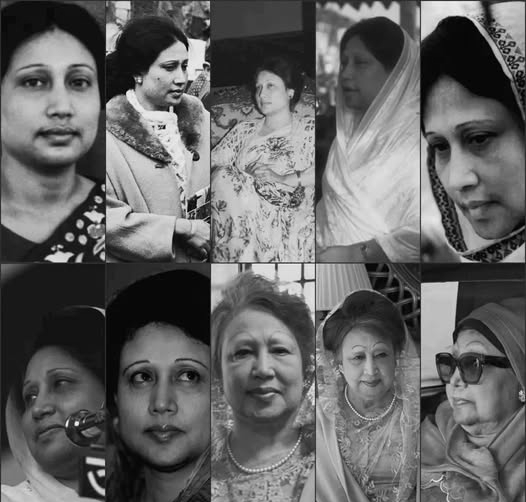
Khaleda Zia, Bangladesh’s first woman prime minister, dies at 80
Khaleda Zia, the first woman prime minister of Bangladesh and one of the most influential leaders in the country’s post-independence history, passed away on Tuesday morning at the age of 80 after a prolonged illness. She died around 6 am at Evercare Hospital in Dhaka, where she had been receiving treatment for multiple age-related ailments. Her death marks the end of a political era shaped by her leadership and her long rivalry with Sheikh Hasina, a contest that deeply influenced Bangladesh’s domestic politics and its relations with India.
Born as Khaleda Khanam, popularly known as “ Putul ,” on August 15, 1945, in Dinajpur during British India , she lived largely outside public life before entering politics. In 1960, she married Ziaur Rahman, then a young Pakistan Army officer. Her life took a decisive turn during the Bangladesh Liberation War of 1971, when Ziaur Rahman emerged as a central figure in the independence movement. On March 26 that year, he made a historic radio broadcast from Kalurghat in Chittagong declaring Bangladesh’s independence on behalf of the provisional Mujibnagar government, at a time when Sheikh Mujibur Rahman was imprisoned in West Pakistan.
After independence, Ziaur Rahman rose through the ranks to become army chief and later president in 1977, playing a crucial role in stabilising Bangladesh after years of coups and political turmoil. Despite later political narratives that often stressed nationalism and distance from India, Ziaur Rahman acknowledged India’s decisive contribution to Bangladesh’s liberation . He once remarked that R. N. Kao , the first chief of India’s Research and Analysis Wing, “ knows more about my country than I do ,” a statement widely interpreted as recognition of India’s intelligence and military role in the 1971 war. His assassination in 1981 profoundly altered Khaleda Zia’s life and led her into politics.
Khaleda Zia entered public life at a time when Bangladesh was under military rule and democratic institutions were fragile. She became chairperson of the Bangladesh Nationalist Party in 1984 and emerged as a prominent leader of the mass movement that eventually restored democracy. When she assumed office as prime minister in 1991, Bangladesh was struggling with weak institutions, economic uncertainty and the legacy of authoritarian governance.
Her first term from 1991 to 1996 is widely regarded as a key moment in Bangladesh’s democratic consolidation. Parliamentary democracy was restored, press freedoms expanded and civilian authority over the military was reinforced. Her government pursued market-oriented economic reforms, encouraged private investment and promoted rural development. While economic growth remained moderate, the period brought relative political stability compared with the turbulence of the 1980s.
Khaleda Zia returned to power for a second term from 2001 to 2006, a period marked by improved economic indicators as well as growing political polarisation. Bangladesh recorded higher GDP growth, rising foreign remittances and progress in education and social development. At the same time, her government faced criticism over governance, allegations of corruption and the rise of militancy. The emergence of extremist groups during this period raised serious domestic and international concerns, including for India, although subsequent security operations weakened several militant networks.
Throughout her career, Khaleda Zia remained a deeply polarising figure. Supporters viewed her as a defender of national sovereignty and a leader who helped restore democracy after years of military rule. Critics accused her governments of weakening institutions and perpetuating political confrontation. These competing perceptions shaped public opinion and ensured that she remained a central figure in Bangladesh’s political life for more than three decades.
India-Bangladesh relations under Khaleda Zia were often complex and cautious. While diplomatic ties were maintained, her governments adopted a more nationalist foreign policy, resisting Indian influence on issues such as transit, connectivity and regional security cooperation. Her administration placed greater emphasis on relations with China, Pakistan and Middle Eastern countries, reflecting a multi-vector approach that contrasted with Sheikh Hasina’s closer alignment with New Delhi. This divergence made Khaleda Zia’s tenure a defining phase in the evolution of bilateral ties.
In her later years, Khaleda Zia’s political influence declined amid legal challenges. She was convicted in corruption cases in 2018, charges that she and the BNP described as politically motivated. Following years of imprisonment and house arrest, she was released after major political changes in 2024. In 2025, the Supreme Court acquitted her and her son Tarique Rahman, partially restoring her political standing.
Condoling her death, Prime Minister Narendra Modi said he was deeply saddened and extended condolences to her family and the people of Bangladesh. Recalling a meeting with her in Dhaka in 2015, Modi said her contributions to Bangladesh and to India-Bangladesh relations would be remembered, adding that he hoped her vision and legacy would continue to guide ties between the two neighbouring countries.
Khaleda Zia is survived by her elder son Tarique Rahman, the acting chairman of the Bangladesh Nationalist Party, his wife Zubaida Rahman and their daughter Zaima Rahman, while her younger son, Arafat Rahman, died in 2015. With her death, Tarique Rahman is expected to consolidate his leadership of the BNP, a development analysts say could influence the party’s strategy and the political landscape ahead of the upcoming elections. Funeral prayers are expected to be held in Dhaka, followed by her burial beside her husband , former president Ziaur Rahman.