
Kerala Records 28% Monsoon Deficit as Water Security Risks Grow
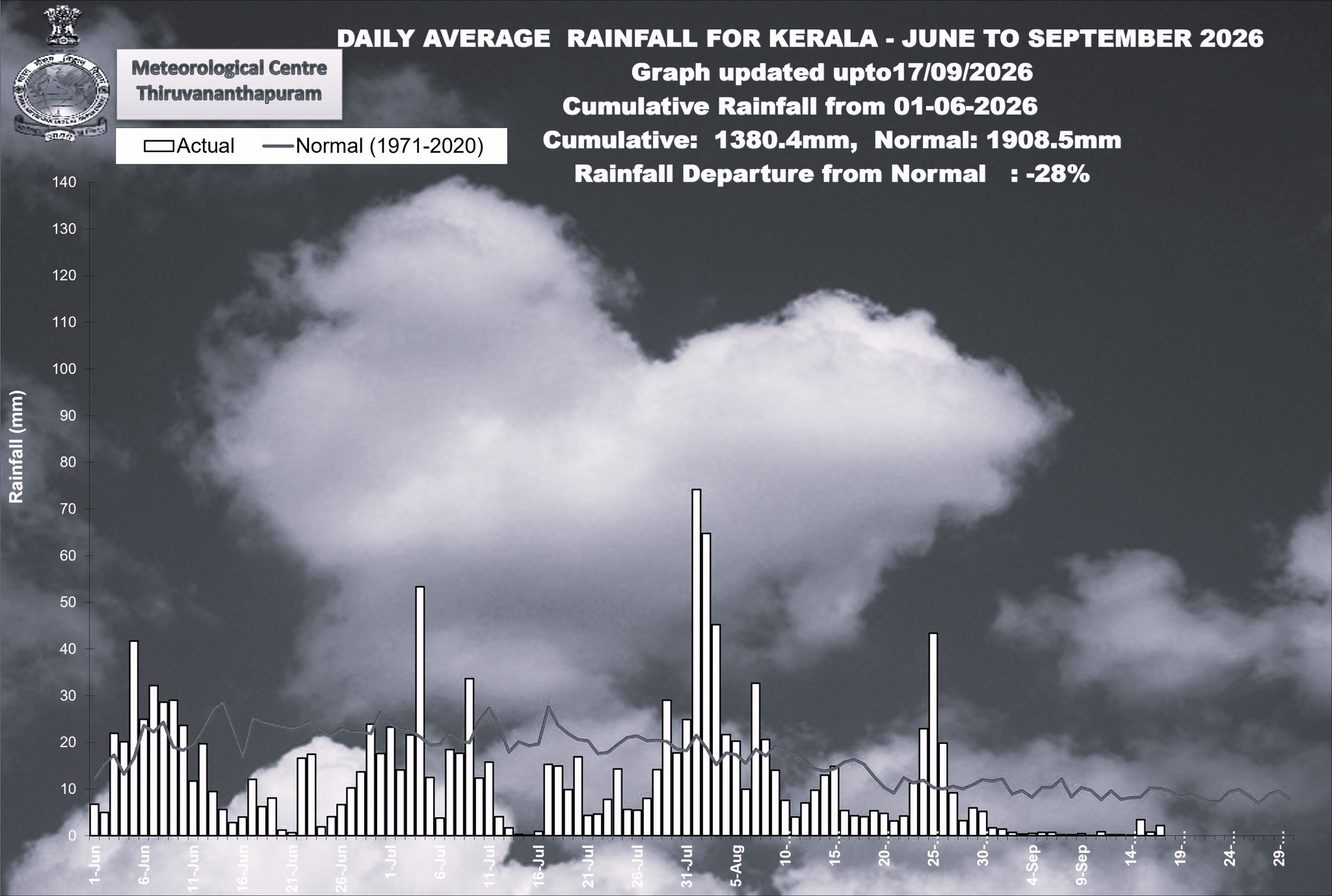
Kerala has received 28 per cent less rainfall than normal during the southwest monsoon so far this year, raising concerns over reservoir storage, hydropower generation, agricultural activity, groundwater recharge and water security as the season enters its final phase. According to India Meteorological Department (IMD) data for June 1 to September 17, the state received 1,380.3 mm of rainfall, against the normal 1,908.5 mm, leaving a shortfall of 528.2 mm. Of Kerala’s 14 districts, eight recorded deficient rainfall, with Wayanad facing the highest deficit at 54 per cent, followed by Idukki at 47 per cent, Kollam at 36 per cent and Alappuzha at 32 per cent. Palakkad, Thrissur, Ernakulam and Malappuram recorded deficits between 26 and 29 per cent, while Kannur, Kasaragod, Kottayam, Kozhikode, Pathanamthitta and Thiruvananthapuram received normal rainfall.
The deficit is significant because Kerala’s water system is heavily dependent on the monsoon despite the state’s high annual rainfall. Its 44 short rivers, steep Western Ghats terrain and rapid runoff mean large quantities of rainwater can flow into the sea unless effectively stored or recharged. Around 69 per cent of annual rainfall has historically arrived during the southwest monsoon, making a weak season particularly important for water availability.
Current KSEB data show that major reservoirs still retain substantial water. As of September 17, Idukki stood at 61 per cent effective storage, Pamba at 65 per cent, Sholayar at 86 per cent, Idamalayar at 68 per cent and Kundala at 56 per cent. However, reservoir levels had been critically low before the monsoon, when KSEB reservoirs were around 21 per cent full. The subsequent recovery highlights the importance of rainfall for both storage and hydropower generation.
Agriculture remains another concern, particularly in Wayanad and Idukki, where paddy, pepper, cardamom, coffee and plantation crops are important. Kerala’s net irrigated area increased from 4.1 lakh hectares in 2015-16 to 4.4 lakh hectares in 2024-25, with growing dependence on groundwater-based irrigation.
That makes groundwater recharge crucial. The Kerala Development Report 2026 estimates that rainfall contributed 82 per cent of groundwater recharge in 2024. Total recharge stood at 5.67 billion cubic metres, with 5.13 billion cubic metres considered extractable and 2.76 billion cubic metres extracted, equivalent to 53.8 per cent.
Experts have linked the rainfall deficit to El Niño, although monsoon circulation, Arabian Sea conditions, local weather systems and rainfall distribution also influence the outcome. Kerala has responded by expanding water budgeting, covering more than 250 panchayats, alongside drought-monitoring and groundwater-management initiatives.
The immediate situation does not indicate a uniform statewide water crisis, but the rainfall shortfall has reduced Kerala’s hydrological cushion. Reservoir inflows, groundwater levels, soil moisture, agriculture, drinking-water sources and the performance of the northeast monsoon will determine how severely the deficit affects the state during the coming dry months.