
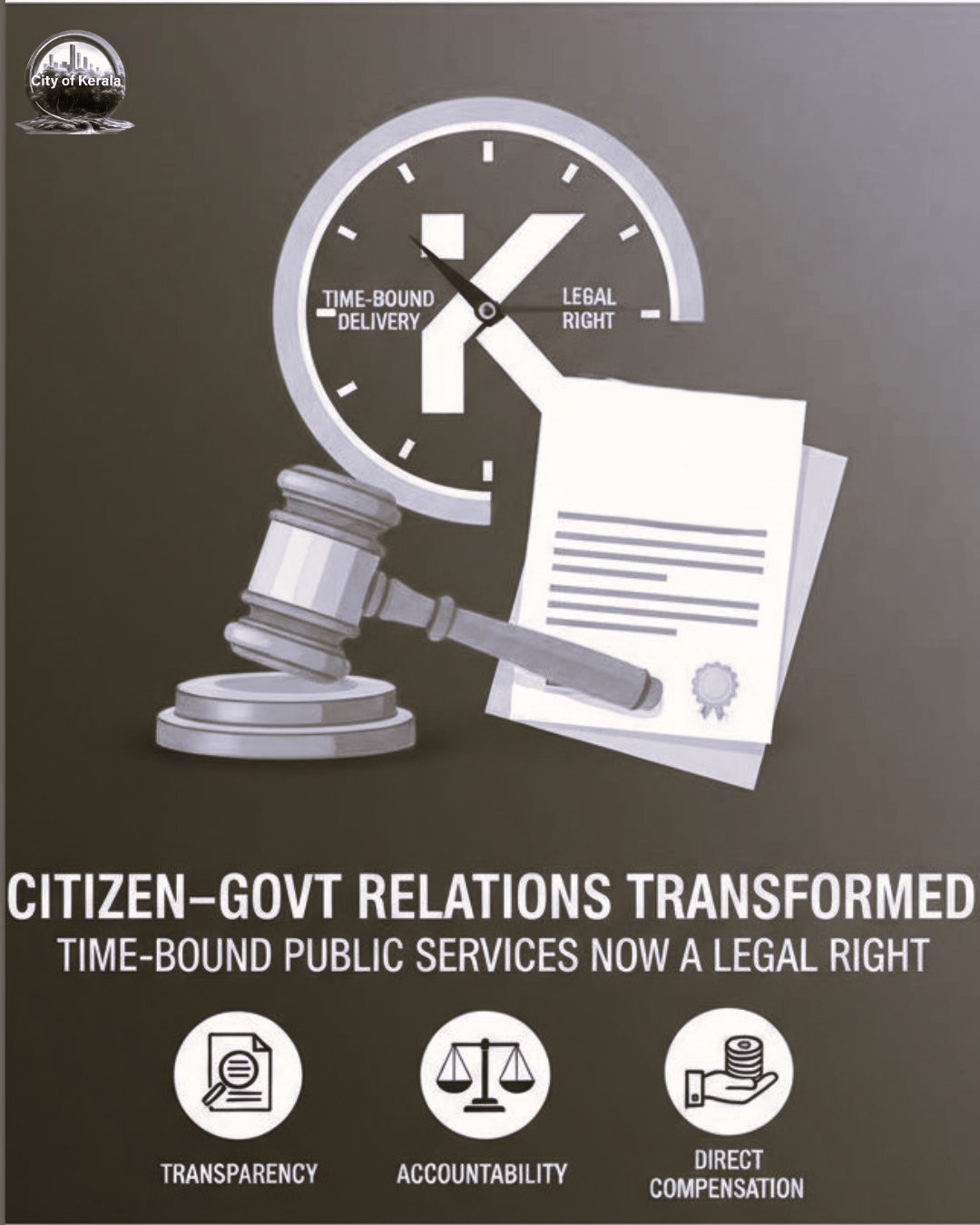
Kerala passes right to Public Service Bill, 2025 - Setting new Governance benchmarks
In a major move to enhance citizen-centric governance, the Kerala Legislative Assembly passed the Kerala Right to Public Service Bill, 2025, signaling a decisive shift toward timely, transparent, and accountable public service delivery. The legislation is designed to address gaps in previous frameworks and introduce stringent measures ensuring that government services are provided within stipulated timeframes.
The Bill introduces several key features aimed at improving service efficiency. It mandates that all public services must be delivered within specified timelines, with any delay treated as a breach of responsibility. To ensure accountability, each government department is required to designate officers responsible for service delivery. Online applications will receive automatic acknowledgment, enabling transparency and traceability, while a strengthened grievance redressal system allows citizens to report delays and seek timely resolution. Penal provisions have also been incorporated to hold departments accountable for non-compliance, reinforcing the state’s commitment to efficient service delivery.
While the Kerala Right to Public Service Bill shares a common goal of promoting accountability with the Right to Information (RTI) Act, the two legislations differ in scope and approach. The RTI Act empowers citizens to access information from public authorities, promoting transparency through a request-response model. In contrast, the new Bill emphasizes proactive service delivery, establishing defined timelines and penalties for delays, with a focus on operational efficiency rather than information access alone.
Kerala’s legislation aligns with similar initiatives across India. The Madhya Pradesh Right to Services Act, 2010, pioneered time-bound service delivery and penalty mechanisms, while Delhi’s 2011 legislation and Bihar’s 2011 Act provided frameworks for citizens to demand services within fixed periods. By 2025, 22 states and union territories have adopted Right to Service laws, reflecting a growing national commitment to improving public service efficiency. Internationally, countries such as France, the United Kingdom, and Canada have also implemented frameworks to ensure timely and accountable public services, highlighting a global trend toward standardized service delivery and citizen-focused governance.
The anticipated impact of the Kerala Bill is significant. Clear timelines and accountability measures are expected to enhance service efficiency, reduce bureaucratic delays, and improve citizens’ trust in government. By fostering a culture of accountability through penal provisions and robust grievance redressal, the legislation aims to strengthen governance and set a benchmark for citizen-centric policy implementation.
Kerala’s initiative is also poised to influence neighboring states. Tamil Nadu, which has yet to enact a comprehensive Right to Public Service Act, may draw inspiration from Kerala’s model, while Karnataka and Andhra Pradesh have existing frameworks for timely service delivery. Kerala’s proactive approach and innovative provisions—such as strict service timelines, penalties for non-compliance, and a comprehensive grievance mechanism—position it as a potential role model for other states seeking to enhance their public service delivery systems.
Looking ahead, Kerala’s successful implementation could lead to the replication of best practices across India, inspire the development of a national framework for standardized public service delivery, and establish continuous monitoring mechanisms to ensure effectiveness. The Right to Public Service Bill, 2025, reflects Kerala’s commitment to governance reform and may serve as a catalyst for a nationwide movement toward efficient, accountable, and citizen-focused public administration.