
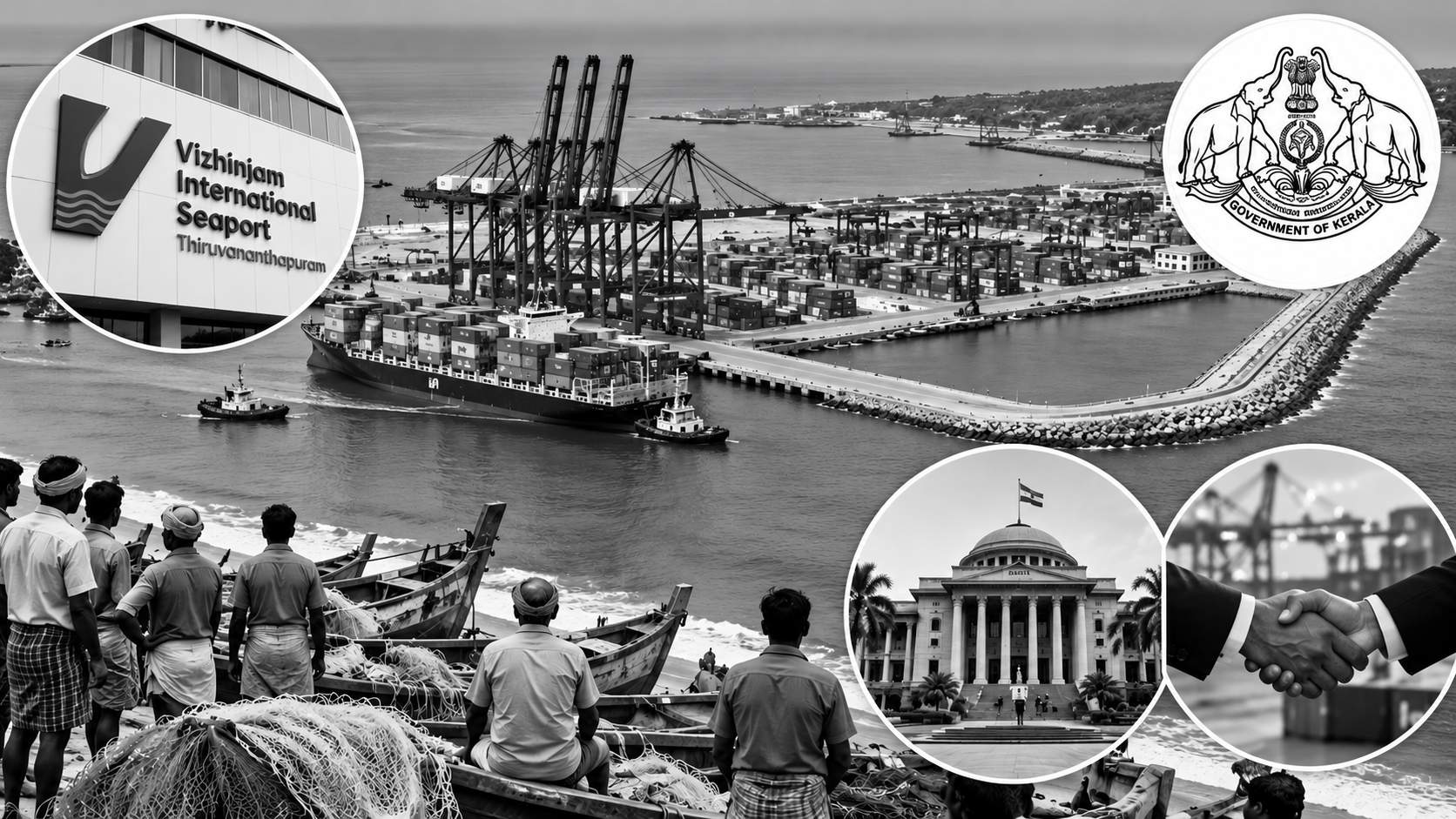
Kerala Orders Social Impact Study for Vizhinjam Port Expansion
The Kerala government has invited expressions of interest (EoIs) from eligible agencies to conduct a comprehensive Social Impact Assessment (SIA) for the second, third and fourth phases of the Vizhinjam International Seaport, bringing the rehabilitation of coastal communities, livelihood protection and environmental concerns into focus as the state advances its major maritime infrastructure project.
The assessment will examine potential employment and livelihood losses among fishermen, tourism workers, small traders and other coastal-dependent communities. It will cover Vizhinjam and neighbouring areas, including Adimalathura, Jubilee Nagar, Pulinkudi and Ambalathumoola. Interested agencies must submit applications to the Thiruvananthapuram Sub Collector by November 13, 2026. Only district-empanelled agencies with at least five years of experience are eligible.
The initiative comes amid longstanding concerns over the project's impact on fishing communities. Protests in 2022, led by the Latin Archdiocese of Thiruvananthapuram, demanded independent investigations into coastal erosion, compensation, rehabilitation and protection of traditional livelihoods. Concerns also extend to fish vendors, processing workers, transport operators and tourism-dependent businesses.
Under a revised framework introduced through G.O.(Rt) No.527/2026/F&P on September 7, the state established a Rehabilitation Implementation Committee (RIC) and an appellate committee to identify affected persons, assess compensation and recommend alternative livelihood programmes. The framework covers fisheries, tourism, agriculture and transport. Around ₹114.52 crore in livelihood compensation was approved for 2,936 fisheries beneficiaries during Phase I, while approximately 900 non-fishing applications were reported pending. A separate ₹194-crore corpus has been earmarked for environmental management and social-welfare commitments.
Coastal erosion remains contentious. On October 30, the Kerala High Court directed the government to constitute a fresh independent expert committee after finding flaws in the earlier panel's composition. It ruled that the previous report attributing no erosion to the port should not be acted upon, without establishing that the port caused all reported erosion or ordering construction to stop.
Meanwhile, fisherfolk staged a Secretariat march on October 28 seeking scientific assessment of the expansion. Independent studies have also highlighted concerns over coastal ecology and fishing livelihoods.
The port, commissioned by Prime Minister Narendra Modi in November 2025, was developed at an estimated Phase I cost of ₹8,867 crore. Its expansion, estimated at ₹16,000 crore, aims to increase annual capacity from one million to three million TEUs by December 2028. The proposed assessment will be crucial in balancing maritime growth with rehabilitation and coastal livelihood security.