
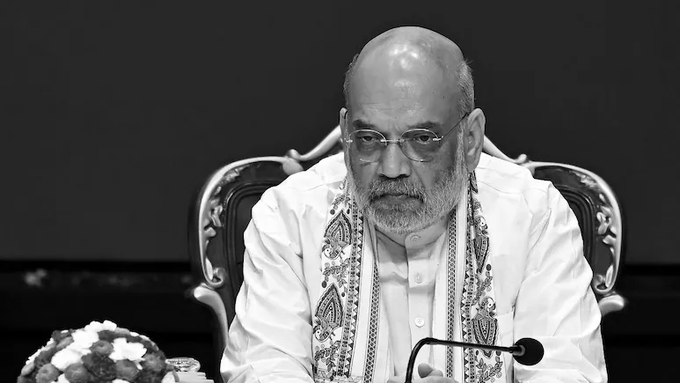
Kashmir Free of India-Born Terrorists After 35 Years, Amit Shah Announces Major Milestone
Union Home Minister Amit Shah on Thursday said Kashmir has become free of India-born terrorists for the first time in 35 years, calling it a major milestone in India's fight against terrorism. He credited Prime Minister Narendra Modi's zero-tolerance policy for the achievement.
Addressing the annual anti-terrorism conference organised by the National Investigation Agency (NIA) in New Delhi, Shah said the elimination of Lashkar-e-Taiba terrorist Lateef Bhat had ended the presence of India-born terrorists in the Valley.
Bhat, carrying a Rs 15 lakh reward, was wanted in connection with a November 11 attack on a CRPF post that injured three paramilitary personnel. He was killed in an encounter with security forces in South Kashmir's Kulgam district on Wednesday.
Shah stressed that counter-terrorism efforts must target entire networks rather than individual terrorists. He called for stronger Centre-state coordination, improved intelligence sharing and proactive action to prevent attacks before they happen.
Citing the crackdown on the banned Popular Front of India (PFI), he said police forces from 11 states and central agencies had jointly dismantled its network in a coordinated operation. He also said over 40 modules of the Pakistan-based Shahzad Bhatti network had been dismantled, with more than 100 cases registered and 271 arrests made.
Shah said 303 fugitives from 36 countries had been brought back to India since 2019 through coordinated efforts by the CBI, Home Ministry and intelligence agencies.
He urged states to strengthen cyber units of Anti-Terrorism Squads, improve intelligence flow from police stations to senior officers and enhance security coordination in border states.
Highlighting the NIA's expansion, Shah cited 16 new branch offices, two zonal offices and 70 special courts. He also referred to the restructuring of the Multi-Agency Centre in 2023 to improve coordination on cybersecurity, narcotics, organised crime and radicalisation.