
Karnataka Cabinet Restructures SC Quota Within 15%, Ends Hiring Deadlock
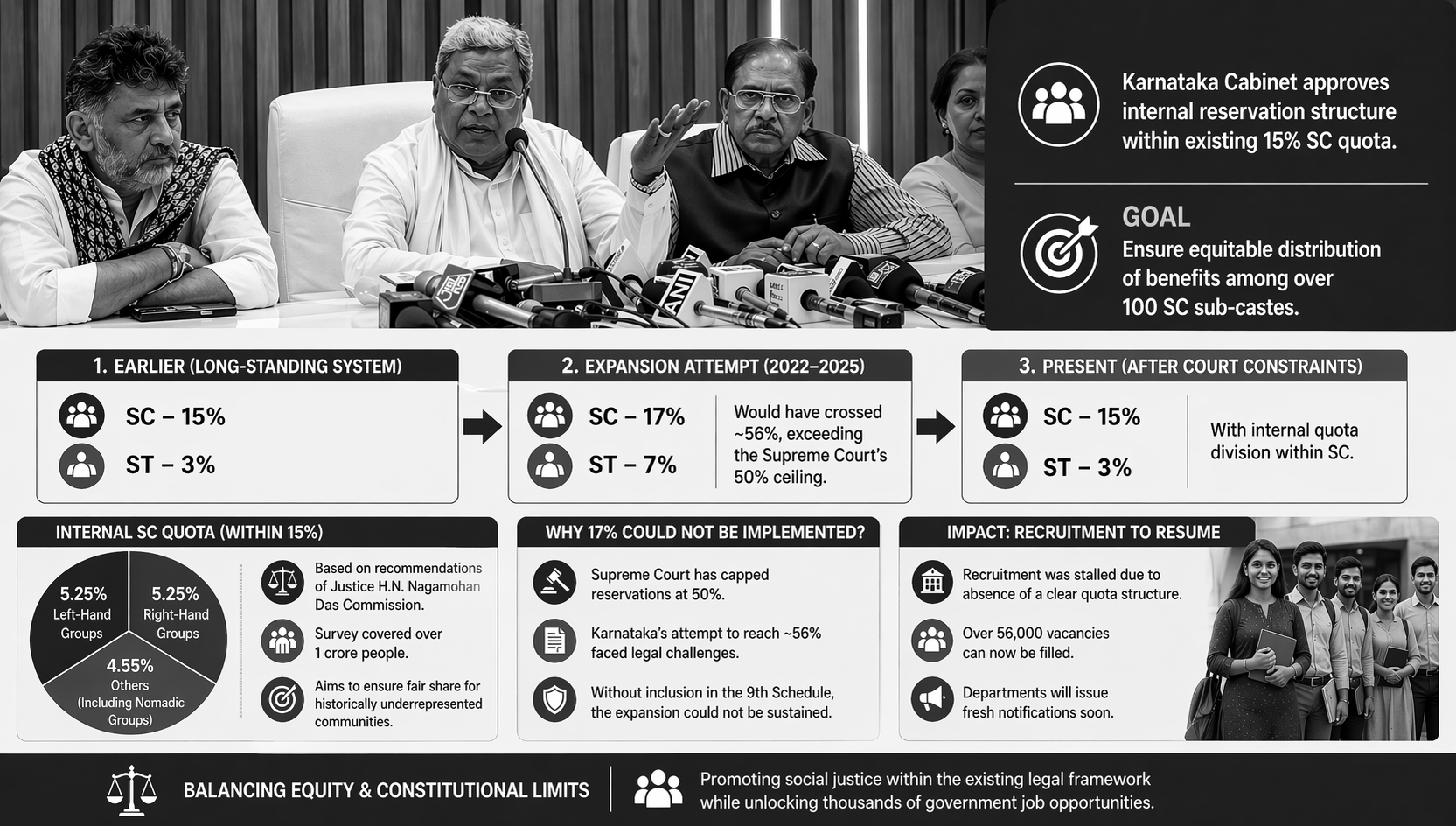
In a significant move aimed at balancing equity within Scheduled Castes (SCs) while navigating constitutional limits, the Karnataka Cabinet led by Siddaramaiah has approved an internal reservation structure within the existing 15% SC quota . The decision is expected to restart long-pending government recruitment and address disparities among SC sub-groups.
Under the newly approved framework, the 15% SC quota has been divided into 5.25% each for “right-hand” and “left-hand” groups , while 4.55% has been earmarked for other SC communities , including nomadic groups . The move follows years of demands for sub-classification , as several communities argued that reservation benefits were unevenly distributed among over 100 SC sub-castes .
The decision comes after Karnataka’s earlier attempt to increase SC reservation to 17% and ST reservation to 7% , which would have pushed total reservations in the state to around 56% . However, this expansion ran into legal hurdles due to the Supreme Court’s 50% cap on reservations , forcing the government to revert to the 15% SC and 3% ST structure . Within this constraint, the Cabinet has now opted for internal redistribution rather than expansion .
Officials indicated that if the proposed 17% SC quota had been implemented, it could have translated into over 1,000 additional reserved positions in a recruitment drive of around 56,000 vacancies . However, such an increase would have involved reallocating seats from other categories , not creating new ones highlighting the zero-sum nature of reservation policies.
The internal quota framework is rooted in findings of the Justice H.N. Nagamohan Das Commission , which conducted an extensive socio-economic survey covering over one crore individuals . The panel recommended a fairer distribution of reservation benefits to ensure that historically underrepresented SC communities receive adequate representation in education and employment.
Chief Minister Siddaramaiah described the Cabinet’s decision as unanimous , noting that there were no differences among Dalit ministers . He emphasized that the policy removes a major administrative bottleneck, announcing that government recruitment will resume immediately with fresh notifications .
The development carries both administrative and political significance . While it enables the state to proceed with large-scale hiring and address employment gaps, it also seeks to balance competing demands within Dalit communities without breaching constitutional limits. At the same time, the broader question of enhancing reservation beyond 50% remains legally unresolved, leaving room for future policy shifts depending on judicial outcomes.
Overall, Karnataka’s approach reflects a strategic compromise retaining the existing quota ceiling while redistributing benefits internally to promote inclusivity and social justice.